30 December 2011

My Heart Would Be A Fireball...

I wasn't a good scout.

Years ago in Brighton, looking up into the July night sky, my then girlfriend was incredulous of how ignorant I was of the constellations.
'Weren't you a scout?'
'Well, yes...' I said, 'but not a very good one. Not like you. If you were one of the kind of scout that had "be prepared" carved into your heart, I was the sort with "ah, it's grand" scrawled across my chest.'
'"Ah, it's grand"?'
'Yeah. I was basically our motto. As in "There's grass on my burger!" "Ah, it's grand," or "Are you sure we can put up a tent without a middle pole?" "Ah, it'll be grand."'

I spent last night with my oldest friend, the two of us sitting up chatting till six in the morning, catching up on a year and a half of time having passed. Along with tales of building dams from lard, and other childhood memories, we got to talking of our scouting days, reminiscing of campcraft competitions in Rathdangan, where we were picked up on for mocking some passing Guards, practiced songs in a bluebell grove, and felt scandalised by other scout units being far too polished.

To my astonishment, Diarmait couldn't remember my first trip to Larch Hill. Not that he ought to have remembered it because it was my first time there; no, he ought to have remembered it, I thought, because it should have been unforgettable.

We can't have been more than thirteen. I was a new scout at the time, and hadn't yet been invested, when our troop spent a day working on skills at Larch Hill, the CBSI's official site in what we so optimistically call the Dublin mountains; this was my first experience of the potent brew we call camp tea, and also saw me being tutored in the art of knots and lashing.

So far so unremarkable, but what amazed me was that Diarmait couldn't remember what we got up to with the fire.

Our patrol leader, who was of course just a couple of years older than us, thought it'd be fun to see what would happen if we started putting things on the fire. Things? You know the kind of things you're not meant to put anywhere near fires? Yep, those things. The contents of the first aid kit, basically, and some unusual items he'd brought along himself, just for the craic.

The first thing onto the fire was the Burneze, the very stuff we'd need to spray on ourselves if we got burned. And, of course, it exploded, to our delight. With that promising start, aerosol after aerosol was hurled into the very fire we'd fermented camp tea on just an hour or so earlier. Eventually our patrol leader reached into his bag and took out his last explosive-in-waiting, a huge cannister of some kind of spray-on glue. Into the flames it was dropped, with all of us running away and ducking down behind a bank of some sort to wait for the blast.

We waited.

And waited.

Until eventually, as we were getting a bit concerned, we heard the cannister finally go... 'pfutt'.

Hugely disappointed, we looked at each other, until eventually a couple of the lads put on heavy duty gloves and stood up to take the can out of the fire.

And then it exploded.

There was a massive boom, and a fireball that shot straight up, scorching the branches of the trees. We all stared, as impressed by the explosion as we were relieved by the two lads who'd gone to retrieve our bomb not having been burned to death. And, as you'd expect, we exploded in laughter.

Diarmait has no memory of this, whereas I remember it clearly. I can picture exactly where it took place. I realise that it sounds a bit unlikely, in that there were actual leaders there that day, but they could have gone off with the other patrol for some reason, presumably to another field, there being no shortage of such on Larch Hill. I suppose they must have.

Still. Memories are funny things, as I've said before.

I gather it's different now in the scouts. Unsupervised weekend patrol camps -- and I could tell tales of those too -- are most definitely a thing of the past. Perhaps it's for the best, in that it reduces the likelihood of a bunch of young teenagers setting themselves on fire, but I can't help feeling something's been lost.

29 December 2011

Behind the Curtain

Or, a very long post attempting to explain how I wrestled through a complex issue; apologies if it seems rather stream-of-consciousness, not to mention long, but you don’t have to read it if you don’t want to...

Perched at the top of my Amazon wishlist, as it's been for some time, is Ian Ker's recent biography of G.K. Chesterton. To anyone who knows me, of course, this'll hardly be a surprise, given that my shelves are buoyed up with eighty or so books by the great man and more than a dozen books about him.

I've not always been a Chesterton fan; my first encounter with Kensington's greatest son was an unpromising taste of 'The Queer Feet' when I was fourteen or thereabouts, but when I was twenty-one, prompted by Neil Gaiman and Terry Pratchett's Good Omens, I drank deeply from The Complete Father Brown, had my mind prized open and my horizons expanded by The Man Who Was Thursday, and fell in love with the man described so ably in Joseph Pearce's Wisdom and Innocence. Whatever appearances may have suggested, I'd fallen far from the Catholic tree in my teenage years, but it was Gilbert who brought me back to the faith; his impact on me hasn't paled as the years have passed.

His combination of goodness and good sense is something that I've long loved, and I've taken to heart the radical difference between Chesterton and his good friend Hilaire Belloc; if Belloc roared like a vengeful bull, Chesterton smiled in charity and seems never to have lost a friend. Pearce's book says quite a bit on the subject, quoting the two writers' contemporary Frank Swinnerton to good effect:
'One reason for the love of Chesterton was that while he fought he sang lays of chivalry and in spite of all his seriousness warred against wickedness rather than a fleshly opponent, while Belloc sang only after the battle and warred against men as well as ideas.'
Belloc, curiously -- and I think wrongly -- felt that Chesterton's gentleness would do little for his legacy as a writer, but recognised that mere longetivity on the page matters nothing compared to the eternal reward that could be won through the preservation of his soul from the cancer of hatred.

Whatever about that, he's certainly had an enormous impact on this blog. My tagline here is adapted from one of his finest epigrams, my description in the sidebar draws from four others, and I'm pretty sure that were you to trawl through the archives here you'd find them echoing loudly with his words and ideas, perhaps most frequently his astute observation that 'it is not bigotry to be certain we are right; but it is bigotry to be unable to imagine how we might possibly have gone wrong.' That my words should echo his is hardly surprising, really, given how much of his work I've absorbed over the years, such that I've internalised huge amounts of it, perhaps most profoundly his deeply counter-intuitive recognition that 'if a thing is worth doing, it is worth doing badly'.

One of the most recent -- and most interesting -- books I've read about Chesterton is William Oddie's fascinating 2008 study, Chesterton and the Romance of Orthodoxy: The Making of GKC, 1874-1908; very much an intellectual biography, it charts Chesterton's own philosophical growth and the development of his religious and other ideas, taking him from his youth through the superficially ephemeral but truly timeless Heretics to 1908, the year of Orthodoxy and its fictional alter-ego, The Man Who Was Thursday. Oddie's book is, frankly, a masterpiece in its own right, and is one I think I'll treasure for a long time; I'm looking forward to Oddie following Gilbert's inky fingerprints as he writes his way into the Catholic Church, and have been glad to see him making a case for Gilbert being recognised among the saints of the Church.

(I'm convinced Chesterton's among them already, and like to think of the signed book by him I acquired some years back, resting beside me as I type, as a second-class relic of the man who brought me back to the Faith.)


Enter the Controversy
Oddie, who edited the Catholic Herald for several years and regularly contributes to it even now, is a journalist who I've long respected; I don't always agree with him, by any means, but I do think he's worth listening to. As such, I was startled a few weeks back to read a piece by him on the Catholic Herald website in which he took issue with recent comments by Vincent Nichols, the Archbishop of Westminster, in support of civil partnerships. Arguing that Nichols's comments appeared to be at odds with Rome and with the English bishops' previously-stated position, Oddie wondered whether Nichols was also in favour of adoption by same-sex couples, and if so, why the Catholic adoption agencies had been forced to close down, rather than be obliged to facilitate such adoptions. The ultimate question in this matter, he concluded, was ‘what does he believe? Just what is he saying, on behalf of his brother bishops and presumably the rest of us?’

Clearly these were serious questions, and though Nichols twice attempted to clarify his position, his explanations didn't convince Oddie, who nonetheless has since dropped the matter, aghast at the hornets' nest he'd stirred up and the sheer venom being expressed about bishops such as Nichols. 

I tried to follow the story as best I could at the time, chatting to friends about it and thinking pretty carefully about what Rome and the bishops of England and Wales had said back in 2003. As I put my thoughts in an email to a friend a couple of weeks back:
'... I've been trying to figure it out. In the main it all seems very clear, but there is one issue that does trouble me a bit.

I've just read the bishops' own 2004 [sic] submission where they opposed civil partnerships, something I'd not been aware they'd done, and how the submission had cited the 2003 CDF document. It seems to me that the current stance is a complete about turn. As it happens, the current stance doesn't bother me; I believe it's coherent, clear, and fully in line with the CDF document once one looks at how the Civil Partnership Act has been phrased. I also think that it's better to change one's mind so that one becomes right rather than to remain obstinately wrong.

That said, I'm having trouble figuring out whether that's been what exactly has happened. Presumably the 2004 submission was in response to a draft of the act, rather than the act itself, so was the final version different enough that we could accept it, on reflection? Or were we, straightforwardly, wrong? And if we were wrong, wouldn't it be better, if need be, to admit that?'
Such were my tentative thoughts a couple of weeks back, before I was forced to think about things rather more carefully...


Catholic Voices
Like a lot of people a couple of years back, it was with horror that I watched the October 2009 Intelligence Squared debate on the topic 'The Catholic Church is a force for good in the world'. I'd read about it before seeing it online, but even then I wasn't prepared: I ought to have been, given that it was obvious that the combined forces of Anne Widdecombe and the Nigerian Archbishop John Onaiyekan were never going to have been a match for a crowdpleasing power of a Christopher Hitchens and Stephen Fry double-act, and given how I'd read of how comprehensively the crowd rejected the motion, but even so, it was painful viewing. And yet it oughtn't to have been: Hitchens and Fry's predictable arguments were riddled with errors and couched in sophistry; they could have been countered at almost every point.

Describing the debate to a friend of mine who is a priest, I looked downcast as I related just how inevitable it all seemed, and how it ought not to have been. My friend nodded, and said that while Anne Widdecombe does valiant work in putting forward the Catholic case, and deserves our gratitude for that, he often feels she doesn’t help things very much. I agreed, but we were both at a loss to think of anybody else who would have taken her place. The Telegraph's Andrew M. Brown evidently had taken a similar view, ending his piece on the debate with a desperate appeal:
'It was a gripping evening’s entertainment but a little discouraging for those of us who are Catholics. I found myself wishing, one, that the Catholic debaters would for once not content themselves with offering pettifogging excuses but instead actually own up to some of the charges, and, two, I wished that there still existed a great Catholic apologist like Chesterton or Belloc, someone who was not only brave and prepared to square up to the Hitch, but was his intellectual equal. Surely there is someone today who could do that?'
I'm glad to say that not every Catholic who watched the debate simply contented themselves with wishing, as the group called Catholic Voices grew out of that debacle, in anticipation of the Pope's then impending visit to the UK. Jack Valero and Austen Ivereigh's idea was a straightforward one, that being, simply, that a team of young -- or youngish! -- Catholics could be given some basic media training, so that they could articulate the case for the Church on television or radio. I liked the idea, and had I been based in London last year I'd probably have applied to join, though given the rather peculiar directions my life took in 2010, it might well be for the best that I didn't do so. Anyway, they did a good job during the Papal visit, and played their part in ensuring that that visit turned out to be far more successful than anyone had expected.

And no, despite the shriekings of the likes of Terry Sanderson, they weren't Vatican-trained propagandists, taught to obscure, distort, and contradict arguments; they were simply ordinary Catholics, informed of the issues and confident in their faith, able to explain complicated issues in simple language. I thought this was a good thing, and if they weren't always quite as good as people might have wished, or if they made some missteps in the organisation phase, well, if a thing's worth doing at all, it's worth doing badly, as the man said. The point is, this was worth doing.

I suspect Terry was upset mainly because the whole Papal visit left him looking rather foolish, with his hysterical claims that the visit would cost the taxpayer £100 million pounds, rather than less than a fifth of that, being soundly refuted by common sense, not to mention evidence.


And then there's me...
Well, a few months ago I received an email from my aforementioned priestly friend, informing me that Catholic Voices were looking to train a second batch of people, and asking whether I'd been interested. I said I'd been interested the previous year, and so happily applied on -- as it so happened -- the very day that a letter from me appeared in the Irish Times challenging the Taoiseach for having made false statements to the Dáil about the Vatican.

Eventually, after thinking I'd not been selected at all -- something about which I was rather put out, though I still wished the project well as I thought it important -- I was called to come for an interview, and I was interviewed, and a couple of days later was told I'd been chosen; within a fortnight or so of that I met up with the others for our first weekend together in Yorkshire, bumping into one of the others on the train there.

I'm not going to go into how the weekends went, since this sort of thing can only work if we can speak and act in confidence -- one of my closest friends, to whom I've described them in rather more detail than I'll go into here, has said that they sound to her to be akin to retreats in certain ways, and I think she's right.

Still, what I can say is that the weekends have been profoundly transformative affairs: each weekend was an ordeal in its own right, and collectively they've affected me in ways that I'm still trying to grapple with; indeed, there were moments of almost transcendent clarity in Mass last Sunday and the Saturday of the previous weekend, moments which left me lost for words and that unsettle me even now. It's been a privilege and a joy to get to know the other trainees, all of whom have dazzled me with their intelligence, their integrity, their independence, and their fidelity.

That honest harmony of independence and fidelity, I think, is probably essential if we're to be able to speak with any kind of authority on these issues; it'd be utterly wrong for us to say things which we didn't believe, just as it'd be wrong for us to speak as Catholics while saying things that the Church doesn't teach. We're not drones, sent out there to push a line; on the contrary, we're trusted to do our own thing, but that trust is largely rooted in the belief that we're faithful Catholics.

The first weekend focused on just one issue, which we explored in depth as a group in order to help us understand how we can approach these things, and the second saw us looking at two topics, but dealing with them individually in studio situations. For what it's worth, I was terrible on the radio -- almost certainly the weakest of us all -- but that didn't bother me too much. I expected there to be a learning curve. If I was going to be perfect from the offing, I wouldn't need training. And, as it happens, I was far better in the television interview later that day -- it was clear that feedback from the morning and the guidance of the co-ordinators had made a real difference.

Indeed, the training was excellent, and it was fascinating to listening to a couple of the others, after just those first two weekends, taking to the airwaves at short notice to discuss the recent Benetton campaign or the recent BPAS campaign to supply the morning-after pill for free after phone interviews; learning in public can be frightening, but they accredited themselves very well.


Preparing for the Third Weekend
For the third weekend, we were all asked to prepare presentations on various topics that had hit nerves in recent weeks or months; what we said on them was wholly up to us, the idea being that we'd give presentations on issues and the others would grill us on the subjects. Topics were generally well-matched to speakers: a doctor speaking on end-of-life issues, a barrister on employment law, or a female counsellor on Catholic women in public life, say.

My topic seemed a very odd fit, as I was asked to speak about the controversy over Archbishop Nichols's comments. This was a tricky one, partly because the topic was extremely complicated, and partly because insofar as Nichols's support for civil partnerships hits a nerve it does so far more within the Church than it does without. I can only think that I was asked to handle this because, as a historian, I'm trained to winnow through things with a view to figuring out what has happened, and to do so in a diagnostic rather than in an advocatory way. The only guidance I was given was to stay close to the bit of the controversy itself, as Caroline Farrow would be dealing with civil partnerships in a broader sense.

Deep down I'm an analogue sort of fella, the kind of man who thinks a fountain pen is an elegant weapon from a more civilized age, so I printed off Nichols's original comments and his subsequent clarifications, Oddie's articles, the original CDF guidance, and the bishops' 2003 statement so I could work through them all in silent solitude, pencil in hand. I also read the 2004 Civil Partnerships Act online, and read as widely as I could to try to figure out what different lawyers thought of civil partnerships, and how the issue had been discussed in parliament at the time.


Adoption, to start with
One of the first things I was able to figure out was that Oddie's concerns about children being adopted by same-sex couples were wholly misplaced; that issue, about which the Church has expressed serious concerns, was incidental to the civil partnerships debate, having been legislated for in 2002. Although I understand and fully share his distress at the Catholic adoption agencies having been forced to shut down in the face of the new legislation, I honestly can't see why Oddie thought this relevant to the issue of civil partnerships. I'm baffled that people are still conflating these two very separate issues.

(And, for what it's worth, I don't think the Catholic adoption agencies should have shut down; I think they'd have had a very strong case had they taken matters to Strasbourg, since the European Convention on Human Rights, with which the Human Rights Act requires all UK legislation to comply, guarantees freedom of religion and conscience save when the limitation of said freedom is not merely legal, but necessary. Given how many adoption agencies were already facilitating the adoption of children by same-sex couples, it was clear that there was no need for the Catholic ones to do so too. And, of course, since they’ve closed the number of children being adopted each year has fallen further. But that's by the by.)

That left the substantive matter of the civil partnership scheme.

Nichols's statements on the subject were entirely clear, when read in the context of how he was explaining the need to defend marriage as a unique institution, but the key questions related to consistency. Were Nichols's comments consistent with what the bishops had said eight years ago, and were they consistent with the CDF?


What did Rome say?
This forced me to read the CDF's 2003 statement very carefully, such that my copy of it soon developed rather busy margins, illuminated with arrows, circles, and annotations. Entitled Considerations regarding Proposals to give Legal Recognition to Unions between Homosexual Persons, it's an interestingly wide-ranging document, addressed not merely to Catholic bishops, say, but to all those -- Christian or otherwise -- who are committed to promoting and defending the common good of society.

At its heart is a tension between on the one hand the need to explain and defend the basic idea of marriage, and on the other the need to give true respect to people who are homosexual. This respect, it must be stressed, isn't a matter of charity in the modern sense that can seem so patronising, but of charity in the truest sense, that being love; it is also a simple matter of justice.

The CDF distinguished between three ways in which states could deal with homosexual unions: tolerance, legal recognition, and the bestowal of legal status equivalent to marriage. It has a bit to say on how we should deal with the first situation, and regarding the other situations it says:
'In those situations where homosexual unions have been legally recognized or have been given the legal status and rights belonging to marriage, clear and emphatic opposition is a duty. One must refrain from any kind of formal cooperation in the enactment or application of such gravely unjust laws and, as far as possible, from material cooperation on the level of their application. In this area, everyone can exercise the right to conscientious objection.'
It goes on to explain why such opposition should be necessary, but says very little on what such opposition should entail, and almost as little on what exactly would constitute a 'homosexual union', save to identify homosexual unions as grounded in 'homosexual behaviour'. This, I think, can't be glossed over; the CDF doesn't give a straightforward definition, really only nearing one when it says:
'In this area, one needs first to reflect on the difference between homosexual behaviour as a private phenomenon and the same behaviour as a relationship in society, foreseen and approved by the law, to the point where it becomes one of the institutions in the legal structure. '
This point is taken up again when the CDF document says:
'It is one thing to maintain that individual citizens may freely engage in those activities that interest them and that this falls within the common civil right to freedom; it is something quite different to hold that activities which do not represent a significant or positive contribution to the development of the human person in society can receive specific and categorical legal recognition by the State.'
It was clear that central to the CDF's argument was its understanding of a 'union' as something analogous to marriage, which as an institution is intrinsically sexual and uniquely valuable; as such, it seemed to me that it was exhorting people to oppose the specific and categorical legal recognition of unions that are rooted in homosexual behaviour; it was not exhorting people to oppose legal arrangements between homosexual persons, save where those arrangements included the legal status and rights belonging to marriage.

Somewhat unhelpfully, the CDF didn't outline what it believed the legal status and rights belonging to marriage to be. I realised that this almost inevitable: such rights must differ from country to country, after all, and the CDF document was not addressed specifically to the minority Catholic Church in the UK, say, but rather to the entire world.

I spent a bit of time wrestling with this, and came to the conclusion that if certain rights belong to marriage, then whatever rights these are they must transcend individual states and legal systems. As such, it hardly threatens marriage for rights which states merely happen to have been bestowed upon marriages to be likewise bestowed upon other legal arrangements, provided that these are not the more fundamental status and rights that belong to marriage alone and that are not the property of the state.

And so, with all these thoughts buzzing in my head, I turned to the bishops' 2003 submission...


What did the Bishops say then?
In June 2003, the Department of Trade and Industry published a consultation paper entitled Civil Partnerships: a framework for the legal recognition of same-sex couples, setting out proposals for what has become the civil partnership scheme. I couldn’t help but think the DTI seemed an unlikely department to be handling the subject, for what it’s worth, given the DTI’s remit, since it gave the impression that civil partnerships were basically business arrangements, but I’m sure there was a good reason for it at the time.

The Bishops’ Conference submitted its response in September 2003, drawing on the CDF's guidelines in making their case and stressing the simultaneous need for the State to defend both the institution of marriage and the fundamental human rights of every person.

They expressed concerns that the proposed scheme would elevate homosexual relationships to a legal status virtually equivalent to civil marriage, thereby giving a signal to society that the two states are equally deserving of public protection. Their central point, in this regard, was as follows:
'Marriage would be undermined because it would no longer hold a privileged place.  The signal the law would send to rising generations is that marriage as husband and wife, and a same sex relationship, are equally valid options, and an equally valid context for the upbringing of children.   By publicly elevating same-sex relationships to a legal status virtually equivalent to civil marriage, the signal given to society would be that these two states of life are equally deserving of public protection and respect, when in fact they are not.'
The bishops further argued that the proposed scheme was largely unnecessary given recent legal developments, that it was a distraction from the real problems undermining family life in modern Britain, and that in some respects the proposed scheme was inadequate in that it created anomalies with regard to other long-term loving relationships which were not sexual in nature. In this regard the bishops cited the example of two sisters who might have shared property over many years, but they could as easily have made the same point by citing disabled people and their carers, or simply two lifelong friends.

On balance, then, they felt the proposals would not promote the common good, and strongly opposed them.

There was more to their argument than this, of course, but what was clear was that they opposed the proposed Civil Partnership scheme and did so for several reasons, some of which drew on the CDF's own guidelines. Such was their opinion in 2003, before the Civil Partnership Act was debated and codified in Parliament, and before it was granted royal approval.

The 2003 submission was, in short, their opinion of what they feared might happen; it was not their opinion of what did happen.


So, looking at the law...
The Civil Partnerships Act came into law in November 2004, and was striking in a couple of major ways. Unlike civil marriages which require publicly-made promises in a civil ceremony, civil partnerships become legal solely through the signing of a civil partnership document. This isn't something that should be brushed aside as a mere technicality. If I can pluck Chesterton's The Superstition of Divorce from the shelf, we'll see that the great man saw the idea of promises as being essential to marriage:
'I shall therefore begin by asking, in an equally mystical manner, what in the name of God and the angels a man getting married supposes he is doing. I shall begin by asking what marriage is; and the mere question will probably reveal that the act itself, good or bad, wise or foolish, is of a certain kind; that it is not an inquiry or an experiment or an accident; it may probably dawn on us that it is a promise. It can be more fully defined by saying it is a vow.'
And onward he goes to explain that the act of marriage is a vow analogous with vows of chivalry, poverty, and celibacy, just as he had twelve years earlier in Orthodoxy or seven years before that in 'A Defence of Rash Vows'. Marriages, unlike civil partnerships, entail promises; they're covenants, not contracts, and we should never forget this.

Furthermore, whatever its political objectives, the Act was not phrased in such a way that same-sex partnerships should intrinsically be understood as homosexual unions. The law never mentions sexuality or sexual acts in any respect, and does not cite anything analogous to adultery as grounds for dissolution of civil partnerships; fidelity, whether romantic or sexual, is not even implicitly identified as an assumed feature of civil partnerships. In principle, therefore, the scheme can be entered into by any two people of the same sex, other than family members or those who are already married, without any expectations that the partnership contains a sexual or romantic component.

It's worth going back to the 2003 CDF document on this. The document recognised that homosexual unions are a fact, and that civil authorities adopt three broad appoaches in deal with this fact: some authorities simply tolerate them, some advocate legal recognition of such unions, and some favour giving them legal equivalence to marriage.

As I’ve said, the bishops were originally opposed to the scheme as first proposed, and drew on the 2003 CDF document in making a case largely based on the need to defend and promote the traditional understanding of marriage. They were worried that the law of the land would be altered in such a way as to signal that that marriage and same sex relationships were equally valid options and equally valid contexts for the raising of children. In short, they were worried that the

As codified, however, the 2004 law – while not without shortcomings, particularly with reference to its exclusion of siblings from the arrangement, say – did not strike me as sending such a signal; as far as I could tell, it did not undermine the unique position of marriage in British law as it did not presuppose that civil partners are engaged in a homosexual relationship.

As I read, I understood that some have argued that it's only for technical reasons that offenses analogous to adultery aren't cited in the Civil Partnership Act as grounds for the dissolution of partnerships, but I wasn't convinced by this; the law is a technical thing, and it would hardly have been beyond the wit of Parliament to devise technical solutions to whatever difficulties might have faced them in that regard. The fact that sexuality and sexual behaviour are wholly absent from the Act is striking; it's as though Parliament went to a great deal of trouble to omit them.

Wholly silent on the issue of sexual behaviour, treating sexuality as a private phenomenon, the Civil Partnership Act did not enshrine homosexual unions as institutions within the legal structure of the United Kingdom. The Act did not give homosexual activities specific and categorical legal recognition, and it neither foresaw nor approved on homosexual behaviour. Homosexual unions exist as a fact in British life, of course, and these certainly can subsist within civil partnerships, just as they can without them, but civil partnerships should not, in themselves, be understood as homosexual unions.


But But But -
In the main I thought this worked, and I slept on it and it still made sense to me, but it left me with a few little problems to think through.

The first was that whatever about what the law says, as legislated, the nature of the English common law system meant that it would be interpreted in the field, with the courts possibly treating civil partnerships as analagous to marriage, or as being essentially homosexual unions. In ways this has already happened to a significant degree, but I don't think this is something that the bishops can ever comment on in any legitimate sense; whatever input they might have into the making of laws, they can hardly interfere in the interpretation of it.

And yes, I realise that judges will sometimes speak of parliamentary intent when interpreting laws, but that's a dangerous game, which can hardly be second-guessed; given how many hundreds of people vote to enact laws, the judges can hardly speculate on the intentions of all of them.

It was obviously true that the range of people barred from entering into civil partnerships with each other was, as far as I could tell, identical to those barred from entering into marriages with each other. This is clearly the case, and it’s something that – as far as I can tell – the bishops have always objected to. They ‘two maiden aunts’ scenario in their 2003 submission implicitly made this point, and I gather that’s still the bishops’ line now: they believe the civil partnership scheme should be expanded so that it could be entered into by a wider range of people.

I wondered too about the fact that whatever the law may say, it's very clear that lots of civil partnerships are accompanied by ceremonies and vows, and appear to take the form -- in effect -- of civil marriages for people of the same sex, such that they appear to be 'gay marriages' and are widely thought of as such. This is all true, but it is, strictly speaking, unrelated to the civil partnership registration itself; it may provide a context in which the civil partnership document is signed, but it is, ultimately, window dressing, and in any case, the bishops can hardly be expected to comment on individual partnerships. Regardless of whatever common practice may involve or common perception may be, it is important to stress that the CDF's guidance related to questions of legal recognition; the fact remains that the law does not foresee or approve homosexual behaviour, and that it does not give specific and categorical legal recognition to homosexual activities.

I really didn’t know what to make of the peculiar detail in the Civil Partnership Act that said a partnership was voidable if at the time of its formation one of the partners was pregnant by someone other than the other partner. On the face of it, this challenged my belief that the law was devoid of sexual references, but after further thought I concluded that that challenge was a feeble one, not least because it's oddly phrased: it would be impossible for one civil partner to become pregnant by the other; by definition civil partners are of the same sex!

More pertinently, in a world of contraception, IVF, and turkey basters, we surely have to acknowledge that sex and pregnancy have been divorced from each other; we cannot ever assume that a pregnant woman has become pregnant as the result of sexual intercourse. What the law seems to say is that one partner can have a partnership declared void if the other partner had been pregnant at the time the partnership had been formed, even if her pregnancy had followed an agreement between the partners and a third party, possibly not involving a sexual act, or even if it had followed a rape. It’s striking that this relates only to female civil partners; there’s nothing that says a civil partnership should be declared void if either partner should be found, at the time of the partnership, to have caused somebody else to become pregnant. Whatever this detail was meant to signify, it certainly says nothing whatsoever about sexual fidelity.

This, of course, forced me to think hard about the situations faced by those registrars who were opposed to their registering civil partnerships as they felt that by doing so they'd be approving of things which were, in effect, homosexual unions. I've talked about this in the past, actually, when trying to get my thoughts sorted on the issue of gay marriage, and my thinking is that individual registrars could probably differ on this; some might be able to live with presiding over the signing of a document that says nothing about what people do in their private lives, while others might feel that by presiding over registrations of partnerships they were facilitating things they felt they couldn't agree with. In such situations, they surely ought to be able to object to their involvement in such registration, though I think we can imagine such cases making their way -- eventually -- to Strasbourg.

Curiously, I wasn’t able to find any indication that the English or Welsh bishops had ever spoken on this topic; if they had been opposed to civil partnership as they were instituted in law, they should surely have argued that Catholic registrars would be obliged, in conscience, to refrain from registering civil partnerships. Granted, my research may have been lacking, but this seemed to be one of those ‘dog that didn’t bark’ moments. It really did look as there’s no evidence whatsoever that the bishops of England and Wales have ever opposed the civil partnership scheme as it exists in law.


So...?
Having ploughed through heaps of data on the subject, I ultimately came to the conclusion that it’s entirely consistent with Church teaching for Archbishop Nichols to say he supports the civil partnership scheme as an existing and legitimate mechanism to help give stability to committed couples of the same sex, given that the law refrains from granting homosexual unions any sort of parliamentary imprimatur and thereby does not undermine the unique position of marriage in UK law.

It would, of course, be a different matter if marriage itself were to be redefined; definitions are about limitations, after all, and things gain meaning from what they're not as much as from what they are. Nichols's main aim, as he's made clear on many occasions, is to defend marriage as it has always existed in British law.


The Weekend and the Blog
I pulled together my thoughts on the subject into a presentation of 1,400 words or so, and gave my presentation on Saturday afternoon; it went down rather better than I thought it would, given that I was arguing something rather counter-intuitive, which I hadn't believed myself only a few days earlier.  

There were precious few questions, though what there were homed in on the conflict between how the law existed in theory and worked out in practice. Afterwards a few of the others complimented me on the paper, saying there'd been so few questions because I'd explained the controversy so clearly, and later on -- indeed, it may well have been the next day -- I was asked whether I'd be willing to turn it into a post for the Catholic Voices blog.

I came home on Monday, and on Tuesday I finished streamlining my talk, losing a few hundred words so that it wouldn't be absurdly long and so that people could read it in one easy go to get a clear handle on the issue. Following a tiny bit of editorial tweaking, it was posted on the Catholic Voices site shortly afterwards.

There was nothing frantic about this. There was no rush to defend the bishops, whatever others might imagine. It just happened; I was asked to explore and explain an issue, and in the process of doing so, reached conclusions I hadn't expected to reach. Others agreed, and we thought it'd be helpful if we could shed some light on the issue.

I fully understand that others might disagree with the conclusions I've reached, and that my colleagues have come to share. That’s fine: this is a complicated issue, and I think we have to recognise that others might legitimately disagree with us. I've no plans to shout down those who disagree with me. Following Chesterton, I may be certain that I am right, but I’m not so bigoted that I’m unable to imagine how I might possibly be wrong.

25 December 2011

Maternal Abstractions

Last year I attended my first ever carol service -- I'd attended Christmas concerts in the past, of course, but never a designated carol service. It was at an evangelical Anglican church where I used to go with friends, and out of a spirit of curiosity and a desire to understand. Afterwards a friend asked me what Catholic carol services were like. I said I didn't no, but that they were probably much the same, though there was a chance that Adeste Fidelis would be sung in Latin, thus skirting the problem of old translations sounding rather odd to our prosaic ears.


A few days later I went to my first Catholic carol service, and indeed it was much the same, albeit with Adeste Fidelis in Latin, and Stille Nacht in German. The priest who presided over the ceremony gave a remarkably wide-ranging sermon, and though much of it's lost to the mists of memory, I remember one detail.

In his book Motherhood of the Church, Henri de Lubac tells of how the Belgian Cardinal Suenens had told him of a conversation he'd had with Karl Rahner:
'I asked Father Rahner how he explained the decrease of Marian piety in the Church. His reply is worthy of attention. Too many Christians, he said to me, whatever their religious obedience, have a tendency to make an ideology, an abstraction, out of Christianity. And abstractions have no need of a mother.'
At Christmas we remember how God became flesh, how he became as puny and frail and vulnerable as we all are when we enter into this world, how he couldn't stand on his own two feet, much less feed himself or wash himself or speak; this weakness, this absolute dependency on others is part of the human condition, and it's a part of it that God took on. 

For many Christians, Christmas is the only time of the year that any thought is given to Mary at all; in pushing her aside so often, they ignore what it means for the world that the Word became flesh, failing to engage with the fullness of Jesus' humanity, which deserves our embrace as much as does his divinity. In so doing, they reduce Our Lord to an abstraction and turn Christianity into an ideology. 

God deserves better than that. He isn't an idol. Stronger than all of us, he became as weak as any one of us. Christmas, as much as Good Friday, allows us to contemplate just how weak and helpless he was; in meditating on the fullness and the weakness of his humanity, we enter into a profound understanding of the value and worth of every single one of us, no matter how weak and helpless we might be.

Happy Christmas.

24 December 2011

Midnight Mass

It being Christmas Eve, and with Christians imperilled in the most ancient heartlands of the Faith, this seems as good a time as any to type this up....
 'The 24th of December 1099 was the first Christmas Eve for more than 450 years on which free, armed Christians might celebrate the Nativity in Bethlehem. The great marble basilica built by the great Constantine was packed to overflowing. Many of the congregation had been there all day, to make sure of getting in; but places had been kept for the distinguished lords come down from the north, Bohemond of Antioch and Baldwin of Edessa, and tall Tancred had pushed his way in to kneel beside his uncle.

The Midnight Mass of Christmas, after the Latin rite which was now the only use in Bethlehem, was to be offered by Daimbert, Archbishop of Pisa, the newly arrived papal legate with the pilgrimage. The new legate was evidently as tough as his predecessor; for he proposed, after offering the Midnight and Dawn Masses in the Church of the Nativity, to ride to Jerusalem and sing the Morning Mass of Christmas within the Holy Sepulchre. Of course he had been fasting throughout the Vigil of Christmas, and he must continue the fast until dinner on Christmas Day.

When the clergy entered Bohemond had been kneeling on the marble pavement for some hours. This was the very place, the very time, of the Incarnation; the manger in which God had become Man was only a few feet away. To be free to kneel here at this hour the best knights in Christendom had left their homes; for three years they had marched and fought, until the greater part of them were dead; but the survivors had accomplished all they set out to do. Tears streamed down Bohemond's cheeks as he tried to thank God for the Incarnation. Then he began to pray for the souls of dead comrades. But they were martyrs who had gone straight to Heaven. they would not need his prayers.

He was accustomed to long hours in church, to kneeling on bare stone pavements. But it was difficult, tonight of all nights, to keep secular thoughts out of his head. Our Lady had lain on this spot of earth in the agony of childbirth, while St Joseph cleared up the droppings of the ass and the ox. But it had been a tricky moment when Tancred pushed in to kneel on his right, within arm's length of Count Baldwin kneeling on his left. Luckily the two had smiled at one another; this was not a place for enmity.

The bell tinkled for the Consecration. God was present again in body as He had been for the first time more than a thousand years ago. Peals thundered from the tower in token of rejoicing. That brought a comforting memory. Only a few months ago Tancred had hung those loud bells. The infidels who had ruled here so long did not tolerate bells in Christian churches.

Here was the Pax coming round. They had brought it to him gratifyingly early, probably the first among the laity. but politics could not be ignored even on this sacred occasion. He motioned to the subdeacon to present the little olive-wood carving first to Baldwin and then to Tancred. As he himself kissed it in third place he knew with joy that those two had once again exchanged the Kiss of Peace. In a few moments they would receive Communion side by side. In Cilicia Baldwin had compassed the deaths of many Apulians, and the injury was still unavenged; but after such a reconciliation in such a place the blood-feud could never be revived.

As he received Communion the love of God entirely filled his mind. But he was not a mystic, and he could not keep his soul at full stretch for very long. As often happens, the Devil began to tempt him while he was making his thanksgiving. Was he worthy to receive the Body of God? Was he truly in a state of grace? Was he genuinely a pilgrim?

Such thoughts must be faced, and dismissed. No Christian was worthy of anything, but in receiving Communion he was obeying the Will of God. If there was such a thing as a Church, he was in a state of grace; he had been absolved by a priest who had received the power of absolution in unbroken descent from the Apostles. Was he also a pilgrim, entitled to the Great Pardon promised by Pope Urban?'
And so on.

That's from Count Bohemond, a 1964 historical novel by Alfred Duggan, a good friend of Evelyn Waugh, and a man whose sense of the grittiness of Christianity seems to have been just as clear as Waugh's. I first read that passage on a now-defunct blog some years ago, and intrigued by it I sought the book out.

In the main the book's not nearly so explicitly theological as in the passage above, and concentrates on the characters, the violence, the rivalries, and the intrigues that marked the First Crusade. It doesn't go into the historical roots of the conflict, which it presents -- as in some ways it must have seemed to those first crusaders -- as being in many ways just another stage in the Norman expansion that had in previous decades seen them conquering England, southern Italy, and Sicily. They were warriors; fighting was what they did.

Still, good though it's been to revisit Duggan's book this evening, it's left me feeling somewhat maudlin. I don't know why it is that I didn't visit Bethlehem when I was in the Holy Land years ago. I wish it were practical to go to Midnight Mass this evening, as I've never been before. And far more important than my own petty regrets, it strikes me as a tragedy that throughout the world this evening and tomorrow there'll be Christians who'll be unable freely to celebrate the Incarnation. 

But this has always been the way. We shouldn't leave Herod out of our Nativity plays. The Church was born in the jaws of the wolf.

23 December 2011

The Boy Reporter: A Catholic Hero?

As I said the other day, I have of late been reading my way through Hergé's Tintin books, finishing them this week. They're remarkable, really, and once one gets beyond the crude stereotypes of the first couple of volumes they develop in subtle and intriguing ways.

A few weeks back I read a post on Dylan Parry's Reluctant Sinner blog in which he took issue with a ridiculous column in the Vatican's newspaper, L'Osservatore Romano, which argued against restrictions on how Tintin in the Congo is sold in Britain.

Pointing out that such columns make a joke of a once-important paper and run the risk of making the Church and Rome seem out of touch with reality, Dylan rightly homes in on L'Osservatore Romano's ludicrous and embarrassing attempt to argue that Tintin in the Congo isn't racist, and I think I'd agree with almost everything he says.

Almost everything. Not all of it, though. Drawing his post to a close, he says:
'Tintin is a cartoon character, and one would be hard pushed (as far as I know) to find any explicit reference to God or religion in Hergé's The Adventures of Tintin. Although Hergé first published the Tintin stories in a Catholic newspaper, it's probably right to say that his time in the Boy Scouts had more of an influence on the cartoons than did the Catholic catechism. Being a divorced and remarried man, one would have to question, too, how much of an influence, if at all, Catholicism really had on Tintin's creator.'
Well, having read all the books in a fairly concentrated period, I've been surprised to discover just how Christian -- and in particular how Catholic -- Tintin is.

Hergé originally created Tintin for the youth supplement of Le Vingtième Siècle, a Belgian newspaper a strongly Catholic and conservative slant; its editor until 1933, when the first Tintin stories were written, was Abbé Norbert Wallez, a right-wing priest-journalist who had an immense influence on Hergé. There's a level, then, at which Tintin was originally intended as Catholic propaganda, but what's remarkable is the extent to which religion remains important in Tintin right up to the end.

Frankly, there's more evidence for Tintin being Catholic than for Tintin being a reporter...

Religion first appears in an overt way in the early, controversial, and quasi-canonical Tintin in the Congo, a book that makes for very strange reading now, notable not merely for its racism but for Tintin's rather dramatic depopulation of the local wildlife, whether accidently gunning down more than a dozen antelope, shooting a chimp so he can don its skin as a costume, or using dynamite to dispatch a rhinocerous in a rather decisive fashion. 

Anyway, there's a scene where he's rescued from crocodiles by a Belgian missionary priest, one of I think only two clergymen to appear in the entire Tintin oeuvre, the other being Reverend Peacock who appears and never speaks in a scene in The Cigars of the Pharaoh. I'd be inclined to assume Peacock's an Anglican to judge by the context -- British India -- but given that he's introduced as 'our padre', I'm not sure.


So, having been rescued Tintin is taken off to the Mission, where we see the only church that appears in all 24 volumes, that being the Mission's chapel, with the cross displayed prominently on the roof. Impressed by all of this, Tintin's dog Snowy remarks 'Missionaries are the tops!'


Hergé eventually struck out from Vingtième Siècle but in the subsequent decades there are occasional moments when Tintin's Catholicism flickers through. It is, after all, his knowledge of Christian iconography that enables Tintin to solve the riddle of Red Rackham's Treasure.


While some might be tempted to dismiss this as simply childhood knowledge, retained while his infant faith faded away, but there are glimmers that show Tintin as holding fast, even when nobody is looking, to the faith within which this iconic Belgian would almost certainly have been raised.


Look at his comments about how Captain Haddock seems to have some kind of heavenly protection. In Prisoners of the Sun he explains to a presumably-Catholic Peruvian boy that the Captain's guardian angel has a full time job. While that is something that every educated Christian, or whatever denomination, should recognise as part of the deposit of faith, the line in The Crab with the Golden Claws, an earlier book telling the tale of how Tintin befriends the Captain, about there being a patron saint of drunkards, reflects a more distinctively Catholic theology.

This begs the question of where the Captain stands on the whole issue of religion, and there are glimmerings that he is, at the very least, clued in on the subject. In Flight 714, for instance,  he's seen imagining a grateful man in prayer, as though he thinks of prayer as a natural reaction for a grateful man.


That's worth noting, as it happens. Prayer's a real rarity in the Tintin books, save amongst Muslims, so it's striking that when Haddock imagines it he does so in the context of prayers of thanks and praise, and not of petition. Flight 714's an odd book all told, hardly short on religious references, and it's striking that Haddock's contribution to the jigsaw is to think of prayer and to refer to a French saint notable for having heard messages...


Saints are referred to one way or another throughout the Tintin books. If you're paying attention you'll catch references to Mary, St John the Evangelist, St George, St Augustine of Hippo, a St Theodore, St Vladimir the Great, and St Joan of Arc.

St John the Evangelist is the crucial element in the riddle of Red Rackham's Treasure, as I've said, and St John of Arc is mentioned by Captain Haddock in Flight 714, but what of the others? Well, if we read King Ottakar's Sceptre carefully we'll notice a few things. We'll notice that Syldavia is a tiny Balkan country the identity of which is defined by its early -- I would say historically impossible -- opposition to the Turks, where the King wears a Maltese Cross at  his neck, and where the crown is surmounted by a cross. The key national day seems to be St Vladimir's Day, and the kingdom is known as the Kingdom of the Black Pelican.


Here is where the crown jewels are kept; you can see the crown in the centre and beside it the royal sceptre, surmounted with a pelican, just as the canopy housing both items is surmounted with five pelicans. There's no explanation given anywhere in the text as to why the pelican is important to the Syldavians, but it's surely not insignificant that in Christian iconography the pelican has always symbolised Christ himself, with particular reference to his feeding of us through the Eucharist. If we look on the walls of this room we'll see a number of frescoes, at least two of which are religious in character; the one on the far left I cannot identify, though it clearly shows an angel addressing someone, while the on the far right we can see St George slaying the dragon.

It's striking that St George is evidently important to the Syldavians, given how closely his cult was linked with the crusades, and how Syldavia's nationhood was forged in war against the Turks. There appear to be haloed saints depicted on the king's royal carriage, which appears later in the book, but it's impossible to tell who they are.

If it's not really possible to say whether Syldavia should be understood as a Catholic country or an Orthodox one, there can be no doubts about the other great fictional land of Tintin's adventures, that being Latin America's troubled little republic of San Theodoros. The land is named after a saint, albeit in a grammatically dubious way, and it's clear that Carnaval is a high point -- perhaps the high point -- of its national calendar. And, as it happens, it houses the only church ever named in a Tintin book.


Yes, the principle church in San Theodoros' capital city, Los Dopicos, is the cathedral church of the Holy Virgin of the Immaculate Conception. This isn't the only reference to Our Lady in the Tintin books, though, as she also gets a mention in a scene in The Red Sea Sharks, a book which is largely about people being freed from slavery. Yes, people being freed from slavery in a story that entails them crossing the Red Sea. I'm not making this up, you know.

Anyway, there's a scene in The Red Sea Sharks where Tintin is adrift at sea with Haddock and an Estonian pilot named Skut; they come within range of a luxury yacht called the Scheherazade, owned by Tintin's recurring nemesis, Rastapopoulos. Onboard is Bianca Castafiore, the opera singer who appears on a regular basis in the tales, and someone whose reaction to seeing Tintin is in stark contrast to that of Rastapopoulos.


Whereas Rastapopoulos, clad in a red Conquistador outfit surmounted by two plumes and completed by a pointed beard, with the effect that it's almost a Mephistopheles outfit, swears by the Devil and by the fires of hell on seeing the heroes, Bianca responds with a delighted invocation of Our Lady. It may not be wholly insignificant that her name translates as 'White Chaste-flower', which itself calls to mind the idea of the lily, the standard medieval emblem of Mary; Captain Haddock, curiously, bears the name of a fish and bears on his body the emblem of an anchor, those being probably the two oldest symbols for Christ.

That might seem to be pushing things, but the more I look at Tintin, the more I think there are depths there that need excavating. Take, for example, this scene from Flight 714, where the millionaire Laszlo Carreidas is given a truth serum and asked to reveal his bank details to Rastapopoulos.


Immediately launching into a lengthy confession, he begins by telling of how he stole a pear. So what? Well, trivial though the theft of this pear was in itself Carreidas seems acutely aware of the damage such behaviour did to his soul, and there can be no doubt that Hergé must have adopted the idea of using this particular fruit in this way from St Augustine, who famously describes in his Confessions how he stole pears in his youth; it's a blatant allusion of a sort that every educated adult of Hergé's generation would have recognised.

Granted, that's probably the kind of subtext that would have bypassed all of  Hergé's younger readers, but he could be pretty obvious when he wanted to. Here, for instance, is how we learn of the fate that befalls the villains of The Broken Ear:


You can't really get much more to the point than that, can you? That last panel's coloured a striking red, for what it's worth, standing in stark contrast to the sequence of largely blue panels that preceded it, and it's not presented -- as in scenes where Snowy's or Haddock's better and worse angels squabble over them -- as merely someone's imagination. I think we're meant to take this as a genuine depiction of how villainous sorts who die suddenly without making their peace with God can wind up facing a very dark fate.

I've no doubt there's far more to say on this topic, but I'm a busy man and it's not for me to say it. I've work to be doing.

22 December 2011

Praise be to Woody Allen Jesus

The hoohah in today's news about Tim Minchin's 'Woody Allen Jesus' song having been cut from Jonathan Ross's Christmas special is a curious one. There seems to be a certain disingenuity in how Minchin himself has been describing the song, and indeed in how others have followed the story.

On his own blog, Minchin says, 'Being Christmas, I thought it would be fun to do a song about Jesus, but being TV, I knew it would have to be gentle. The idea was to compare him to Woody Allen (short, Jewish, philosophical, a bit hesitant), and expand into redefining his other alleged attributes using modern, popular-culture terminology.'

That all sounds very innocent, really, and on the face of it, one would think Minchin could be excused for being a bit miffed at how his song, the lyrics of which had gone through the lawyers and producers and so forth, had wound up being cut from the show at the last minute; seemingly Peter Fincham, ITV's director of television, got nervous in light of how people might react, and said it had to go.

Well, okay, but it's worth listening to the song, or at the very least reading the lyrics -- as accurately transcribed, in the main, by this fellow -- and then wondering whether they really would have been ideal Christmas television.

Sure, the song starts with a Woody Allen comparison, which, even if wholly contrary to what historical evidence we have -- Jesus doesn't seem to have been admired by his peers or been remotely political, as far as we can tell -- is nonetheless not something that would bother many people, but then it starts to crank things up. Comparing Jesus with Darren Brown doesn't quite work, as it suggests that Minchen doesn't understand what magic supposedly is, and how it differs in rather profound ways from conjuring and from miracles, but it's only with the next verse that things get really tricky.
'Jesus died but then came back to life
So the Holy Bible said
Kinda like in Dawn of the Dead
Like a film by Simon Pegg
Try that these days, you’d be in trouble
Geeks would try to smack you with a shovel

Praise be to Jesus
Praise be to Magic Woody Allen Zombie Jesus
Magic Woody Allen Zombie Jesus!'
Now, given that I'm a huge fan of Stewart Lee, who's gone much further than this in his attempts to lampoon Christianity, being far more offensive, far more original, and far more intelligent than Mr Minchin, I'm hardly going to say that Minchin ought not to be allowed say such things. That'd be absurd. No, I'm just saying that I'm a bit surprised he was naive enough to think this would be the sort of thing that would be likely to be broadcast as bland light entertainment at Christmas.

And, of course, he went on in his puerile way, comparing Jesus with a superhero flying into the sky and Mary with a parthenogenetic lizard or snail, and likening Jesus to Psychic Sally because of his ability to communicate with the deceased -- though I'm not sure when he's meant to have done that, unless that's a really oblique reference to the Transfiguration.

In any case, that's a prelude to saying,
'Jesus lives forever, which is pretty odd
But not as odd as his fetish for drinking blood'
Which, let's face it, was never really going to be broadcast by a thoughtful or pragmatic broadcaster at Christmas time. Saying, 'Hey guys, did it ever cross your minds that Jesus was a bit like a zombie or a vampire?' is, aside from being neither a challenging nor an original idea, something that ITV probably wasn't ever going to run with, especially at Christmas time, and most especially not with a presenter whose career they're relaunching in the aftermath of stupid behaviour on BBC.

There's a sense in which Minchin's point is about free speech, but like it or not, commercial television isn't about free speech. It's about advertising and making money, within the limits of official broadcasting standards. Sorry, but that's how it works. On his blog, Minchin says
'It’s 2011. The appropriate reaction to people who think Jesus is a supernatural being is mild embarrassment, sighing tolerance and patient education. And anger when they’re being bigots. Oh, and satire. There’s always satire.'
Fine. Minchin's fully entitled to his views, childish and ill-informed though they are. But he must surely realise that others are entitled to theirs too, and that lots of people's views might differ from his own, and it's only prudent of ITV to take them into account. He must be extraordinarily naive -- childish, even -- if he can't grasp that. This isn't even about fear of the Daily Mail. It's about being polite, and having basic respect for people, and not insulting people's views just because you don't agree with them.

Especially at Christmas. Because there wouldn't be a Jonathan Ross Christmas special for Mister Minchin to tinkle the keys on were there no Christmas to celebrate, and because there wouldn't be a Christmas if it weren't for Christians, and because there wouldn't be Christians if it weren't for Christ.

After all, despite all the factoids long absorbed by so many who think themselves educated, Christianity predates Paul of Tarsus and Christmas was not a creation of the Emperor Constantine.

I've liked some of Minchin's work. He's a talented musician, and sometimes can pen some genuinely witty songs. This isn't one of them.

20 December 2011

The Famous Boy Reporter?

The last month's been an odd one, as readers of this blog will probably have guessed; output here has dropped due to a combination of being busy and being ill, such that priorities haven't been what they were. My studies take most of my time, of course, and other matters have rode into second place, so the blog and other things have slipped a bit behind them. I'll be rectifying that from now on, all going well.

Work and other matters aside, I've not even managed any serious reading of late; Congar's The Meaning of Tradition remains unfinished and I've made little headway into David Copperfield. I have, however, managed to plough through Hergé's entire Tintin oeuvre, which has been both fascinating and fun.

There's an immense amount to say about Tintin, and no doubt pretty much all of it's been said already, but one of the first things that's struck me is how the boy reporter seems to be no more dedicated to his trade than Doctor Watson was to his practice or Father Brown to his parish. Indeed, were one to exclude the quasi-canonical Tintin in the Land of the Soviets and Tintin in the Congo from the Tintin canon -- as my set of hardback omnibus volumes does -- one would wonder about the veracity of Tintin's press credentials.

Tintin in the Land of the Soviets first began running in 1929, telling the story of how Tintin travelled to the infant Soviet Union in order to tell the world of the evils of communism; the story features the only instance in all twenty-four Tintin tales of the boy reporter actually filing copy.


Well, I say 'filing copy'; he writes a huge amount, but a whole series of shenanigans follow and there's no suggestion in the story that he ever gets around to filing his work; indeed, it seems to be left behind in his room as life gets in the way of his plans.

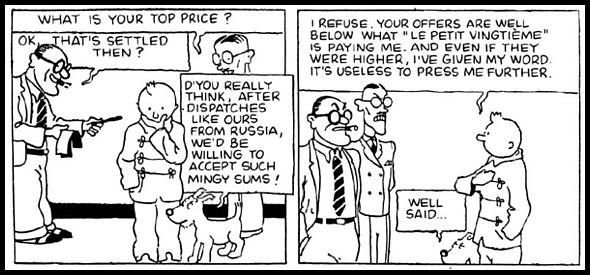
Still, he's evidently very successful, as Tintin in the Congo shows him being approached by several newspapers from other countries offering him huge sums of money to pay for his dispatches. Tintin, of course, will have none of this, having given his word to his own paper, Le Petit Vingtième.


This, as it happens, must have been a bit perplexing for those young readers of Le Petit Vingtième, a children's supplement, who surely wondered where Tintin's despatches were to be found. Search as they might through their weekly eight-page supplements, not once would they have found any of these dispatches for which Tintin was handsomely remunerated. It's all very fishy.

Making matters far worse is that we never again see Tintin doing even a jot of work. Sure, 1937's The Broken Ear features Tintin scribbling in his notebook while scurrying for facts, but even if we assume that he was in journalistic rather than detective mode at that point, it doesn't last long.


No, within a couple of panels he's chasing crooks, as is his wont, and he continues doing so, battling baddies and thwarting drug-smugglings and people traffickers for a further four decades or so, all the while being hailed as a great reporter whilst clearly living off Captain Haddock and coasting on his youthful reputation.

19 December 2011

Home Again

Well, I'm home.

It's been a long ten months away, but it's already nice to be back. Some terribly sad news in the car from the port, but still, I'm glad that I was here to hear it.

The journey was a smooth one, and well-fuelled with a flask of tea, said flask having been excavated from the attic last night in a fit of thrift. A kind lift got me to the station in the proverbial nick of time, and then it was a train, a swankier train filled with luggage, and a peaceful journey on the boat, with plenty of reading done on the way. 

It made for quite a contrast with last December's Christmas return, in the dead of night in a train crammed with hundreds of exhausted and hopeful Irish people, struggling onto a boat that'd been delayed for us at Holyhead, and then befriending people and getting into uncharacteristic rounds with complete strangers on the boat, with thousands of us arriving home in Dublin, bright-eyed and rosy cheeked on a snow-blanketed Christmas Eve.

This time it was a gentle and mild affair, and hardly was I off to boat, looking around for my lift, when I met my accoutancy teacher from school, there to collect his daughter, who'd been behind me in the queue at Holyhead.

Because even if the world's not always a small place, Dublin is.

13 December 2011

Is Rupert Really Due An Apology?

I see the odious Kelvin McKenzie's in the news this week. Last Thursday he claimed that the Sun's vicious calumnies about the Hillsborough disaster were due to reporters from Liverpool, and on Friday he said that he'd got that wrong, and he was sorry about that

Of course, he doesn't seem particularly sorry about the calumnies themselves, about which he's changed his line a few times. In 1993 he says he believed the lies because he'd been told them by an unnamed Tory MP, and in 2006 he said he'd only apologised as Rupert Murdoch had told him to do so. Indeed, in an interview in Press Gazette that year he said, 
'When I published those stories, they were not lies. But I don't really think of it all in the way you suggest. They were great stories that later turned out to be untrue -- and that is different. What am I supposed to feel ashamed about?' 
All of which throws a supremely ironic light onto his current rant in the Spectator.

The Spectator's really not had a good few weeks, and I know because there's a big pile of them in our bathroom, with the newer ones being less readable than those below them. No, really, there is, and though it's not been me who brings them into the bathroom I have been known to peruse them in my more idle moments. They're often fairly well-written and sometimes they make sense. Not so much lately, though...

The recent trouble started with Rod Liddle's column about the Stephen Lawrence trial, which the jury had to be asked not to read and which may yet lead to a prosecution, and was swiftly followed by an article and a front cover banner devoted to the crazed claims of that chalatan Nils-Axel Mörner; now McKenzie has a particularly emetic piece entitled 'Who Will Say Sorry to Rupert?'

Beginning with 'Welcome to the world of journalism, Nick Davies,' the McKenzie piece is an excoriating and hypocritical attack on Nick Davies and the Guardian for the Guardian's coverage of how the News of the World had hired Glenn Mulcaire to hack into people's phones, including that of the then-missing murdered schoolgirl Millie Dowler.

As has become clear, the Guardian's claim that Mulcaire had deleted messages from the girl's voicemail account and that by doing so he gave her parents false hope seems to have been wrong. It seems, instead, that while Mulcaire may well have been responsible for messages being deleted -- by listening to messages he set in motion the voicemail's own automatic deletion process -- he wasn't responsible for the particular deletions that generated false hope.

Was the Guardian factually wrong on this? Yes, it certainly seems to have been.

Does that mean that McKenzie can claim the moral high ground for the Murdochs and their minions? Don't be silly.

After all, as the Dowlers' own lawyer, Mark Lewis, has said, 'It remains unchallenged that the News of the World listened to Milly Dowler's voicemail and eavesdropped on deeply personal messages which were being left for her by her distraught friends and family.'

And unless Kelvin McKenzie thinks it acceptable for newspapers to hack into the voicemail accounts of missing schoolgirls -- regardless of whether they're still alive or not -- in order to make money from their plight and their families' distress, then I don't see that he has a leg to stand on. After all, it was hardly exclusively with reference to the deletion of messages that Rupert Murdoch said in October that:
'When I met with the Dowlers in July, I expressed how deeply sorry I was for the hurt we had caused this family. The behaviour that the News Of The World exhibited towards the Dowlers was abhorrent and I hope this donation underscores my regret for the company's role in this awful event.'
The Spectator's let itself down by publishing this vile sophistry. It's been a bad month.

09 December 2011

The Superhero With A Thousand Faces

Few books have ever had as big an impact on me as The Hero With A Thousand Faces, Joseph Campbell's massively influential study of the archetypal hero's journey in the world's myths, legends, and folklore; since reading that just and a book-length interview with Campbell after I turned twenty-one, I've ploughed through several of Campbell's other books, including his monumental study of comparative mythology in general, The Masks of God

Why so many of our stories are similar is an interesting question, and one open to all sorts of answers, whether psychological, sociological, or theological. I'm inclined to favour a theological explanation, following the likes of Chesterton and Tolkien in seeing the legends of the world as prefiguring the Incarnation in which they were fulfilled; it makes sense to think of the story of Jesus as a true myth, where God expresses himself in reality rather than through dreams and poetic images. 

Still, attempted explanations aside, I don't think there's any getting away from the fact of how structurally similar our myths tend to be. Campbell's work has had a huge impact on Hollywood, as is well known -- George Lucas is surely his best known acolyte, but one thinks of George Miller too, and more recently Christopher Vogler, author of a staggeringly influential memo, and whose book The Writer's Journey: Mythic Structure for Writers, has proved a potent conduit for Campbell's thinking. David Eddings has said that using mythic archetypes in storytelling is the literary equivalent of peddling dope, and in that sense there's a fair case for calling Vogler a narrative drug-lord.

His book, it's worth saying, is well worth reading, no matter what one thinks of it: his influence on the craft of storytelling has been such such that it needs to be understood. One thing I'm left wondering, though, is whether he had any influence on Disney's 1997  film Hercules, because that follows a very clearly beaten path and it's most definitely not the path beaten by the Heracles of ancient myth -- in any variant.

I'm not saying it doesn't owe a lot to Greek mythology -- it does, in that its loaded with characters and references from ancient Greece, but these ingredients are used in a recipe which is far from Classical. In fact, the story of Hercules seems to be not so much ancient Greek as modern American, in that as far as I can tell it draws from the template most firmly laid-out in 1978's Superman: The Movie.

Let me show you what I'm talking about. I've reeled this comparison off enough times over the years that it shouldn't take long here...


A Heavenly Child raised in Obscurity...
Both films start with a little baby boy being cherished by his parents in a place far from our own, a place where mere lesser mortals like ourselves don't belong. All, however, is not blissful in these paradises; Krypton is doomed, while Hades makes it known that his exclusion from Olympus does not please him...


Like Moses in his basket, the infant Kal-El is sent away from Krypton by his parents in a small spaceship destined for Earth, while Hades' henchmen kidnap young Hercules and take him away from Olympus where they attempt to turn him mortal. Each infant is found by a childless couple who resolve to adopt him as their own...


And all the adults are astonished by the little boy's prodigious strength. By this point, in case you're wondering, the Hercules story has already strayed some way from the myth; in the legends, he is indeed the son of Zeus and the strangling of serpents is an important tale of his infancy, but it's not quite like this. Rather, Heracles is the child of Zeus and Alcmene -- a mortal, and not Zeus's sister-wife Hera; consumed by anger and jealousy it was Hera who sent serpents to kill the baby in his cradle. I'll not point out any further differences, unless it's seems really obvious. You can look them up for yourself.


Anyway, the boys grow up and never quite fit in. Young Kal-El goes by the name of Clark Kent, and doesn't play football with the other teenagers in Smallville, while Hercules isn't allowed to play discus with other Greek lads of his age. Neither boy had any idea of his real identity, until he comes unto the possession of a mysterious amulet found with him as a child.


Taking the amulets with them, the boys leave home and set out on foot on a long journey, crossing the most barren of wildernesses...


Until they eventually reach great white temples...


Where they can finally speak to their real fathers, who tell them everything about who they really are and how it is their destiny to become heroes.


Clark's eighteen when he arrives at the Fortress of Solitude and begins his training, whereas Hercules isn't so young -- he'll fly off on Pegasus, who features in the Belleraphon myth, to meet and be trained by Philoctetes, who in Classical myth is someone who only shows up as Heracles dies, but will be eighteen by the time the crucial events in the story play out.


From Obscurity to the Big City
Anyway, once they're ready, they set out for the big city. Clark Kent, who we'll henceforth know as Superman, arrives in Metropolis, while Hercules goes to Thebes, 'the Big Olive' as it's known. The two heroes meet a sharp-nosed, sharp-tongued brunettes who comment on his innocent farmboy routine. Lois Lane will bestow the name Superman on Clark, while Megara refers to Hercules as Wonderboy.


Lois and Megara both fly with the heroes, much to the girls' consternation...

You've got me? Who's got you?
And both girls press the heroes for information about themselves, including potential weaknesses.

Do you like... pink?
Time goes by, and the heroes make great names for themselves, doing all manner of wonderful deeds and saving countless lives, but all is not well, because while they can soar through the skies, great dangers lies beneath their feet.

Deep under the ground live people who are determined to destroy our heroes, supervillains, for want of a better word, who have huge plans for real estate deals -- yes, both Lex Luthor and Hades both refer to their apocalyptic plans as real estate ventures -- that they realise Superman and Hercules could thwart.


Each of these villains is notionally aided by two none-too-bright henchmen...


And each does most of his scheming in a large round room, built around a large round map.


Triumph, Death, and Resurrection
Well, the villains eventually put their plans in motion and capture the heroes, removing their powers.


But though the heroes lie impotent, eventually they are enabled to get back on their feet so they can thwart the villain's plans and save the world.


Unfortunately, even then victory comes at a cost, as in both cases the price of the world being saved was the life of the girl. 


'There's some things,' says Phil to Hercules, 'you just can't change,' but Hercules refuses to accept that and instead sets out to change things by defying the law of death itself, bringing Meg back from the dead by going to the underworld and diving into the swirling waters of the Styx to save her. Likewise, Superman resolves to restore Lois to life by breaking the laws of time, despite the admonitions of his father; he will turn back time if that will restore the one he loves to life. 


Both men drive onwards, circling as fast as they can to save the ones they love. It takes all their effort -- just look at Hercules who's clearly dying or Clark who is bearing the strain of someone who loves absolutely and who would do anything to save someone who has no idea how much he loves her, someone who will never be able to understand how much he has done for her.


And how do the two stories end? Well, Lois and Megara are both restored to life....


While as for the villains, let's just say that they both meet their just desserts, with Lex Luthor being locked away and Hades being himself dragged into the Styx. Both villains, curiously, end up bald as coots.


I've been banging on about this for years, and whenever I say to people that the plot of Hercules is obviously based on the plot of Superman they invariably laugh and say that surely I've got it the wrong way round. If anything, isn't it more likely that the plot of Superman is based on the ancient legends of Hercules. And then I sigh, and point out that the plot of Hercules owes very little to the Greek myths. Sure, the ingredients are ancient, but the recipe is rather more modern.

Though of course, there are those who'd point out that it's anything but modern, as the Superman story in the broadest sense is the story of a profoundly Jewish hero, and that the film owes more than a little to the story of Christ. Jor-El's words to his son, saying 'The Son becomes the Father... and the Father the Son.' The name, Kal-El, supposedly meaning 'Star Child', but clearly a theophoric Hebrew name like Emmanuel. The childhood rescue from certain death -- itself an echo of the Moses story -- followed by a life in obscurity. The emergence after thirty years in obscurity to perform all manner of wondrous deeds and save life after life. The transformation of death so that it becomes a path to resurrection, triumph over evil, and the salvation of the world...

I've come to disagree with Joseph Campbell pretty profoundly in some respects, but he's taught me an immense amount, not least how to look at stories, and to think about where they came from. If you've not read anything by him, you should give it a shot. The Way of Myth, his book-length interview with Fraser Boa, was my introduction to him, but I think Bill Moyer's The Power of Myth might make an even better starter.

Stick your toe into the water. You might end up walking on it.