27 October 2004

A bit of perspective, please...


Over at Crooked Timber there's been some analysis of the online hoo-ha over a recent Guardian article by Charlie Brooker. The article itself is no longer available online, but I've scanned it in here, at almost exactly the same size as it was initially published.

If you go to where the article used to squat online, you'll instead read that '"Charlie Brooker apologises for any offence caused by his comments relating to President Bush in his TV column, Screen Burn. The views expressed in this column are not those of the Guardian. Although flippant and tasteless, his closing comments were intended as an ironic joke, not as a call to action - an intention he believed regular readers of his humorous column would understand. He deplores violence of any kind."'

Why's he apologising? Well, it appears that some people are determined to convince the world that the old canard about Americans lacking any sense of irony. If you check out this hateful rag, you'll see that a smart-arsed TV review has instead been interpreted as a call to assassinate the American president - 'The Left’s campaign of hate and defamation against the American president has hit a new low: a major media organ of the international Left, edited by an associate of Bill Clinton, has called for President Bush’s assassination.'

I'm not sure how to respond to that sort of thing. Blinking is probably a good start.

Did Brooker, even in jest, call for Bush's assassination? He said, after all 'John Wilkes Booth, Lee Harvey Oswald, John Hinckley Jr - where are you now that we need you?'

Is that a call to kill the president? Hmmm. I'm not sure. Bill Hicks used to say something similar about George Michael. What was it? 'The fact that we live in a world where John Lennon was murdered, yet Barry Manilow con...tinues to put out albums. GOD DAMMIT. If you're gonna kill someone, have some fucking taste. I'll drive you to Kenny Rodgers' house. Get in the car I know where Wham! lives.'

Sorry, guys, it was a joke. Not a funny joke, perhaps, and one in questionable taste - after all all human life is sacred - but a joke for all that. By screaming about this being a threat to kill the President you just draw attention to it and make yourselves look like fools.

But then, that just supplies more amusement for those of us in the real world.

26 October 2004

Remarkable Redheads

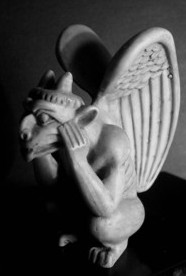
Um, in case anybody comes here looking for something -- a Kipling poem, say, or an analysis of gargoyles and grotesques in Gothic architecture -- and is dismayed to find it hardly mentioned at all, curse Google all you want, but before you do, go pop over to Sarah's site and take a look at Brummie Baywatch. At least this way you'll leave with a smile.


Ginger Genius
Now, on a rather frivolous note, I had a thought a couple of days ago. It wasn't my most profound thought, I must admit, but I reckon it's one worth blogging nonetheless.

A few years ago, a girl I worked with was astounded to hear that unlike virtually every bloke she knew, I didn't find Gillian Anderson, or at least her X-Files alter-ego Dana Scully, to be remotely sexy. 'But she's so intelligent!' wailed my friend, to no avail. Despite my weakness for those whose hair tends towards an autumnal hue, I didn't find Scully to be particularly attractive. Or intelligent, for that matter.

Eddie Izzard used to do a routine where he talks about Scully's complete disbelief in the paranormal, with typical exchanges between Scully and Mulder generally going something like this:
'"Look, Mulder, I don’t believe that Martians with big elbows are taking over the world."

"There’s 50 lbs. worth of files – there’s tons of files on that thing; it’s all here, Scully, you gotta read these files!"

And by the end of the episode, there’s Martians with big elbows everywhere! And she’s swatting them off with a tennis racket, "I believe you! I believe you, Scully! Mulder! You know who you are!"'
But the thing is, that would never happen. Because despite her supposed intelligence, Scully is possessed by an invincible scepticism, overriding all reason and experience. Even if she was swatting Martians off with a tennis racket she'd be coming up with all manner of ridiculous explanations for what was happening, every single one of them less plausible than the Martian invasion that was happening under her nose.

But anyway, Scully is supposedly intelligent. Exceptionally so, in fact. Everyone says so. And since the glory days of The X-Files, red hair has acquired a shamanic quality, becoming some sort of televisual totem, a shorthand symbol signifying feminine intelligence.


For example, take The West Wing's C.J. Cregg, the public relations wizard whose work for EMILY's List brought her to the attention of the Bartlet campaign and eventually elevated her to being, as Press Secretary extraordinaire, the public face of the Bartlet administration.

Yes, she's not the reddest of redheads, but she's certainly no blonde.

And is she, or is she not, the quickest, funniest, cleverest, classiest, most elegant, and quite possibly sexiest fraulein to currently bestride the small screen?

(Admittedly, The West Wing is a show awash with intelligent characters of both sexes, but of the women in the show I reckon C.J. reigns supreme.)


Or take a look, if you can stomach it, at the overpraised Sex and the City, a show memorably described by someone on The Simpsons -- I can't remember who, though I'm told it wasn't Bart -- as being about four women who act like gay men.

Look at the naive and prissy Charlotte, the insatiable Samantha, and the shallow Carrie - let's face it, the only one of the foursome who'd be bearable in real life would be the pragmatic, cynical, and decidedly pessimistic, but nonetheless witty and eminently practical Miranda.

And yes, again, she's a redhead.


And then of course, when it comes to redheads on television, one particular young lady really stands out. Yes, you've guessed it, it has to be the delightful Willow Rosenberg, Buffy's science-geek wallflower turned confident technowhizz turned lesbian witch turned revenge-crazed demon turned world-saving and woman-empowering goddess...

I recently saw the unaired pilot for Buffy - one of my students lent me a copy, and I was rather stunned to see that Willow was played not by the delectable Alyson Hannigan, but instead by one Riff Regan.

I've seen Regan referred to online as 'The Wrong Willow', and that's being nice - there've been snide comments about how she doesn't so much look like Willow as look like she ate Willow. Be that as it may, she's no match for Alyson Hannigan in the part.

Joss Whedon says the network had wanted Willow played by 'a supermodel in horn rims', and casting Alyson Hannigan proved to be a stroke of genius. Not merely did she bring a mixture of vulnerability and optimism to the part, she also brought wry humour, buckets of sex appeal, and -- above all -- red hair.

And as I've said before, that's important in Tellyworld.

Here endeth the lesson.

In Memory of Me

Over the last week or so I've had a couple of interesting chats -- first with The Other Half and then with Eddie earlier today -- about the nature of the Eucharist. I know, not the lightest of conversation topics, but there you have it.

Herself and I got talking about it after Paul and Sinead's wedding mass last Friday. She was a bit concerned about how non-Catholics might feel excluded at a Catholic marriage ceremony, since they can't partake of Holy Communion. I don't think communion features in Anglican marriages, but even if it did, the Church of England allows all present to receive.

Anyway, a lengthy discussion of the nature of the Eucharist followed, and when Eddie popped round after his service this morning, I took the opportunity to quiz him on why his church doesn't have communion every week, despite this having the practice of the earliest Christians, and espoused by Calvin, and also on why the Church of England -- and indeed Protestants in general -- do not regard the Eucharist as being the body and blood of Christ. The latter's an odd question, you might think, but since the vast majority -- about two-thirds -- of all Christians are bound to believe in the Real Presence of Christ in the Eucharist, as indeed did all Christians until the sixteenth century, the burden of proof surely falls on those who dissent.

Of course, as happens all too often in these conversations, we got sidetracked into discussions of what sacraments are, how many sacraments there are, why Protestants follow the Pharisees rather than the early Church in leaving out seven books from the Old Testament, and how on earth we're meant to interpret ambiguous passages of scripture.

Despite that, though, shorn of all the digressions, Eddie's argument basically came down to saying that Jesus was speaking symbolically at the Last Supper when he said 'this is my body'. He likened it to a parable, and said that yes, we should break bread as Jesus commanded us, but only as a way of remembering how Our Lord sacrificed himself for us. Furthermore, he said, it's not really that important to Christianity, not when compared to simply evangelising, and telling people about Jesus.

Maybe, I wondered, but what on earth do you tell them? How can you be sure you've got it right? The Bible might well be infallible, but it's meaning is all too often far from clear. How can you be sure you're reading the Biblical map right? It's not good enough for us to claim as individuals that the Holy Spirit guides us. It's unlikely to be guiding over 20,000 sects in very different directions. But then, I've talked about this before.


'I am the Truth...'
It seems to me that if we're to be honest in our Faith; indeed, if we're to be honest with ourselves, we have an obligation to seek after the Truth. This means not shutting out ideas that challenge us, whatever we believe, but facing them and grappling with them. We have been given the gift of Reason for a reason. It is our duty to use it.

Could Eddie be right? Could it be the case that the consecrated bread and wine Catholics receive at mass is just that, bread and wine? That it's merely symbolic of the broken body and shed blood of Our Lord, rather than really being the Body and Blood of the Lord?

On the face of it, Eddie would appear to be right. After all, the Host looks like bread. It tastes, feels, and smells like it. Under a microscope it would surely be identical to bread. And the same goes for the contents of the Chalice. By any practical test, it's wine, diluted by just the tiniest drop of water. Surely these aren't really the Body and Blood of the Lord?

But if they're not, then we're left with a problem. Was Jesus a Liar? Was he lying that night in the upper room, when he told the Apostles to eat the bread he had blessed, saying 'This is my body... do this in memory of me'?

Well, obviously not, but he could have been speaking symbolically, surely. Could? Is there anything that suggests that he was? He doesn't say 'This is like my body,' or 'This represents my body,' or 'Honour this as if it were my body.' And it's not as if he couldn't have said that, if he really wanted his disciples to know his was speaking figuratively.

Yes, but this hardly proves that it's not a metaphor. Granted, that's true, but this is a dangerous path to tread: it would be absurd to approach every statement of Our Lord as if it's most likely to be read symbolically; so why pick this one statement in particular? The burden of proof, as I've said, is on those who would claim that Jesus was speaking of the bread and wine as mere symbols of his body and blood.

John's account of Jesus' teaching after the Feeding of the Five Thousand should dispel any notions that Jesus spoke symbolically at the Last Supper. John records how Jesus told the multitudes that he was the Bread of Life, come down from Heaven, telling those who wished for Eternal Life that they must 'eat the flesh of the Son of man and drink his blood'.

Jesus' language here is gritty and earthy; it's tactile stuff, not the language of metaphor; a less graceful but more literally reading might render 'eat' as 'gnaw' or 'chew'. Further, John uses the word sarx for 'flesh', a word that can only mean physical flesh, rather than the more ambiguous soma. Jesus wasn't talking about some floaty absorption of himself, but rather of something much more 'real'. In fact, the multitudes who were listening to him took his words at face value and were appalled. Many turned away in disgust, horrified at what seemed to be an injunction towards cannibalism. Many of these had previously witnessed a great miracle, and yet they could not accept this teaching. Even the apostles were confused.

And yet Jesus made no attempt to retract his teaching, or to explain it away as symbolic. Jesus wasn't above explaining things which his disciples couldn't understand. Yet here he simply reiterated his teaching, but more forcefully.

The meaning of what he was saying only became clear with the Last Supper, when he transformed bread and wine into his flesh and blood.


'Three things are alleged against us: atheism, Thyestean feasts, Oedipodean intercourse...'
Saint Paul, writing to the Corinthians, was quite adamant that the consecrated bread and wine was indeed the Body and Blood of the Lord and ought to be treated as such. He makes it quite clear that anybody who 'eats the bread or drinks the cup of the Lord in an unworthy manner will be guilty of profaning the body and blood of the Lord' and that 'any one who eats and drinks without discerning the body eats and drinks judgment upon himself'.

Could this be clearer? In the light of this, how can anybody claim that Our Lord was speaking figuratively when he instituted the sacrament at the Last Supper? Paul explicitly says that those who take Communion without recognising it as the body of Christ condemn themselves.

Of course, it doesn't look like flesh and blood. Nevertheless, it's pretty clear that the very first Christians followed Paul and John in regarding it as such; there was a reason, after all, why the Pagan Romans considered the Christians to be cannibals.

Take a look at what Saint Ignatius of Antioch has to say on the matter. Ignatius was a Syrian Bishop and a disciple, along with Polycarp, of Saint John, who was martyred in Rome at the start of the second century. On the way to Rome he wrote a series of letters to local churches, including one to the Smyrnaeans, where he warned them to beware of 'those who hold strange doctrine touching the grace of Jesus Christ which came to us, how that they are contrary to the mind of God... they allow not that the eucharist is the flesh of our Saviour Jesus Christ, which flesh suffered for our sins, and which the Father of His goodness raised up.' (6.2)

Think about that. We're dealing with historical fact here. Even if you're a convinced atheist, you can't deny the fact that Ignatius is a credible source for mainstream Christian belief in his day. He's basically warning his fellow Christians to beware of being tempted towards Gnosticism, of which 'strange beliefs' about the Eucharist are a hallmark. The notion that the Eucharist was not really the Body and Blood of the Lord would hardly have been strange to the early Christians if the belief in the Real Presence hadn't been central to their faith, would it?

Or take Saint Justin Martyr, writing in the middle of the second century. Justin wrote the first detailed account of Christian worship which is still extant - Biblical references scarcely do more than make vague references to the singing of psalms or the breaking of bread. Take a look at it -- it's towards the end of his First Apology. His comments on the Eucharist are most instructive, built as they are around the observation that the Eucharistic bread and wine are not received as common food and drink but that 'the food which is blessed by the prayer of His word, and from which our blood and flesh by transmutation are nourished, is the flesh and blood of that Jesus who was made flesh.' (66)


Yes, but how?
The problem still remains that the consecrated bread and wine, when consecrated, still seem to be bread and wine. When we receive communion our sense scream that what we are consuming is ordinary bread and wine. How could it be the Body and Blood of the Lord?

This is something that the Church has grappled with from the start. Saint Cyril of Jerusalem accepts the transformation as real, but a mystery nonetheless, when he notes in a lecture to the newly baptised that 'the seeming bread is not bread, though sensible to taste, but the Body of Christ; and that the seeming wine is not wine, though the taste will have it so, but the Blood of Christ.' (22.9)

Cyril clearly doesn't understand how the bread and wine could have been transformed into the Body and Blood of the Lord. Despite his incomprehension, however, he believes without question. Jesus took the bread and identified it as his body; who could gainsay the Lord?

Cyril's faith is a model to us all, and I think important in refuting one of Eddie's points. Eddie had argued that our faith had to be simple enough for a child to understand, as otherwise we'd be excluding people. At the time I countered that it also should be complex enough for an adult to understand, as otherwise we'd be excluding people.

We were both wrong. The issue isn't that the faith be simple or complex enough for anyone to understand. Cyril obviously didn't understand. No, what's needed is that the faith be simple enough for a child to believe, complex enough for an adult to belief.

It's belief that counts, not understanding. If understanding helps belief, so much the better. Ideally they should work as a team. But it's our faith that saves us, not our intelligence.


Yes, but come on, if it looks like a duck, and it walks like a duck, it's, um, bread, isn't it?
But even allowing that it's faith that saves us, it has to be said that this is a great stumbling block - indeed, it has been since many of Jesus' first followers declared the command to 'eat his flesh' to be 'a hard saying' and wondered 'who can listen to it?' (Jn. 6.60)

Saint Irenaeus of Lyons, writing in the second half of the second century, says of the host that 'the bread, which is produced from the earth, when it receives the invocation of God, is no longer common bread, but the Eucharist, consisting of two realities, earthly and heavenly' (4.18.5)

Two realities? But how? Well, over time, it was felt that the concept of 'transubstantiation' best explained what happened at the consecration, with it becoming officially accepted by both the Catholic and Orthodox churches in the thirteenth century.

Greek philosophy speaks of things having an accidental and a substantial reality. The 'accidents' of something are its physical properties, those attributes that can be perceived with the senses. The 'substance' of something, on the other hand, is its inner reality, what it really is.

The accidents of something can change - for instance a potato can be cooked - without the substance changing - it's still a potato. That's normal. Accidents change all the time.

But when Jesus is reported to have changed water into wine, he changed not merely its accidents, but its substance too. It did not become like wine, as it would if it had just acquired the taste, the colour, and the properties of wine. Rather it really became wine.

So what happened at the Last Supper? And what happens whenever we celebrate the Eucharist as Christ commanded us to do? Well, if the doctrine of transubstation is right, the accidents of the bread and wine stay the same, as they did in the upper room, but their substance changes. At their ultimate and innermost level, they cease to be bread and wine, despite all appearances, and become the true Body and Blood of Christ.

Yes, I know it's hard to believe. And ultimately, it is a matter of faith. Saint Thomas Aquinas puts it well, as ever, when he says that 'The presence of Christ's true body and blood in this sacrament cannot be detected by sense, nor understanding, but by faith alone, which rests upon Divine authority. Hence, on Lk. 22:19: "This is My body which shall be delivered up for you," Cyril says: "Doubt not whether this be true; but take rather the Saviour's words with faith; for since He is the Truth, He lieth not."'

18 October 2004

A Drunken Thesaurus

I was chatting to one of my students earlier, before letting her into her room and admiring her heron, when I mentioned my legendary drunken thesaurus, which I've again amended. It's up to 217 terms of inebriation at this point, I think.

To remind you all, if you were -- in Ireland or in her neighbouring lands -- to see a man stumbling by, having been engaged in alcoholic recreation, you could describe him in any of the following ways:

Annihilated, Armchaired, Ar meisce, Arseholed, Badgered, Banjoed, Battered, Beery, Befuddled, Binned, Binnered, Bladdered, Blasted, Blathered, Blithered, Blitzed, Blocked, Blotto, Bluthered, Buckled, Bollixed, Bollowed, Bombed, Boosy, Brahms and Liszt, Buzzing, Cabbaged, Comatose, Couldn't see straight, Couldn’t spell his own name, Couldn’t touch the tip of his nose, Couldn’t walk straight, Cut, Destroyed, Didn’t know his own name, Disorientated, Dizzy, Drizzly, Drunk, Drunk and disorderly, Drunk as a lord, Drunk as a skunk, Effervescent, Elephants, Elephant's trunk, Elevated, Flibbered, Flower-potted, Flush, Flustered, Fluthered, Foggy, Foofered, Fou, Frazzled, Fresh, ****ed, ****ered, ****faced, Fuddled, Full as a shuck, Full up to the gills, Fuzzy, Gee-eyed, Goggle-eyed, Gone, Gonzoed, Groggy, Had a drop too much, Had a buzz on lush, Had a jog on, Had one too many, Half-cut, Hammered, Happy, Have a bit of a lean on, Hazy, Head just about in the toilet, Hobbled, In a right jocker, In a right state, Inebriated, Incapacitated, In the bag, Intoxicated, In his cups, Jam-jarred, Jarred, Jolly, Kale-eyed, Langered, Langers, Lashed, Lathered, Leathered, Legless, Levelled, Lit, Lit up, Locked, Lubricated, Maggotty, Mangled, Mashed, Mellow, Merry, Monged, Monkeyed, Mortal, Mortalled, Mouldy, Muddled, Mullered, Muzzy, Never saw it coming, Nished as a pewt, Not in full possession of his faculties, Not the best, Not too stable, Not well, Obfuscated, Obliterated, Off his face, Off his head, Off his tits, Oiled, Oodled, Ossified, Out of it, Out of his face, Out of his head, Out of his tree, Palatic, Paralytic, Parkbenched, Pasted, Pickled, Pickled to the tonsils, Pie-eyed, Pie-faced, Pished, Pissed, Pissed as a fart, Pissed as a newt, Pixilated, Plastered, Plastic, Polluted, Puddled, Raddled, Ratarsed, Ratted, Rotten, Rubbered, Screwed, Scuttered, Scuttled, Seeing double, Shitfaced, Shot, Shot to Buggery, Shot to ****, Shot to Hell, Shwallied, Skankers, Skanky, Skinned, Skulled, Slammed, Slaughtered, Sloshed, Smashed, Smackerooed, Soused, Sozzled, Spannered, Squiffy, Stushied, Steamed, Steaming, Stewed, Stewed to the gills, Stocious, Stuko, Swizzled, Tanked, Tanked up, Tankered, The worse for wear, Three sheets to the wind, Tiddly, Tight, Tipsy, Tired and emotional, Toasted, Totalled, Toxicated, Trashed, Trollied, Trousered, Twatted, Twisted, Two sheets to the wind, Under the influence, Under the weather, Unwell, Upside-down behind the telly, Walking didn’t come naturally to him, Wankered, Wasted, Watered, Wellied, Well-oiled, Well on, Woozy, Wrecked, and Zonked.

It's all in the intonation, I think. Further suggestions will be gladly received.

06 October 2004

Whose Isles Are They Anyway?

As the discussion at chaplaincy tonight wound down, conversation meandered onto different topics and somehow the notion of Ireland and its relations with Britain popped up. Predictably that cursed term 'British Isles' came up, and just as predictably I got annoyed. The lad who said it tried to justify the term on the grounds of convenience, but I retorted 'Look, you ask a Portuguese bloke what it's like to live on the Spanish Peninsula and see how long it takes until he clatters you.'

It's strange to feel so strongly about a mere geographical term, but there you have it.

Look, the term's meaningless nowadays aside from in a political context where it appears to hint, at the very least, at ownership. It's no good banging on about it having been used for two thousand years.

Greek and Roman authors, it's true, did refer to Britain, Ireland, and their surrounding islands as the 'Prettanic' or 'Brittanic' islands, but that's because the two main islands had at one point been settled by European Celts called Priteni. Following the Romans, we've remembered these peoples as the Picts. Somehow I can't see the slightly more accurate 'Pictish Isles' catching on as a term. Even if it did, it'd be wrong.

In Ireland the Priteni are remembered as the Cruthin, which pretty much shows that they hardly left their mark on the country; if they had done they'd surely have gone down as the Pruthin.*

Bearing this in mind, it looks as though the ancient geographers got it wrong. Yes, there were Picts on both islands, but they had preserved their identity best in the north of Britain, while in Ireland they had really only settled in Ulster; Ireland was hardly a Pictish island.

Should we keep the term because of an ancient error?

Yes, the term was also used by Renaissance mapmakers, but then they were just following in the footsteps of their Classical forebears. Its meaning was purely geographical at that point, but it was soon to gain a political meaning, following the accession of Scotland's James VI to the English throne in 1603. From then on it was only a matter of time before he started calling his united kingdom 'Great Britain', a term which became official in 1707. Britishness, as a concept, only really began to take off in the eighteenth century, and the notion of 'British Isles' was clearly tied with ideas of dominance and ownership.

To be fair, I'd agree that Ireland was indeed a British Isle during that period. She may have had her own parliament, albeit one filled exclusively with the Protestant descendants of fairly recent English and Scottish settlers, but she was undoubtedly under the British Crown, and after 1801 all Irish affairs were conducted directly from London, which was clearly a great idea, as the hamfisted efforts to deal with the Famine of the 1840s showed. I always find it curious that the single biggest blow ever to the the population of the UK was the Irish famine, rather than either world war. I wonder why that's played down so.

(Niall Ferguson gives the famine about three lines in his recent book on how wonderful the British Empire was. I can't for the life of me think why.)

But anyway, yes, I think Ireland genuinely was a British Isle - in a purely political sense - for about three centuries, but it certainly hasn't been one in over eighty years. The term now is, frankly, offensive, suggesting subordination and British dominance.

But what collective name should we use for the islands off the north-west coast of Europe? One clumsy suggestion has been Islands of the north Atlantic, but I can't see that catching on. I suppose the Celtic Isles might work, in that both islands were heavily settled by Celts before being thinly settled by various northern European mobs. But let's face it, can you really see that catching on?

But does there even need to be a collective name for Ireland, Britain, and their surrounding islands? After all, if you divide up Europe as though on a Risk board you find plenty of places that don't fall into natural groups.

Think about it. Iberia (Spain and Portugal), France, The Low Countries (Belgium, the Netherlands, Luxembourg), Germany, Italy, The Balkans (Albania, Macedonia, Romania, Bulgaria, Serbia, Bosnia, Crotia, Slovenia), Scandinavia (Denmark, Norway, Sweden, possibly Finland), yeah, sure, all these are recognised areas... but what then? Where do Austria, Hungary, Poland, the Czech Republic, Slovakia, and Switzerland fit in? Does anybody have a collective name for them? Aside from 'the group of crappy countries in the middle'? Does anybody need one? I'd hardly have thought so.

And for what it's worth, look at those clumps again. We don't call Iberia and Scandinavia the Spanish and Swedish peninsulas, do we?

With the Celtic Isles seeming unlikely to catch on, I think Norman Davies is right simply to refer to these islands as The Isles. It's a vague term, but if people can cope with 'The Gulf', and if medieval and early modern Greeks could cope with 'The City', then it should work out okay.

On a slightly related note, this shot of Europe at 11:19 GMT on 11 August 1999 is fabulous. It shows Britain and Ireland completely under shadow, owing to the solar eclipse that day. In fact, they were under cloud, and the cloud was under shadow, but there you have it. I was in Luxembourg at the time. And the following day one of the strangest episodes of my life began. But that's another story...
__________________________________________________________________________________________
*A brief aside - the Celts of these islands can be linguistically divided into P-Celts and Q-Celts. Breton, Cornish, and Welsh are P-Celtic languages, which Irish, Manx, and Scots Gaelic are Q-Celtic. The two language families have a lot of words in common, but with the first letter being either a P in the first group or a C in the second.

02 October 2004

Green-Clad Babies

The Better Half and I infuriatingly wound up at cross-purposes this evening after watching an episode of Robin of Sherwood. I'd borrowed the first series on DVD from Gareth yesterday, keen to revisit a cherished part of my childhood and see if it had stood the test of time.

I needn't have feared. Despite the involvement of a Muslim sidekick for Robin and the omnipresence of the Dark Arts, this was no Hollywood farce. Admittedly, it lacked the technicolour exhuberance of the Errol Flynn version, the grim authenthicity of the Patrick Bergen rendering, the tenderness of Robin and Marian, and the sheer delight of the Disney version, replete with an exceedingly foxy Maid Marian... but it somehow settles nicely between all these well-known tellings of the tale.

In fact, I'd go as far to say that this is pretty much the definitive Robin Hood. Michael Praed may not be quite as swashbuckling as Errol Flynn, but at least his deeds stay just about on the line of plausibility.

In fact, this Sherwood is as a whole more plausible than any with the exception of the Connery and Bergin versions - and yet it manages to be a richer world than those. Partly this is through there being a constant atmosphere of oppression, of how the Normans have come to England under a pretext of civilising it but really with no aim other than to milk Albion dry; Robin's band are an inspiring bunch of guerrillas, fighting for English freedom against England's armoured conquerors.

But it's not just this; through the introduction of mystical elements that had hitherto been avoided in modern retellings, this version gives a new depth to the story, weaving extra strands into the tapestry of the Greenwood, strands that have been eagerly if clumsily taken up in more recent retellings.

The Sheriff is magnificently cynical, a Machiavellian pragmatist with a great line in dry wit. His Abbot brother is exquisitely amoral, a Chaucerian nightmare. Gisborne is nasty, self-righteous, hotheaded, none-too bright, and somehow genuinely dangerous. And the rogue's gallery doesn't end there... there are plenty of chilling minor villains.


Do Liberators Always Come In Sevens?
And as for the 'Merry Men'? Ray Winstone's Will Scarlet is cynical, bitter, and somehow charming, a deeper and more interesting character than in any other version. Judi Trott may not be quite the luminous beauty that Olivia De Havilland was, but her Marian manages to combine an elvish beauty, a fiery temperament, a sharp mind, and a better eye than any of the merry men to make her almost certainly the sexiest Marian to have lit up any screen - yes, even the great Uma must bow before her.

The silent Saracen Nazir is a mesmerising character, a Muslim answer to Kurosawa's Kyuzo in Seven Samurai. He's a wonderful addition to the Sherwood mythos, and a far more convincing figure than the deus ex machina that is Morgan Freeman's Moor in Prince of Thieves. Much is endearingly dim, and while this version adds little to the characters of Little John and Friar Tuck, there's not a fault to be seen in either their roles or their performances.

Anyway, I've digressed in spectacular fashion.


What Exactly Does 'Happily Ever After' Mean Anyway?
As the second part of the series ended we got to talking about the characters and I mentioned to Herself that in some version of the legends I'd read as a child - probably the Roger Lancelyn Green version - it mentions Friar Tuck and Little John moving to Ireland and eventually dying in Dublin after Robin's death.

I wasn't quite prepared for the reaction.

'Robin Hood dies?!?!?!?!?!?!?!?!?!?'

It turns out that if you know Robin Hood mainly from cinema, and if you haven't seen Robin and Marian, you tend to think that the story ends in 1194 with Richard I returning from his imprisonment in Austria, Prince John being driven from office, Robin's nobility reinstated, and Robin and Marian getting married and presumably having lots of green-clad babies, living happily ever after...

The problem with this is that it leaves out the fact that of his ten-year reign, Richard spent only ten months in total in England. And once he was dead, sans an heir, his conniving brother took the throne once more. John ruled from 1199 to 1216, memorably signing the Magna Carta on the way. You can imagine how he might have borne a grudge against such a notorious old enemy as Robin.

I won't babble about how the legendary lord of the Greenwood supposedly met his end. You can read about it yourself, or at the very least go and watch Robin and Marian.

But anyway, this got us arguing about whether Robin's death should be part of the tale or not. Me, I'm in no doubt of the matter, and completely take the view of the great Alan Moore in his fine introduction to Frank Miller's The Dark Knight Returns:
'All of our best and oldest legends recognize that time passes and that people grow old and die. The legend of Robin Hood would not be complete without the final blind arrow shot to determine the site of his grave. The Norse Legends would lose much of their power were it not for the knowledge of an eventual Ragnarok, as would the story of Davy Crockett without the existence of an Alamo.'
There's obviously no right and wrong way to approach these things; it's obviously just a matter of temperament. For me, I suppose, a life isn't complete until it's over - nobody can be judged until they're in the grave. After all, there's a reason why King Oedipus has traditionally been taken to end with the injunction to call no man happy until he's dead.

I'm not sure what it says about my worldview, but all too often it seems to me that a story's not over till the hero's dead. I need Cuchallain to strap himself to the pillar, and the armies of Ireland to shrink back from him until the raven lands on his cold shoulder. I need with Bedivere to watch the hand take Excalibur back into the lake, and then to see Arthur being taken away to Avalon. Herakles has to put on the poisoned robe. Jason needs to be betrayed by Medea and die beneath the rotten hull of the Argo.

The Iliad, perhaps more than anything else I've ever read or seen, glorifies this tragic view of life, presenting it as something genuinely epic. In the Iliad, the Gods live forever, and as such their lives are meaningless, trivial, inconsequential things. But the mortals on the plains before Troy? They'll die, every single one of them, sooner or later. And knowing that they'll die, it falls to them to make their lives count for something. Mortality gives their lives meaning. Death makes Life matter.

I think.