29 March 2012

Torturing the Census Data

Back in my misspent youth, I enjoyed a brief dalliance with Fine Gael membership -- yes, I know, but I think we can all be forgiven our childhood errors. Besides, I rightly suspected John Bruton had real potential and suspicions I had about Labour were to be vindicated a couple of months later when they merrily snuggled up against Fianna Fáil in the governmental bed.

Anyway, I went to meeting one evening in UCD in anticipation of Michael Noonan, the finance spokesman of the day, addressing us; Noonan couldn't come, alas, but Austen Currie, one of my own TDs, stepped into the breach. Speaking at length about the situation in the North, Currie described how he'd gotten tired over the years with people saying that in time Northern Irish Catholics would outbreed Northern Irish Protestants.

'Rabbit theory,' he called this, dismissing it as unhelpful and crude; his standard response to people in the North who'd taken this line had been to advise them to go home and start breeding, as they obviously weren't interested in discussing things and working in accord with justice and charity towards the common good of the Northern Irish people as a whole.

Unfortunately, to judge by comments I've seen earlier today in response to the national census figures, we're not immune to our own form of rabbit theory in the Republic.


'Increasing' doesn't mean 'big'
'No Religion up 45% in Irish census, despite census question that favoured religion,' say some.

Number of Catholics in Ireland up by 4.9%, say others. Ah, the first crowd tend to counter, but most of the new Catholics are immigrants, they say, as though immigrants don't count. The rise in disbelief is an Irish phenomenon, they insist: atheism is on the rise. Huzzah!

People need to catch on to themselves.  'Increasing' does not mean 'big', just as 'decreasing' doesn't mean 'small'. What's more, we need to recognise that while numbers matter, truth matters more. Societies shouldn't be dictated to by their minorities, but they should most certainly be judged by how they treat their minorities. A State which doesn't act in accord with justice is no more than an organised crime syndicate.

Yes, there were about 80,000 more people in Ireland in 2011 who were willing to say they've no religion -- whether because they're atheist, agnostic, or apathetic -- than there had been five years earlier. Big deal: remember when people used to get excited about the Green Party vote doubling, when it had just risen from a risible 1.4% to a laughable 2.8% of the national vote? Indeed, do you remember the Greens? Or the PDs, who averaged just under 6% of the vote in each of the six campaigns they fought? 


Some pictures really are worth a thousand words
More substantively, the number of people willing to self-identify as Christians had risen by about 230,000 in the same period. Yes, I know there's a reasonable case to be made that it's not fair that children are probably listed by their parents as Catholics or whatever, regardless of what they believe themselves, but we should be careful about assuming that religion is about what you think rather than -- as so often -- what you do or who you are.

180,000 of those new Christians are Catholics, and most of the increase in Catholics in particular and Christians in general is due to natural increase rather than immigration.

Yes, really. Pay attention at the back.

Let's look at the broad national picture, as shown in Figure 35 of the Census 2011 Highlights, published this morning.


Ignore the second sentence for now; it's overblown nonsense and I'll deal with it in a minute. Instead focus on the main story, as taken for all in all, it's quite striking: 84% Catholic; 6.25% other Christians; 6% atheists, agnostics, and those of no religion in whatever sense; 2.5% everybody of religions other than Christianity; and 1.5% all those who declined to answer the question.

Granted, other than that more than 90% of the Irish population self-identify as Christians, with more than 90% of those self-identifying as Catholic, we don't know what these figures mean; there are already people arguing that Mass rates suggest that many Catholics are Catholic in name only.

I'm not sure about this, as leaving aside the issue of sacramentality, I'm always uneasy with attempts to second-guess people's self-identification. It always seems to be those who are quickest to claim the 'no comment' and 'no religion' answerers as secret atheists who are also quickest to claim that most religious people are secret atheists too. You'd almost think they had an agenda, the way they go on.

So all we have really go on are the numbers.


Pay more attention to the numbers than to the pictures
Now, what about the relative increases? Here, unfortunately, there seems to be a false narrative already in danger of slipping into the mainstream. Here's the Irish Times, for instance:
'The result show Ireland is still a predominantly Catholic country. Some 84 per cent of people described themselves as Roman Catholic, an increase of almost 5 per cent which was driven mainly by Eastern Europeans moving here.'
This is obviously misleading in the sense that it suggests that in 2006 our population was 79% Catholic and is now 84% Catholic, whereas it's the number of Catholics that's risen by almost 5%, not the percentage of the Irish population espousing Catholicism, but more importantly, the article perpetuates what seems to be an error in the CSO document itself.

It's an error that gives the impression that growth in Irish Catholicism has stagnated, and that the Irish Church is dependent wholly on immigration for new blood, and an error that needs to be challenged.

Look at Figure 36 here, which aside from the kind of disingenous chart that'd give Edward Tufte heart failure, purports to show the percentage change in religion by nationality.


It's not very clear what this chart purports to show, and it's hardly surprising that the Irish Times has read it as saying that Ireland's Catholic increase is almost exclusively due to lots of Catholics having moved to Ireland since 2006, mainly from mainland Europe. That's certainly the most natural reading of it.

And that's not true.


Are alarm bells ringing yet?
They should be. How high do you think our immigration rates have been since 2006? They were massive before that, of course, such that there were Polish signs at Luas crossings and in the Tax Office, but since then? Immigration's not been insignificant since the economic downturn, but does anyone seriously think it's been high enough to explain away the greater number of 180,000 new Catholics? High enough to explain it being possible to fill Croke Park twice over with new Catholics? Really?

Table N, below, should cause us to wonder further. Seemingly since 2006, roughly 52,000 Poles have moved to Ireland, along with 10,000 Lithuanians, 6,000 Latvians, 4,500 Brazilians, and 4,000 Filipinos. That's 76,500 newcomers from countries with largely Catholic populations.You'd fill Old Trafford with that. You wouldn't fill Croke Park once, let alone twice.


154,000 more immigrants, more or less, in that five year period, including Romanians and Indians. But Figure 36, as we've seen, makes it seem as though almost all the 180,000 or so new Catholics were immigrants. What's going on?

Well, putting it bluntly, it looks as though the likes of the Irish Times has taken the CSO's summary and messed up whatever it was that the CSO was clumsily trying to communicate. In 2006, there appear to have been 213,412 non-Irish Catholics in Ireland. By 2011, this number had increased to 282,799. In other words, only 69,387 of Ireland's new Catholics are people who've moved to the country since 2006.

Now that's not a small number, of course -- it'd almost fill Old Trafford, to put it mildly, and constitutes more than 55% of the last five years' non-Irish immigrants, contrary to popular narratives about how we have to change our education system to accommodate the massive numbers of immigrants who aren't Catholic -- but let's not exaggerate its importance if doing so means we've to ignore the natural increase that'd comfortably fill Old Trafford again, and Goodison Park or Stamford Bridge too.

According to the CSO, in 2006 there were 3,644,965 Catholics in Ireland; by 2011 there were 3,831,187, such that it seems that Ireland's Catholic population rose by 186,222 in that period. 37% of this figure can be accounted for by immigration during those five years, but that still means that 63% of it is natural increase.

It looks to me as though somebody  looked at the total figures showing how many Catholics in Ireland are from the rest of Europe -- just over 162,000 -- and mistakenly treated them as though they'd all arrived since 2006, whereas the vast majority arrived before then and have since become well-established in Ireland.

It's disappointing to see such sloppiness from our Central Statistics Office. Disappointing too to see people recycling supposed data without crunching numbers for themselves. People should get beyond the graphs.

Torture the data. It'll tell you what you need to know.


Update: I no longer understand this at all. I went through a phase later this evening of thinking I'd misunderstood the chart and been unfair to the CSO, but now I'm left baffled as to what it means by any definition. That it's a mess with the Catholics is clear, but look at the Orthodox, for instance. It looks from Figure 36 as though three quarters of the 24,000-strong Orthodox increase are Irish, but if the chart's saying that it's clearly wrong as we know from the tables at the back that just under 27% of the increase was Irish. So it obviously can't mean what it most naturally would be taken as meaning.

Having squinted at the chart for a bit longer than the Irish Times has evidently done, though, I thought I'd figured out what's going on, reckoning that it was a chart that's trying to do a lot, but in a murky way and not comparing like with like in any sense. My guess was that it was intending to show two data sets, the dark bars showing the increases on a percentage basis of Irish people in each religious group, and the light bars showing the increases on a percentage basis of non-Irish people in each religious group.

I suspected that it would have been easier to decode had it been a grouped vertical bar chart, with nine pairs of columns showing the increases or decreases in each religious group by national and non-national criteria. What's more, I thought it'd have been more honest if it were based on total numbers, rather than by percentages, as though percentage increases are in any way comparable: a sect with five members gaining ten new ones would show a 200 per cent increase, but it'd still count for nothing!

The problem is that that doesn't work either. Again, take the Orthodox as an example. Given that there were 2,881 Irish Orthodox Christians in 2006, and that this rose to 8,465 in 2011, the chart should represent this with a 294% increase in the dark bars. Likewise, there having been 16,845 non-Irish Orthodox in 2006, rising to 34,854 of such in 2011, the chart should likewise show a 207% increase in the light bars...

Except that's not what's what's happened. The chart shows roughly a 120% increase in the dark bars representing Irish nationals, and a 45% or so increase in the light bars representing non-Irish nationals.

I have no idea whatsoever what this chart is meant to be telling us.

23 March 2012

Thousands of Words

It's long been a conviction of mine -- and as usual this is based on observation and not upon prejudice -- that academic talks with witty and dramatic titles tend towards tedium, whereas those with more workmanlike names can often surprise. Obviously, this doesn't work across the board, but it's a good rule of thumb, and one that first struck me when I attended a talk entitled 'Oaths, Omens, and Abominations' and found myself learning about Greek grammar.

The tragic aorist, to be particular.

I'm not saying it wasn't a good talk -- it was, and it's one where I really learned stuff -- but it certainly wasn't what I felt I'd signed up for.

In contrast, many's the talk I've attended with a dull title that's turned out to be utterly fascinating. Again, I'm not saying that all talks with uninspiring names prove inspirational; a serious contender for the worst talk I've ever attended had the kind of boring title that trained eyes recognised as promising hidden pleasures, but proved both condescending and deeply flawed, delivered in a ponderous manner and accompanied by an atrocious Powerpoint presentation, the nadir of which was an utterly incomprehensible flowchart.

Afterwards, as my colleagues made sure to take away their handouts lest the speaker notice the scathing comments they'd scrawled upon them, I remarked that I hoped the speaker was to be made pay for her own dinner; a friend who wound up seated opposite her during the meal then spent a tortuous two hours desperately trying to avoid discussing her paper.

Still, the principle holds, I think. Don't trust exciting titles, as they merely raise hopes, while things that seem functional and mundane can have poetic depths.

One of my favourite non-fiction books has perhaps the most soporific name of any book on my shelves, it being Edward Tufte's The Visual Display of Quantitative Information. Dull of title it may be, but the book's a thing of rare beauty, and is one of those things that could change how you look at the world.

Scathing of charts and diagrams that are cluttered with useless or distracting information, and damning of those that mislead, Tufte sings the praises of elegant diagrams that convey large amounts of information in a clear and efficient way, especially those that do so in a narrative fashion. Not every picture's worth a thousand words, but some are worth that and more.

John Snow's cholera map, showing how outbreaks of the disease were distributed in the 1854 London epidemic, is recognised by Tufte as an exemplary instance of quantitative information being displayed visually, but the real highlights of his book are the nineteenth-century creations of the French engineers Ibry and Jean Joseph Minard.

Perhaps Ibry's most ingenious creation is this Paris-Lyons train timetable, as published by Étienne-Jules Marey in 1885. The horizontal axis reflects the time of day, while stations are placed proportionately by distance along the vertical axis. Southward-bound trains descend from left to right, while northward ones ascend from left to right. The table reveals an immense amount of information at a glance, with, for instance, it being immediately obvious that the steepest lines indicate the fastest trains.


There's no denying that this isn't all that clear when reproduced on a small size, but at its original larger scale it would have been admirably clear. Tufte's applied Ibry's methods to other modern timetables with impressive results, which really just leaves one wondering why this system hasn't been commonly adopted by transport authorities around the world.

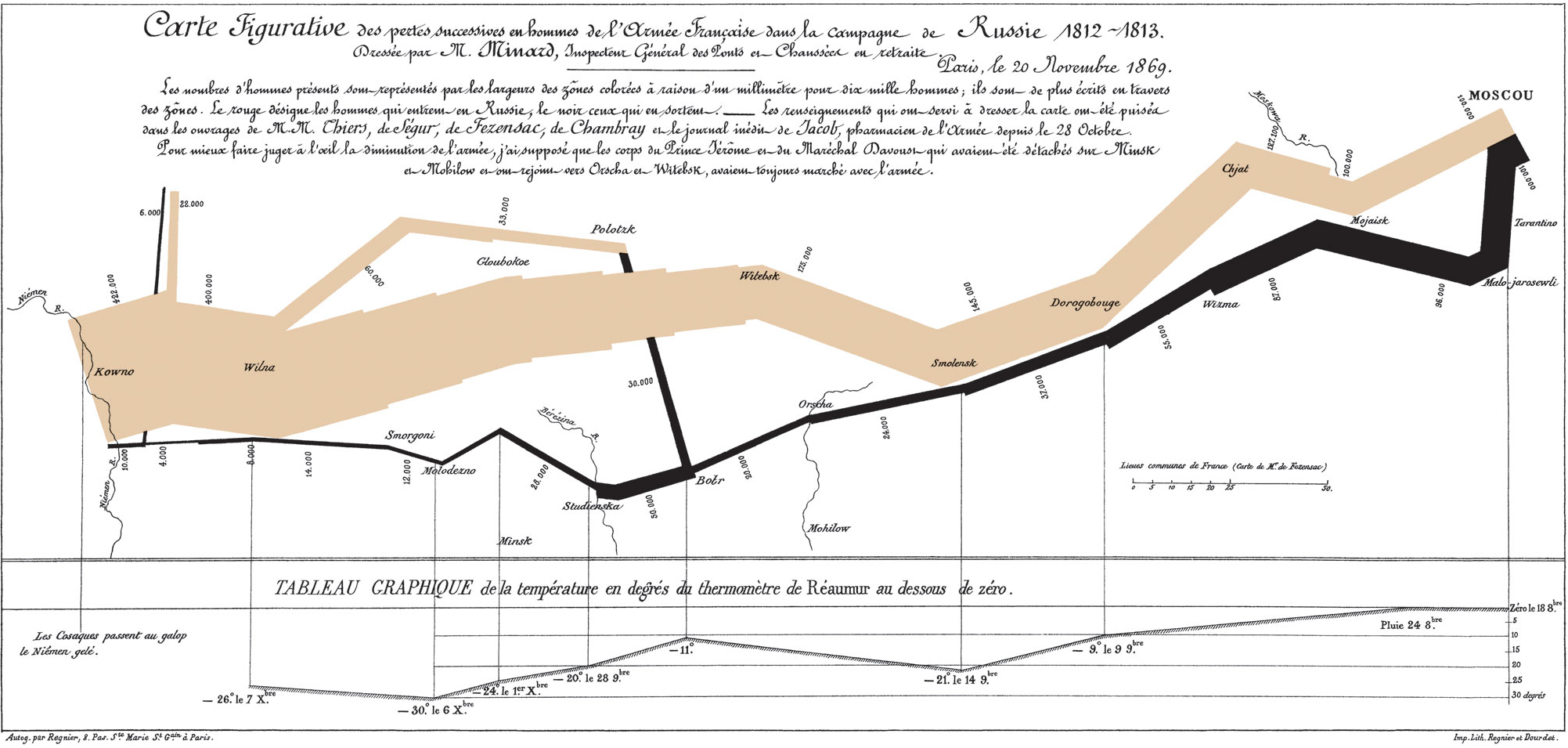
Minard's historical maps are perhaps even more remarkable than Ibry's timetable. Indeed, Tufte is of the view that this 1869 map, depicting Napoleon's doomed march on Moscow, may well be the greatest statistical graph of all time, defying the pen of the historian, as Marey said, in its brutal eloquence.


The thick upper band depicts the advancing army as it sets out from the Polish-Russian border towards Moscow, the band narrowing along the way as thousands of men deserted and thousands more died through cold, starvation, typhus, and suicide; 422,000-strong at the beginning of the invasion, hardly more than a 100,000 reached Moscow.

The dark lower band -- tied to to temperatures along the route -- represents the broken and shrinking army's desperate retreat through the bleak and deadly Russian winter, harassed along the way by Russian peasants and irregular troops, such that barely 10,000 returned across the Neman.

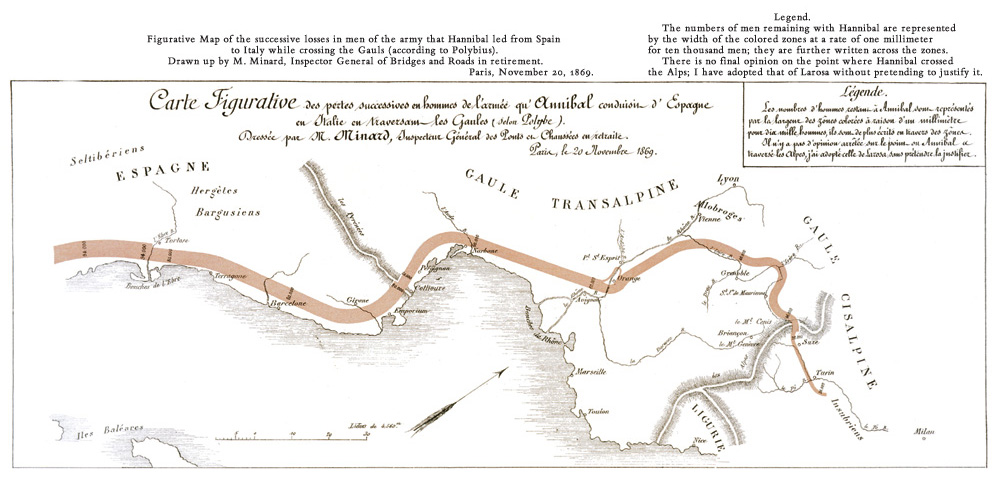
I was horrified and thrilled when I beheld this map for the first time, as me being me I wondered whether Minard's methods could be applied to a similar map depicting Hannibal's march; surely, I thought, that'd be a boon to any book on his Italian invasion. Well, I discovered as I read on, Minard had beaten me to it and rendered such a map more gracefully than ever I could have done.


Working from Polybius' second-century figures, and following -- it would seem -- the route postulated by Jean-Louis Larauza, Minard showed how Hannibal's army set off from Cartagena with about 90,000 infantry and 12,000 cavalry, but after leaving men behind at the Ebro river to protect Punic Spain, continued to decline in numbers as it crossed the Pyrenees, Gaul, the Rhone, and especially the Alps, such that it eventually arrived in Italy reduced to a mere 20,000 infantry and 6,000 cavalry.

Granted, this map takes Polybius' figures at face value, which I wouldn't do -- all else aside, I rather suspect that Polybius' figures exclude Hannibal's skirmishing troops who he regularly refers to as euzdonoi as distinct from pezdoi, his standard word for infantry -- but it nonetheless strikes me as an eloquent and valuable visual aid, and the kind of thing which should feature more often in modern books.

Dry it may look, but Tufte's book is an absolute wonder, and a call to arms. We shouldn't rely on lazy cookie-cutter diagrams or clutter our work up with noise and effects, the kind of sound and fury that signifies absolutely nothing. We can do so much better.

22 March 2012

Cameron's radical social experiment on gay marriage

Scotland’s Cardinal Keith O’Brien made headlines last week when he wrote a Telegraph article describing government proposals to introduce same-sex marriage into UK law as “madness” and “a grotesque subversion of a universally accepted human right”. The substance of his article was lost in the fury that erupted over his language, and hardly anyone seems to have noticed – or cared – that his argument wasn’t remotely faith-based.

Under the civil partnership scheme, he said, same-sex couples already have the same civil rights as married ones, such that redefining marriage would give them no tangible benefits; in no real sense, therefore, should this be seen as a debate over equality or about gay rights. This is a debate about the nature and value of marriage.

While its form may have varied across cultures, marriage – whether Christian or otherwise – has always and everywhere been understood as existing, in the Cardinal’s words, “in order to bring men and women together so that the children born of those unions will have a mother and a father.”

This timeless and universal conception of marriage has children at its heart; we cannot redefine marriage as “committed loving relationships between adults” unless we jettison its primary purpose, that being to provide a safe, stable, and balanced environment within which children can be born and reared.

Lynne Featherstone, the Liberal Democrat junior minister with responsibility for equality, has accepted that neither the State nor the Church “owns” marriage; in response, Cardinal O’Brien pointed out that “No Government has the moral authority to dismantle the universally understood meaning of marriage.”

The Government certainly has no electoral mandate for such a radical change; proposals to redefine marriage were conspicuously absent from the manifestos of both Conservative and Liberal Democrat parties in the 2010 election, and were accordingly absent from the agreed programme for government.
Betrayed
Such silence was hardly surprising. The 2004 Civil Partnership Act, giving committed same-sex couples the same rights the State had long given to married couples, had satisfied all reasonable demands for civil equality. If neither David Cameron nor Nick Clegg campaigned for same-sex marriage in 2010, this was because there was no popular demand for such a thing.

Same-sex marriage was effectively absent from Britain’s political radar until last September’s Liberal Democrat conference, when Lynne Featherstone announced plans to introduce it; David Cameron echoed her at October’s Conservative conference, declaring, “I support gay marriage because I’m a Conservative.”

I’ve no idea how the Prime Minister kept a straight face while claiming that redefining a timeless social institution is in any way conservative, but it’s easy to see what motivated this revolutionary proposal.

It’s common knowledge that the Liberal Democrats felt betrayed by the Conservatives in the aftermath of last year’s electoral reform referendum. Although the coalition agreement allowed for Conservatives to campaign either way in the election, the Liberals felt their centrally co-ordinated campaign to block the Liberal attempt to make parliament more accurately reflect the will of the British people to be wholly contrary to the spirit of the coalition agreement.

Since then the Liberals have become far more discriminating in their willingness to support Conservative policies, forcing the Conservatives in turn to appease their newly obstructive junior partners.

The Liberal Democrats must have proposed the introduction of same-sex marriage in the hope of being able to brandish such a change as a totemic victory to restore the faith of their many disillusioned voters. This proposal would have been a bitter pill for many Conservatives, but for others, close to the Prime Minister, it would have offered a way of helping banish their popular image as “the Nasty Party”.

Even allowing for internal dissent, this surely looked like an easy win, but the Government seems to have miscalculated popular feelings on such a radical social experiment.

Complexity
Already the Coalition for Marriage’s petition that the Government preserve the legal definition of marriage looks set to receive more signatures than any other petition since the modern e-petition system was established. What’s more, a Catholic Voices-commissioned ComRes poll published last week found that more than two thirds of British people continue to believe marriage, defined in the traditional way, should be promoted by the state.


UKIP, that lost tribe of Conservatism, now publicly oppose the redefinition of marriage, and though a tiny minority party they could easily do serious damage to the Conservatives’ prospects in the next election, given the winner-takes-all nature of the voting system the Conservatives fought so hard to retain last year.

In marginal constituencies, the loss of a few hundred votes on the right could easily lead to dozens of Conservative seats falling to the Liberals or Labour.

The Government also seems to have given no thought to the complexity of their proposal: redefining marriage would require the amendment on hundreds of pieces of legislation, not least – arcane though this may seem – the 1662 act licensing the Anglican prayer book.

People too easily forget that the Church of England is in many respects an arm of the British state, and it is Parliament that speaks when the 1662 prayer book identifies marriage as a union of man and woman, all marriages being unlawful unless in accord with what “God’s Law doth allow”.

Does the Conservative party really want to interfere in Anglican services, given how this could be a decisive step towards the disestablishment of the Church of England? But how could it avoid doing so, if doing otherwise would entail allowing the established Church to contradict the State?

Lynne Featherstone claims that religious bodies wouldn’t be compelled to celebrate same-sex marriages, but – mistaking weddings for marriages – this misses the point. The law would still require religious people to accept same-sex unions as marriages, and those who refused to accept such unions as marriages could be found guilty of hate speech.

In a recent Tablet column, Timothy Radcliffe, former Master of the Dominicans, wrote warmly of the blessings gay people bring the world, but began by saying, “The Catholic Church does not oppose gay marriage. It considers it to be impossible.” If marriage is redefined in order to institute same-sex marriage, such statements could be construed as section 5 public order offences.

Cardinal O’Brien’s language may have been inflammatory, but he made some important points, not least by asking what would happen, were marriage to be legally redefined, to those who hold and teach that marriage can only mean and has only ever meant the union of a man and a woman.

I don’t think David Cameron wants to define ordinary mainstream Christian teaching as hate speech or to criminalise ordinary teachers, priests, and parents. I suspect he’s not thought this through.
 
 
-- Originally published in The Irish Catholic, 15 March 2012

On Misunderstanding the Arguments Against Same-Sex Marriage

There's a blog of which I'm fond which is currently running a hugely disheartening post, setting forth the arguments -- as the blog's author understands them -- against same-sex marriage.

It's a puzzling post, and a disappointing one, cluttered by at least two substantial asides and marked by a complete failure to engage with what's being said by those who are speaking up in defence of marriage.

That may well be our fault. Our arguments shouldn't be so easily misunderstood, or misconstrued, or misrepresented. We may have to make the case all the more clearly.

I agree with the author an immense amount of the time, not least by virtue of likewise being politically centre-left, ardently europhile, and a big fan of both Germany and dogs. I'd very much like to meet him in person, as I think he'd be fun, interesting, and thoughtful; he comes across that way. I've also -- one distressing and I think deeply unfair episode aside -- long thought him an absolute model of how people should conduct themselves on the internet, and have directed people to his blog many a time for guidance in that regard.

Not this time. Having at one point thought same-sex marriage wouldn't be that big a deal, I've come to change my mind on this, and I'm astounded by this caricature of views such as mine, not to mention flagrantly wrong and deeply offensive claims that all arguments against same-sex marriage being legalised come down to homophobia.

Yes, I know that on his blog he says that it's discrimination rather than homophobia, but that explains nothing; discrimination is a term that denotes action, not what lies behind an action, and on Twitter it seems he's pretty clear on what lies behind opposition to legislation for same-sex marriage.

Summing up the arguments against the redefinition of marriage, someone earlier today said to him, 'It's simple: gays are an abomination. That's their only argument. The rest is window-dressing.'

The reply?
'Yes. Nail on head. Rest depends on how "reasonable" they're trying to appear.'
Sigh. We've reached a very bad point in our discourse when decent, sensible people are willing to condemn everyone who disagrees with them as homophobes and hypocrites.

Allowing for the fact that the civil partnership scheme gives same-sex couples equal rights to married ones in English law, it seems there are one or two areas where gay couples feel they are discriminated against in terms of not being allowed to marry, just as -- as Peter Tatchell and Nelson Jones argue -- straight couples are discriminated against in terms of not being allowed to enter into civil partnerships.

Though hardly tangible things, I've come to agree that these are valid concerns, as it happens, albeit not ones that it's beyond our wit to find ways to resolve.

Ways, I mean, that won't necessitate abolishing marriage as currently understood, that won't impose restrictions on already recognised rights to freedom of conscience, belief, and religion, and ways that won't require us as a society to abandon the only institution we have that exists to promote and protect the principle that ideally every child would be raised by his or her mother and father.

I'm currently wondering whether Julie Bindel has a point, and whether we might want to think in terms of something like the French system if we want to resolve this and ensure everyone feels fully equal in the eyes of the State. It seems I'm not the only one thinking along those lines. I don't think such concerns can be put down to homophobia. I think this is a 'gay' issue even less than it's a 'religious' one.

Anyway, to go back to the post that troubled me, what does the blogger regard as the arguments being deployed against the government's proposal to legislate for same-sex marriage?


1) This isn't civil marriage, it will be forced on churches
The government has expressly said that the proposed change relates to civil marriage and churches will not be forced to marry same sex couples (just as for example divorcees cannot marry in the Catholic Church: they set their own rules on this).
And onwards then into a lengthy digression about some dodgy reporting on the part of the Mail.

Ignore that, and focus on the key point -- which the blog, like the government consultation, passes over -- that there's no such thing in law as 'civil marriage', just as there's no such thing as 'religious marriage'. 

There is only 'marriage'. Anybody who tries to make out that there are two types of marriage in English law either doesn't understand what marriage is in English law, or doesn't care. I'll leave it to you to decide which category the Government falls into. This matters. We can't conduct an honest and reasonable discussion of whether marriage should be changed unless we recognise what marriage is.

Yes, there are religious marriage ceremonies and civil marriage ceremonies, but it's the ceremonies that are deemed religious or civil, not the marriages themselves. To assume that a marriage ceremony is the same thing as a marriage is to mistake a doorway for a room. This misunderstanding cuts to the heart of the Government's same-sex marriage consultation document.

I'm far from convinced by government claims that religious organisations would not be forced to celebrate same-sex marriage ceremonies, and not just because I don't trust this government, with its confusion of weddings and marriages and its pretense that there's a legal distinction between civil and religious marriages, and its questionable approach to university fees, the NHS, pension schemes, workers' rights, and the European Union.

Given that there's no legal distinction between religious and civil marriage, such that there is only one thing the law recognises as marriage, surely it would be unfair discrimination to limit the ways in which people could enter that institution on the grounds -- it would be argued -- of their sexuality?

I think it must have been with reference to this fact, rather than with reference to the substance of the European Court of Human Rights' recent Gas and Dubois ruling, that Neil Addison has been quoted as saying,
'Once same-sex marriage has been legalised then the partners to such a marriage are entitled to exactly the same rights as partners in a heterosexual marriage. This means that if same-sex marriage is legalised in the UK it will be illegal for the Government to prevent such marriages happening in religious premises.'
In any case, the government gives no assurance that the the conscience rights of people will be respected with regard to the question of whether or not they shall be compelled to accept that  same-sex unions can be marriages. The consultation is particularly slippery on this point, blurring words in section 2.12 in a decidedly worrying manner, taking us right into the heart of Orwell country.

It's only prudent to be concerned about that now; you cannot parry a blow after it has been struck.


2) This is an Attack on Tradition
So was the ending of slavery, giving women the vote, decriminalising homosexuality and any number of other positive legislative changes that conservatives fought tooth and nail against.  This is the weakest of arguments: society changes and tradition per se cannot be a valid reason to discriminate. Marriage has constantly been redefined: a point I make in my original blog at some length.
Well, I basically agree with the blog on this, though if I were making a religious argument -- and I'm not -- I'd distinguish between Tradition and traditions. I might also point out that the Catholic Church welcomed the Wolfenden Report in the 1950s, which advocated the decriminalisation of homosexual acts, and to be fair to conservatives, I'd probably add that William Wilberforce, the key figure in Britain's abolition of the slave trade, was deeply conservative, while Emmeline Pankhurst died a member of the Conservative party.

That aside, though, I take the point; as my Dad has often pointed out, we used to send small children up chimneys, so it doesn't work to argue that we used to do things, so we should keep on doing them.

Not, of course, that the (functionally non-existent) gap between civil partnerships and marriages is any way comparable to that between slavery and freedom, disenfranchisement and enfranchisement, or criminalisation and decriminalisation. It is, frankly, risible to put the redefinition of marriage in the same category as those acts of basic social justice.

But then, I've not argued this, whereas I have argued the following point, which the blog spectacularly misrepresents and describes as disingenuous and nasty. 


3) This is About the Protection of Children
This is actually quite a disingenuous and nasty argument.  By bringing in children, as Cardinal O'Brien did, he sought to muddy the water and appeal to age old prejudices that gay people are somehow not to be trusted around children.
And so on. Of course, Cardinal O'Brien did no such thing, and I'd be pretty confident that he was most certainly not seeking to muddy the water. It's only possible to hold to that view if you think children are basically irrelevant to marriage. The Cardinal may well have used deeply inflammatory language, but he did so while cutting to the heart of the matter, and he's far from the first to have made the point he did.

Take Richard Waghorne, for instance, who made exactly the same argument as Cardinal O'Brien almost a year ago, albeit in measured and sensible language. It's not a 'religious' argument, in that it's not faith-based in any sense, but is one focused on what the point of marriage is, and what it contributes to society. And, for those tempted to hurl words such as 'bigot' or 'homophobe' at anyone with the temerity to disagree with them, it's worth bearing in mind that Waghorne is himself gay.

Let's get down to brass tacks. What is marriage? We could talk about primate pair-bonding, and about anthropology, and we could trawl through history, but that'd require trips to the library for books I've long ago read at home. More to the point, that would take me off-topic without adding anything to my argument, the multiplication of examples beyond necessity only ever cluttering things up; wherever it's found, the basic purpose of marriage invariably comes down to the same thing, which is that it's an institution that exists so each child can be reared by his or her mother and father.

To focus on England in particular, since at least the seventeenth century marriage has been explicitly recognised by Parliament as the union of a man and a woman, with such unions being ordained for three purposes, the first of which is the procreation and rearing of children. This matters. While we can argue about what we think marriage could or should be, from a legal point of view, it's nonsense for me or for anyone else to say what we think marriage is. In British law that's already established.

Yes, it's about love and commitment, but it's not just about that. Why on earth would the State care whether two people love each other? Why would anyone want the State to care? Julie Bindel's right on this, at any rate; nobody should need the State's approval for who they love.

What's more, neither the Universal Declaration of Human Rights nor the European Convention on Human Rights recognise a right to same-sex marriage; both documents distinguish between men and women only in their articles on marriage, and explicitly associate the right to marry with the right to found a family, described by the UDHR as the 'natural and fundamental group unit of society'. What's being recognised here is that marriage as an institution reflects a basic biological reality.

Children are utterly central to marriage as a concept. Cardinal O'Brien wasn't being remotely disingenuous when he pointed this out, and as I've said, he's far from the first to have made this point. Richard Waghorne said it a year ago. Parliament said it three hundred and fifty years ago.

There is those who'll counter by asking why is it that old people or those otherwise incapable of having children are allowed to marry, if marriage is essentially about children.  Fair question, and one which has been addressed elsewhere, including by Waghorne in his 'responses to responses', but for now I'll just say two things:
  • Obviously, marriage is an institution, as I've said, and not a mere ceremony. As such, complementary couples can marry when young in the hope of having children; regardless of whether or not that comes to pass, they can grow old together, such that old people can be married. As complementary couples incapable of having children can be married, it stands to reason that complementary couples incapable of having children can get married.
  • The State only cares about marriage because it's essentially about children. Can you think of one other reason why the State would care about what two people get up to together? That's a case I've yet to see made by anybody advocating the redefinition of marriage: why should the State care whether two people love each other?
Now, nobody that I know is saying that gay people aren't to be trusted about children, and if they're thinking it they're keeping their thoughts to themselves. No, if anybody genuinely thinks this is what's being said they should get over their paranoia and start listening more carefully. Time and again I've heard people saying that plenty of gay people do a fine job of bringing up children -- indeed, I've said so myself and will doubtless say so again -- but that the State supports marriage to promote the position that children should ideally be raised by a mother and a father.

This isn't a binary argument, where people are saying that only one way of raising children is good and all others are bad; it's saying that only one way is rooted in our nature, and that it is an ideal for which we should hope.

As Matthew Parris said last October, in a Spectator column which was sympathetic to the idea of institutionalising same-sex marriage, 
'I’m glad I had both a mother and father, and that as after childhood I was to spend my life among both men and women, and as men and women are not the same, I would have missed something if I had not learned first about the world from, and with, both a woman and a man, and in the love of both.'
Like Waghorne, Parris is gay, which lends extra weight to his uncertainty on the wisdom of jettisoning so universal and natural a societal ideal. That all children, as much as possible, should have such opportunities is, I think, something that we should all champion. Marriage is the only public institution that our society uses to champion this ideal. Do people really want to cast this aside?

4)  This is God's Sacrament
Marriage does not stem from the Bible, it predates it and extends around the world to countries of many different faiths.  Few serious voices would argue it is uniquely Christian: it demonstrably is not. Moreover the Church does not make the laws in this country.  Parliament does.  The leaders of every political party support same-sex marriage and it was in the Conservative Party manifesto.  The Church does have the right to be heard, but it does not have the right to dictate.
It's weird that this should be wheeled out, as I've yet to hear even one Catholic or Orthodox Christian take to the airwaves to make this argument; and yes, it's relevant that I say 'Catholic' and 'Orthodox', because Protestants -- Anglicans included -- do not regard marriage as being a sacrament.

Indeed, Catholics don't regard marriage as being a sacrament in itself; rather, they recognise marriage as something natural to us, with Christian marriage alone being a sacrament. I doubt any Catholic would describe as sacramental a freely-contracted marriage between a Muslim woman and an atheist man, but it'd be an odd Catholic who denied that it was a marriage. If any Catholic is arguing that the State shouldn't change the law regarding marriage because marriage is a sacrament, said Catholic could do with sitting down with his or her catechism for a bit.

That's why you'll hardly ever find any Catholics arguing against the law being redefined on the basis that it's contrary to his or her religion. Catholics don't regard marriage, in the broad sense, as a religious issue. We accept it as a natural thing, an institutional reflection, as I've said, of our biological reality. It's brutally Darwinian, when you get down to it.

For what it's worth, the churches are not seeking to dictate anything to society -- another canard in the post -- but are merely seeking to contribute to the debate. Parliament will decide what happens. We all know that. It's melodramatic nonsense to claim otherwise.

I'd also point out that it's simply false to claim that the proposal to institute same-sex marriage was in the Conservative manifesto. It wasn't. It was undeniably and blatantly absent from the manifesto, which mentions marriages and civil partnerships just twice in its 131 pages, both times only with reference to tax breaks.

Sure, there's a line in the little-noticed and almost wilfully obscure Contract for Equalities that says the Tories would be willing to 'consider the case for changing the law to allow civil partnerships to be called and classified as marriage', but that document is not the Conservative manifesto, and lest anyone claim otherwise, I'd like them to explain to me why the word 'manifesto' doesn't appear once in its 29 pages.

It's worth remembering too that after the Contract for Equalities was published, David Cameron made it very clear that the Conservatives had no intention of renaming civil partnerships. Rather, he said, the Conservatives might look into the possibility of doing that.

There is, I think every reasonable person should agree, a substantial difference between promising to consider the case for something -- which sounds like a long and thoughtful process -- and announcing that the redefinition of marriage was going to be railroaded through parliament, irrespective of what people might think, and with complete disregard for the usual careful system of compiling a green paper, perhaps issuing a white paper, and then maybe introducing legislation.

It wasn't in the Liberal Democrats' manifesto either, despite Evan Harris falsely claiming otherwise*. The people have never been consulted as to whether this should happen, and the Government is adamant that the current 'consultation' isn't interested in that question.**

On balance, far from opponents of marital redefinition seeking to 'dictate', it's proponents of marital redefinition who appear to believe that they should be allowed impose their wishes upon society without such wishes being subjected to the normal process of democratic scrutiny, and regardless of the fact that such wishes thus far lack any democratic legitimacy or popular mandate.


5) It's Ours, You're Not Allowed It
How refreshingly honest it would be to hear this argument articulated.  It is in fact, as far as I can tell, at the base of every argument against same-sex marriage, no matter how it is dressed up.  This is a matter of discrimination per se: opponents believe they have the right to marry, but the state should be allowed to discriminate to withhold this right from others.
At this point I basically want to throw my hands in the air in frustration, not least because it assumes there's a crude 'us and them' dynamic at work, such that it's impossible for anybody who's gay -- such as Matthew Parris as cited above -- to have any doubts about whether the state should be institutionalising same-sex unions and calling them marriages.

It's eminently possible. Yes, I know the likes of Waghorne will be dismissed as self-hating gays for entertaining such reservations, but then we're into 'No True Scotsman' territory, and we all know that's a silly country, policed by the kind of absolutist fanatics Camille Paglia angrily refers to as Stalinists.

That aside, the European Court of Human Rights has already recognised that while men and women have the right to marry, men and women do not have a right to marry whoever they'd like. Individual countries can allow men to marry other men, and women to marry other women, but that's quite different from there being a right to such a thing. No rights are being withheld; the court recognises that the Convention identifies marriage as having a nature -- a specific meaning -- and it's not discrimination for that meaning to be respected.

Keep that in mind. According to the European Court of Human Rights, it is not discrimination for marriage to remain a complementary and conjugal institution.  Of course, the Court might change its mind tomorrow, but as things stand, that's the situation.

Take a look at the government consultation on same-sex marriage involves. It bypasses the fact that Parliament has defined marriage for centuries in such a way that it can't be shared without being redefined, or, if you like, it can't be opened up to others without ceasing to be what it has previously been.

Look at section 1.10 of that consultation, and then think about this. The Government says that it wants to make same-sex couples identical to different-sex couples in terms of marriage. Identical, mind, not merely equal.

There are a small number of important differences between marriages and civil partnerships; the Government is proposing to remove these differences.
  • Marriage should henceforth be defined as being between two people of the either sex, rather than as hitherto between a man and a woman.
  • Marriage shall henceforth be reduced to a public institution that recognises people's love for each other; the interests of children will no longer be recognised as central to the purposes of marriage.
  • Marital vows shall no longer be necessary for marriages to be valid, as some people will be able to contract marriages through a bit of paperwork.
  • Marriages shall no longer be dependent on sexual consummation, at least as the word has always hitherto been understood, for their validity; as same-sex couples cannot engage in the procreative-unitive act, consummation will have to be given a new meaning, which it'll be for the courts to decide and apply to everyone on a uniform basis, regardless of sexuality.
Or, putting it another way, the Government is saying that almost any adult couple can get married, but that in order for that to happen, it'll be necessary to tear marriage from its biological moorings, abolish it as currently and historically understood, and create something quite new -- which we'll call marriage -- in its place. And that something new, it seems to me, is pretty much what civil partnership would be were it open to everybody.

Let's not pretend this is about opening up marriage to gay couples; it's about abolishing marriage as it stands and supplanting it with a new institution, functionally identical to civil partnership, which would be called 'marriage' and would be open to everyone.

You might think that's a good idea, or you might not, but surely we can at least all admit that that's what's on the agenda.


Summary
I don't blame the blogger for not giving any of the arguments he lists any credence whatsoever. I wouldn't either, if they were being made, but they're not.

The most important of the arguments being made for maintaining the status quo is completely misunderstood, and the ultimate question of what marriage is and why the State should care about it is wholly disregarded.

And no, I'm not happy about writing this, but when somebody who I've long rated as a blogger and who I've long hoped to meet as a person basically says that I'm a homophobe who's merely trying to look reasonable, and that all those who agree with me are also homophobes who are likewise masking their hatred beneath a veneer of reason, then it's clear that the debate has moved into very nasty territory.

Because if someone who's surely sensible, reasonable, and nice will make these kind of assumptions, what are those who are none of those things likely to be doing? Because such people are of every persuasion.

We all have to live together. Most of us would probably get on with each other. There's a fair chance that the majority of us like tea, and that we'd happily while away an afternoon or an evening having a pint or three of something stronger together. We need to accept the fact that honest and intelligent people of good will can sometimes find themselves on opposite sides of a debate, and that sometimes people mean what they say.


Update: Originally I linked to the blog, and named its author, but I amended this shortly afterwards, as on reflection I didn't think it was fair. I'm trying to make the point that this debate's gotten absurdly polarised when decent people are assuming the worst of people who sincerely disagree with them; it's not about the blogger in question, save to say that he seems a good example of a decent person who's become convinced that all those who disagree with him are doing so because they think he's an abomination.
__________________________________________________________________
* No really. Have a listen. He says it at the 5:37 point, or thereabouts.
** The rest of this section deals with a wholly unrelated topic which every Catholic I know responded to when the story broke on Saturday with a mixture of horror and caution. It was obvious that whatever had happened in the Netherlands in the 1950s was abominable, but there seemed to be very few facts in the story; given how so many stories about the Church tend to be badly reported, most Catholics have learned to wait, gloomily, and see how the dust settles; since then the story has been somewhat clarified. Much more remains to be explained, of course, and I hope whatever investigation the Dutch establish gets to the bottom of this, but for now it seems clear that the only people screaming about Catholic perversion on this one are those who are utterly in thrall to an irrational and ingrained hatred of the Church. And, for what it's worth, I don't for a moment count any bloggers I admire among them.

21 March 2012

Vincent and the Visitation, or Confusing Correlation with Causation

I feel uncomfortable commenting on Vincent Browne's article in today's Irish Times, because I've not read Marie Keenan's Child Sexual Abuse and the Catholic Church: Gender, Power and Organisational Culture. It's clearly an important book, and one I'll need to read. 

I've read mountains of statistical data and other research on abuse over the years, with special reference to Ireland and to the Church, but also more broadly, and it does seem to me that this is essential reading. I must know at least a couple of people who have copies, so perhaps I'll see if I can borrow one of theirs at some point.

That said, if Vincent Browne's representation of the book is fair, it seems to have at least one utterly colossal failing. Vincent's article consists of, in the main, two things: a potted summary of Marie Keenan's book, and a completely misguided criticism of the summary report of the recent Apostolic Visitation of the Irish Church. I'll quote his summary of Keenan's book at length:
'Clerical sexual abuse is inevitable given the meaning system that is taught by the Catholic Church and to which many priests adhere.

Contradictions in that system lead to failure, increase shame and a way of living that encourages deviant behaviour.

This is the thesis of a revealing book on sexual abuse within the church by an Irish academic and therapist who interviewed, at length, nine priests and brothers convicted of child abuse, who counselled several other clerical abusers and who undertook extensive research on the issue for her book Child Sexual Abuse and the Catholic Church: Gender, Power and Organisational Culture. The author is Marie Keenan of the school of applied social science at UCD.

[...]

The culture inculcated in Catholic clergy is that they are separate from other human beings because of their special “calling” from God, because of their sole capacity to administer the sacraments, to turn bread and wine into the body and blood of Jesus Christ, because of their power to forgive sin and administer the last rites.

From the moment of their ordination they are apart, apart in the minds of other convinced Catholics and apart in their own minds. And they are also celibate, because of that “calling”. Abjuring intimate sexual relations, sublimating their sexual urges and widely admired in the communities they inhabit on account of that sublimation.

Keenan says this theology of sacrifice eclipses all human considerations. She says her argument is not that clerical celibacy is the problem but a Catholic externally-imposed sexual ethic and a theology of priesthood that “problematises” the body and erotic sexual desire and emphasises chastity and purity, over a relational ethic (how as human beings we should treat each other).

She says this theology of sexuality contributes to self-hatred, shame and a sense of personal failure on the part of some priests.

This tension is often exacerbated by a sense of powerlessness on the part of many priests within a hierarchical, authoritarian church, subject to the authority of bishops or heads of religious orders, often allowing them with little sense of being in control of their own lives. And this is further added to by loneliness.

Some priests cope with this by easing off on the celibacy bit. Some ease off the celibacy bit with guilt, some with a sense of doing their best with their human frailties.

According to Keenan it is often the priests who aspire to priestly perfection and are hugely conflicted with the demands of such perfection that resort to child sexual abuse, usually, she says, not opportunistically, but consciously and deliberately over time. And this seems to be confirmed by other research.

Moreover, in many ways, the release of the confessional – the opportunity to dispel guilt in a secret ritual – compounds the problem. The “external” imposition (by the church) of the priestly ethic, rather than the cultivation of an internal ethic, also contributes to the propensity to abuse; for the construction of an internal ethic involves reflection on the impact of one’s conduct on the lives of others and that seems to have been missing in the make-up of many of the clerical abusers.'
While I've no doubt that there is something to this analysis, I don't see that it can possibly make sense. The statistics don't allow for it, as two considerations should make clear.

Firstly, clergy seem to abuse at a rate that is no higher and that may be significantly lower than the general male population. Yes, we all know that abusive clergy and those who've protected them and callously or naively facilitated their activities have done a nightmarish amount of harm, but the fact remains that in Ireland, clerical abuse is but the tip of a massive national iceberg of sexual abuse. The 2002 SAVI report found that for every person abused by a priest, 59 people were abused by people who weren't clergy. As Fintan O'Toole has said, the sex abuse scandal in Ireland has nothing to do with Catholicism.

Secondly, insofar as Catholic clergy have abused children, they don't seem to have abused at a more-or-less uniform rate. In America it seems about 4% of clergy have been subject to credible abuse allegations, and according to the first Murphy Report, accusations may have been levied at as many as 6% of priests who served in Dublin from the 1940s on. Damning though these figures are, it's striking that accusations seem only to have been levied at 0.6% of Catholic priests in England and Wales; given that the theology of the priesthood is no different in England than in Ireland, one wonders why Irish clergy seem to have been ten times more likely to abuse, or be accused of abuse, than their English brethren. 

It really looks to me as though Marie Keenan's book, at least as represented by the likes of Vincent Browne, eschews statistics for anecdotes, begs a few questions, and above all confuses correlation with causation.


On the Visitation
As for the rest of Vincent's article, well, it seems as though he rather missed the point of the Visitation, which was never intended to focus on the precise issue of abuse. Rather, it's worth revisiting how Benedict first announced plans for the Visitation, in his 19 March 2010 letter to the Catholics of Ireland:
'Furthermore, having consulted and prayed about the matter, I intend to hold an Apostolic Visitation of certain dioceses in Ireland, as well as seminaries and religious congregations. Arrangements for the Visitation, which is intended to assist the local Church on her path of renewal, will be made in cooperation with the competent offices of the Roman Curia and the Irish Episcopal Conference.'
The purpose of the Visitation was to help the Irish Church towards  renewal. It would hardly within the remit of the Visitation to consider how society treats priests who had been found guilty of abuse or to have weighed up how the theology of the priesthood contributes towards a culture of abuse when the statistical evidence suggests it does no such thing. 

It should be recognised, though, that the Visitation clearly looked into the Church's current safeguarding procedures and found that they're up to scratch now. Of course, we know that; the Cloyne Report found that the Church's child protection policies are superior to those of the State, and on the basis of the various reports Ian Elliott had conducted into how those procedures are being implemented, it seems that Cloyne had been the weak link in an otherwise -- if belatedly -- strong chain.

That said, it is hugely unfair of Vincent to have said, as he did:
'In general there seems to be little interest in why this clerical abuse has occurred and what it is within the Catholic culture that has engendered it. The dismissive explanation that it is all due to the "flawed" personalities of the abusers ignores the cultural and formative factors that at least contributed to the phenomenon.'
Over the last day or so I've heard no shortage of snorting and sneering about the summary's focus on seminaries and the issue of fidelity to the teaching of the Church. The fact is that these are crucial to ensuring that the Church is renewed in Ireland and that abominations like the abuse scandal don't happen afresh. It's clear that both selection and priestly formation must have been deficient in the past, and there is widespread dissent from the teaching of the Church, not least among the clergy.

There's a sense in which there's a straightforward equation at work. Careful selection and better formation should lead to better priests, and better priests will be less likely to abuse, better equipped to deal with allegations of misconduct of whatever form, and better able to minister to their people.

The Visitation also addresses the issue of clericalism when it talks of a new focus on the role of the laity; it's asking ordinary Irish Catholics to step up to play a responsible, faithful, informed, and active role in the Church, rather than being passive figures.

The Summary should be recognised as being but a summary; it deals in broad brush strokes when it says that if we want a better Church we need a better clergy and a better laity, and while it hints at how these can be achieved, it doesn't dwell on detail. We can assume the detail is, has been, and will be a matter of serious discussion. Matters will become more clear.

In the meantime, we shouldn't be criticising the Visitation's summary for not being something it was never meant to be.

17 March 2012

Leaving aside the Question of Whether there were Two Patricks...

Given previous posts arguing that Saint Patrick was a serious contender for the title of the Greatest Ever Briton, commenting on the impact he and other missionaries had on Britain and mainland Europe, pointing out that the Teenage Mutant Ninja Turtles didn't get his legend quite right, and linking to a painting by the Brother of the mountain most closely linked with our first national saint, I was a bit of a loss as to what to say today.


Seemingly a Cambridge academic named Roy Flechner has announced that Patrick almost certainly fled to Ireland to shirk an inherited and unpopular career as a tax collector, and that while in Ireland, far from being a slave, he surely acted as a slave trader.  

It’s impossible to evaluate Flechner’s claims properly based on the various newspaper reports, as while they all say that Dr Flechner's published his research today, not one of them says where Flechner’s research can be found. I have no idea whether it’s in a journal or is a book in its own right. It seems that no journalists have done their job on this one. 


This Year's Fable
As much as it can constructed, Flechner’s thesis seems to be as follows:

Everything we can say with any confidence about Patrick is based on what Patrick himself told us; as such, we can’t take it at face value, not least because of the two extant documents written by Patrick – his Letter to Coroticus and his Confession –  the second seems to have been written in response to allegations of financial impropriety. 

(I'd also point out that the reference in it to spending 28 days crossing uninhabited country is most implausible, but let that go.)

The Letter says that Patrick’s father had been a decurion, an unpopular civil service position largely charged with tax collection, but the Confession refers to him as a deacon. Flechner argues that in Patrick’s lifetime Roman government was collapsing, which would have made it difficult and perhaps dangerous to discharge the duties of a decurion, and so became a deacon instead, passing on his decurial duties to his son.

Flechner takes the view that Patrick’s claim that he was kidnapped from Britain in his adolescence, forced to work as a slave, escaped after six years and returned to his home where he reclaimed his status should be regarded as fiction, an attempt at promoting and perpetuating his own image.

Escaped slaves, says Flechner, existed outside the law and could be killed with impunity or recaptured by anyone. What’s more, he says, ‘the probability Patrick managed to cross from his alleged place of captivity in western Ireland back to Britain undetected, at a time when transportation was extremely complicated, is highly unlikely.'

Instead, he reckons Patrick actually left Britain for Ireland as he wanted to escape the ‘poisoned chalice of his inherited position in Roman Britain’, and that he probably brought family wealth – in the form of slaves – with him to Ireland, becoming a slave trader before becoming a priest and missionary in his own right.

Now, I agree completely with Flechner that his thesis has the advantage of being free from the hagiographic reverence that has often vitiated attempts to retell Patrick’s story over the years, but I can’t help feeling that his thesis doesn’t quite work.


Patrick's Journey Home
The reference to Patrick feeling from his place of captivity in western Ireland leaves me uneasy, for starters. There’s nothing in either of Patrick’s writings that says where he was kept as a slave, barring a reference in the Confession to the journey from his place of captivity to the port from which he set sail from Ireland being about two hundred miles. Tradition, for what it's worth, has always said that Patrick's place of captivity was at Slemish in County Antrim. Yes, that’d be in north-eastern Ireland, not in western Ireland.

Here’s a painting of it by the Brother, if you’re interested. Not a bad spot, eh? I can think of worse places to be forced to work as a shepherd, even in snow, in icy coldness, and in rain.

Look at the Brother's site to look at it in gorgeous colour.
As for the difficulty Flechner envisaged Patrick would have had crossing the country, well, even if we discount the possibility of miraculous assistance, we still have to recognise that much of Ireland at the time was a land of forest and bog; it would have been dangerous to cross, but such inhospitable terrain would have been ideal country for runaways. I'm not saying the journey would have been easy, but it'd have been far from impossible.

He could have made it to the coast, and once there, who would have known he was a runaway slave unless he had somehow been branded to that effect? If he got home, is it really tenable that his own people would have sent him back as he hadn't been redeemed? That, after all, seems to be the implication of Flechner's claim that:
'The traditional story that Patrick was kidnapped from Britain, forced to work as a slave, but managed to escape and reclaim his status, is likely to be fiction: the only way out of slavery in this period was to be redeemed, and Patrick was never redeemed.'
I'm not saying Patrick might not have had to redeem himself to his former owner if he ever found himself in and around Slemish when he returned to Ireland as a mercenary, just that he says nothing either way on that subject; there's no evidence whatsoever to claim that Patrick was never redeemed.


The End of Rome
I’m also troubled by the assumption that in a situation where Roman authority and law was collapsing it would obviously have been the case that Patrick’s father Calpurnius’ decurial duties would have been passed on to Patrick when Calpurnius became a deacon. 

Partly I’m bothered by the improbability of such obligations being passed on to a teenage boy – for Flechner’s thesis to work, I think Patrick would have had had to have been an adult when his father became a deacon. That’s a change to Patrick’s chronology that wouldn’t be without repercussions.

I’m also bothered by the fact that Flechner seems to be glossing over how Patrick claimed in the first lines of his Confession that not merely was his father a deacon, but his grandfather Potitus was a priest:
‘I, Patrick, a sinner, a most simple countryman, the least of all the faithful and most contemptible to many, had for father the deacon Calpurnius, son of the late Potitus, a priest, of the settlement [vicus] of Bannavem Taburniae; he had a small villa nearby where I was taken captive. I was at that time about sixteen years of age.’
It looks as though the priesthood was very much a family business for Patrick, and I’d be wary of putting too much weight on the reference in the Letter that says ‘by descent I was a freeman, born of a decurion father’.

More troubling still is the fact that Flechner seems to think that Patrick left Britain for Ireland at a time when Roman authority was collapsing. Traditional dating being unreliable, modern historians generally think Patrick was active as a missionary during the second half of the fifth century and so it seems unlikely that he can have been born much before 400 AD. 

So what? Well, Roman rule ended in northern and western Britain in the late fourth century, and ended in Britain as a whole in the early fifth century. Patrick was almost certainly from western Britain, somewhere between the Severn and the Clyde estuaries, so the likelihood is that Roman rule had ended at Bannavem Taburniae before Patrick was even born. 

Think about that. During the late Empire, decurions were tasked with collecting taxes on a local basis on behalf of the imperial government, but if Roman rule didn't apply in Bannavem Taburniae during Patrick's youth, then why on earth would his father have been expected to collect taxes? For whom? And is it even vaguely tenable that Patrick would have inherited such a pointless duty?

The fact is that Flechner has no more data to go on than anybody else, and that he's reading more into the sources than is actually there.

Surely, the most natural reading of the two documents is that Patrick's family were minor local aristocracy – the so-called decurion class – but that, given the collapse of Roman administration, they abandoned their previous decurial duties and took up ecclesiastical roles instead. It's wholly plausible that Patrick was one of the many Romanised Britons who were captured in Irish raids on the British coast, and that he spent years as a slave, before escaping, making his way to the coast and somehow being able to board a ship away from Ireland, eventually returning to Britain.

Don't believe me, though. There are children you can listen to instead.

16 March 2012

Commonwealth Fantasies

There was an annoying article in last Friday's Daily Mail in which David Burnside MLP, formerly Ulster Unionist MP for South Antrim, argued that it was time for Ireland to rejoin the Commonwealth of Nations, formerly known as the British Commonwealth. This, he claimed, would be good for Ireland and good for the Commonwealth as a whole, as well as a wonderful present to Queen Elizabeth II in recognition of her sixty years on the throne.

Putting aside what we might think of Burnside's thesis, it's worth addressing some of his historical errors.
1. 'Relations between the Irish Republic and the UK were at their lowest ever point in the last third of the twentieth century because of the troubles.'
Is it really credible to decribe a 33-year period as a 'point', especially when the Republic of Ireland hasn't yet existed for 63 years?

Perhaps Burnside means that the specific lowest point in relations between Britain and Ireland since the Republic of Ireland act came into force occurred during that 33-year period. This is certainly an arguable claim, given that the most obvious challengers for the title of 'lowest point in relations between independent Ireland and the UK' -- the Economic War and the Emergency -- took place while Ireland was still a dominion.
2. 'Ministers in Charles Haughey’s Government shamefully helped to found and fund the Provisional IRA.'
Given that the Provisional IRA was founded in 1969, and that Haughey did not head a government until 1979, this statement doesn't quite add up.

Nonetheless, it's possible to see what Burnside is getting at, albeit in a muddled way. In 1970, during the so-called 'Arms Crisis', Haughey and Neil Blaney were both sacked from Jack Lynch's government for allegedly attempting to arm the Provisional IRA. The matter went to court, with Blaney being acquitted on 2 July 1970 and Haughey on 23 October 1970. I'm not saying the lads were innocent by any means, but I don't think anyone can claim with any degree of historical honesty that they were arming the IRA. We just don't know. 
3. 'The Republic continued its imperialistic, constitutional claim over Northern Ireland as an integral part of the Irish Republic, gave succour and support to IRA terrorism and refused to extradite murderers across the border to stand trial for their crimes.'
That the Republic, under the old articles 2 and 3 of the Constitution, laid claim to Northern Ireland can hardly be disputed.

Whether it gave succour and support to IRA terrorism is probably a matter of debate, although a fair analysis of the subject would have to recognise that Provisional IRA never accepted the legitimacy of the Irish State, that IRA membership was illegal throughout the Troubles as it is now, and that between 1971 and 1993 it was illegal under section 31 of the Broadcasting Act for Sinn Féin members to speak on Irish airwaves in any capacity.

It is true that extradition warrants for terrorist offences were regularly turned down during the Troubles, either because their offences were recognised as having been politically motivated, or because in many case there was a concern that the accused would not receive a fair trial or would be mistreated in prison. Between 1972 and 1990, for instance, only 7 of 112 extradition requests were granted, with 41 being refused.
4. 'The Belfast Agreement brought the Irish Republic in from the cold.'
This statement is perhaps too nebulous to challenge, but I do not think many people would argue that Ireland had been a pariah state prior to the 1998 Good Friday Agreement. Even in terms of dealings with the United Kingdom over Northern Ireland the position is scarcely sustainable; it's important to note how Burnside omits 1985's Anglo-Irish Agreement from his thesis.
5. 'Britain’s recent £7bn loan to Dublin in the Republic’s hour of need as it faced the eurozone meltdown underlines Britain’s commitment to Ireland, her closest neighbour.'
This is true, as far as it goes, but it's somewhat disingenuous to paint this as an act of altruism. The Mail itself reported in November 2010 that British banks -- and by extension British taxpayers -- were owed £88bn by Irish banks. The British State loaned money to the Irish State so that Ireland could repay money Irish banks owed British ones. And that's not even getting into how much money British banks were owed by continental ones, with them fearing an Irish collapse could bring down the entire Eurozone, washing them away in the financial tsunami that would follow.
6. 'Last year’s Royal visit to the Irish Republic, with all the symbolism it contained - the Queen's visit to the Gardens of Remembrance for both British servicemen and also Irish Republicans who died during the War of Independence...'
The first of the two memorial gardens the Queen visited when in Ireland was the Garden of Remembrance. This is not merely a memorial to those Irish Republicans who died during the War of Independence; it is a memorial to all those who died in the cause of Irish freedom, including the rebels of 1798, 1803, 1848, 1867, 1916, and the War of Independence.

The Irish National War Memorial Gardens at Islandbridge, the second memorial garden the Queen visited, is not a memorial garden for British servicemen. It pays no homage to the men of Nottinghamshire and Derbyshire who were slain at the Battle of Mount Street Bridge, for instance, nor to those Lancastrians and Yorkshiremen who fell at Gallipoli.

Rather, the garden is a memorial to all those Irish who fell in World War One, in whatever army -- most served in the army of the United Kingdom of Great Britain and Ireland, of course, but others served in the American army, and yet more served in the armies of such British dominions as Canada and Australia.

The Great Cross of Sacrifice also bears the dates of the Second World War, so the gardens also operate as a memorial to all those Irish who fought and died as Irish servicemen in British or other uniforms during that struggle.
7. 'The old Fianna Fail Republicanism of De Valera, who withdrew the Irish Republic from the Commonwealth after the Second World War, should now be replaced by the independent Irish Republic rejoining the Commonwealth, where many thousands if not millions of Commonwealth citizens of Irish descent now live.'
It was John A. Costello, and not Éamon de Valera, who withdrew the Republic from the Commonwealth. Costello was Taoiseach from 1948 to 1951; it was under him that the Republic of Ireland Act was signed into law in December 1948 and came into force in April 1949. By becoming a republic we automatically left the Commonwealth; the British changed the rules a few days later, and de Valera took the government of the day to task for not applying to rejoin once it was possible to do so. I think Burnside's done him an injustice here.

Burnside's claim that thousands if not millions of Commonwealth citizens are of Irish descent is, of course, a colossal understatement. It is estimated that as many as six million people in the UK alone have at least one Irish grandparent, and this is without considering those of deeper ancestry, not to mention all those in Canada, Australia, and elsewhere.

It's certainly arguable that David Burnside might well be right that Ireland should rejoin the Commonwealth; the same can hardly be said of the arguments he puts forward in support of his case.

And yes, I know, there are probably better ways to spend my time than explaining why somebody in the Daily Mail is wrong. Still, what's done is done.