28 November 2009

The Murphy Report: From an Email to a Friend

I spent all last night reading the 700 or so pages of the Murphy Report from home, and while this probably wasn't the most productive or healthy use of my time, I couldn't really stop myself, given the rather strong personal interest I have in the matter. I've been thinking about it ever since the news broke, and trying to get my thoughts in order, and largely did so when writing a comment on a Guardian article. Expanded and ordered a bit more carefully, I thought they might interest you.

To be honest, I've mixed feelings. Although it's horrific, I don't think it's hugely surprising. We knew this happened. We knew it was badly handled. Given my own experience of big instiutions closing ranks, I'm far from startled to read that mishandling on this scale takes a combination of machiavellian self-preservation, naivety, misplaced hope and mercy, and sheer incompetence. About the only thing that's new in the big picture is the scorn cast upon the idea that the Hierarchy was on a 'learning curve' until the late nineties - and I'll get to that.

But still, in a tactile way, it's painfully real to read of one abusive priest living for years in a house around the corner from that of one of my closest friends while we were in school, of another having ministered in my own parish and been to a degree protected by a curate who was there through my childhood, of others having ministered the two nearest parishes to my own, and of the bishop who confirmed me having handled this matter worse than, well, almost anyone.

Still, I do think it's important to stress two broad points: firstly, any thoughts on the report in the media simply cannot be regarded as deeply considered given how big the report is and how it only came out yesterday, and secondly, the whole thing is monstrous and Diarmuid Martin's response over the last couple of days is the best and only hope for the Church.


The Report is not a Statistical or Sociological Survey
For all that, though, I think it's worth stressing that this whole report is anecdotal rather than statistical in nature. That's not to say that it's not accurate in its findings - I think it surely is, but I'd be wary about drawing certain conclusions based on it. The Guardian has a piece about how Catholics supposedly attribute the abuse problems to gay clergy if they're right-wingers and to clerical celibacy if they're left-wingers. One thing the Murphy Report doesn't do, as far as I can see, is throw any light whatsoever on that question.

The Report says that male victims of clerical sexual abuse seem to have outnumbered female victims by 2.3:1, so they seem to have made up about 70% of all victims (1.10, 11.12). It's difficult to be sure, though, as the report itself, while based on a statistically representative sample of priests about whom credible charges of abuse were made, is far from statistically useful on the subject of victims. It cites some priests as having claimed hundreds of victims, so reading it all I kept wondering how many victims there were (1.9). After all, it only cites I think 440 complaints from 1975 to today, so there must have been hundreds of other victims.

It also doesn't systematically consider the ages of victims and so forth, which is hardly surprising, given that a demographic breakdown of the victims wasn't in the Report's remit; it'd probably be possible to make some rough generalisations, but you'd have trouble doing Excel charts, putting it bluntly.

The report's also not much better on the question of what percentage of  priests were reported to the authorities, though it looks like me it's between 3 and 4% of those who served in the archdiocese over the period. It'd difficult to tell, given that there's no clear picture given of how many priests served in the Dublin archdiocese at the time, but it looks as though the Report reckoned 102 priests out of a possible c.180 priests were within its remit (1.8), and that perhaps 3,000 priests served in the diocese over the period. That's based on 1,350 being ordained for the diocese from 1940 on, 1,450 clergy from religious orders being based there, and there being an unquantifiable number of supply priests from outside the diocese, &c.


Some Possible Flaws in the Report
Before getting to what the Murphy report gets right, I think it's worth looking at what it gets wrong. It is, after all, broadly right, I think, so I think it's better to do the caveats first rather than detracting from the findings afterwards. In no particular order, then:
  • I think the entire section on Canon Law is unfair (4). The problem seems not to have been that Canon Law is murky (4.6, 87-93), though it clearly could have been somewhat clearer on this issue (and probably would have been clerical sexual abuse had historically been as huge a problem as it now is), as that Canon Law simply wasn't applied. This is one of the most important points, I think.
  •  
  • In connection with this Crimen Sollicitationes predictably comes up (4.6, 17-28),  but it is presented unfairly. In the first place, Murphy stresses the secrecy required by the procedures for investigating solicitation, but completely omits the canonical obligation to report solicitation. Secondly, Murphy takes no account of how CS deals purely with confessional solicitation, and does not preclude the involvement of the civil authorities in instances where crimes have been committed; indeed it indicates that the mechanisms must be modified in such instances. Its sole comment on extra-confessional sexual misconduct, whether criminal or otherwise, is to say that judicial or administrative mechanisms should be implemented to deal with it. In light of this it's worth noting that only one of the priests cited in the Report, the late Father Donal Gallagher, seems to have been accused of conduct which would have constitituted confessional solicitation (22.7,8).
  • I'm deeply uncomfortable with the implication that Murphy could find 'no direct evidence' of there having been a paedophile ring among priests of the Archdiocese (1.76). This seems to suggest that there is indirect evidence of this, but while I did indeed spot two or three worrying overlaps in the sections on the 46 priests, I'd be wary of inferring intentional links between them or suggesting further involvement.
  •  
  • The whole issue of 'mental reservation' bothers me (58.19-22). Murphy reports that one of the abuse survivors was angered by the Church's use of this in dealing with complaints, that Cardinal O'Connell explained what the concept entailed, and that the aforementioned survivor and another survivor gave independent examples of this. I've been looking this up, and as far as I understand it, mental reservation was an idea that was basically condemned by Innocent XI more than three hundred years ago. The instances described by the two survivors strike me as common or garden legalese, where people say something true without revealing the full truth. I'm not saying this is good or admirable or anything akin to who priests ought to behave, as I really think it isn't, just that I don't think these are instances where doctrine can be blamed.   
  • I don't believe Murphy makes sufficient allowance for individual incompetence, weakness, or naivety. McQuaid's abysmal handling of the Father Edmondus case in 1960 might be a good example of this, where Murphy finds his own recorded justification for his deeds incredible, and concludes that he must have been acting simply to avoid scandal (13.11). I'm not entirely convinced by this, as it does seem possible that McQuaid could have been won over by the explanation offered, risible as it seems to me, by Edmondus. After all, even now, after more than three years of institutional mistreatment by You Know What,  keep on seeking to rationalise away behaviour I've experienced and continue to experience that is, on the face of it, utterly wicked. It's as though I'm desperate to avoid facing the reality that some people are flat-out evil and some things are monstrous and cannot be painted otherwise. Painting McQuaid's actions as self-serving and wilfully negligent strikes me as a classic hindsight bias, and one marked by a willingness to apply to McQuaid charges that might more fairly be put to his successor.
  • There seems to be an attempt being made to assume that there can be a blanket explanation of what happened across the period, most clearly the thesis that the Irish Church was, quite simply, willing to do anything in order to preserve itself. I think this approach is flawed. A consideration of the role of the three canon lawyers who advised Cardinal Connell rather shows its weakness: the former chancellor Msgr Gerard Sheehy believed the Church should deal with these things internally but was opposed to applying and penal processes and interfered in others' handling of things; Msgr Alex Stenson, chancellor from 1981 to 1997, was a far less machiavellian figure, and handled accusations very well, but was pretty much incapable of enforcing his decisions; Msgr John Dolan, who replaced Stenson and is still chancellor, was neither as cynical as Sheehy nor as weak as Stenson, but he took a while to find his feet in an initially chaotic situation.
  • It seems to me that there is a recurring inaccuracy in the case of the unnamed priest considered - with redactions - through section 20. The priest in question apparently served in my parish at some point, though I'm having difficulty discerning when. It seems to have been at some point before 1972. Difficulties arose with this priest when visiting the parish in 1982 and again in 1986, and in both occasions, seemingly, the Parish Priest, Father Con Curley, was brought onboard (20.64-66, 92-102). The thing is, though, Father Curley was never Parish Priest, to my recollection. Father Daly, I think, was PP at the time of my First Communion in 1982, and he was succeeded by Father Kelly. Father Curley was a curate under both priests as far as I can remember, and only became a Parish Priest when he moved out to an inner-city parish. He died a few years ago. Granted, this may not be important, but it bothers me. If such a detail can be wrong in the only bit about which I could speak with any authority, I can't help but wonder what the rest of it is like.

The Bigger Picture
These difficulties doesn't take away from the bigger picture, of course, and that is absolutely damning. I don't see a conspiracy to cover things up, but there was certainly a tendency to do this and the same patterns of behaviour happened time and time and time again.. The end result was the vicious abuse of hundreds if not thousands of children, and this is convincingly shown throughout the report. Granted, lots of individual accusations probably wouldn't stand up in court, but that doesn't mean they're not true; the consistency of the disparate allegations from independent sources leave no real doubt about what happened.

One of the most intriguing details is the decision in the late eighties to get insurance against future abuse claims. Was this decision made in expectation of claims based on diocesan experience, as Murphy and all commentators seem to believe, or was it made following the example of American dioceses. Did other Irish dioceses do the same thing? Other dioceses anywhere? It's astonishing that there seems to be little evidence here of high-ranking prelates being asked to explain the reasoning behind their actions.

So without their analysis, the question remains: why?

There are some who are seizing on this as a newly varnished stick with which to beat the Catholic dog, asking whether there's something in Catholicism that invites this kind of behaviour, but I don't think we need go down that road. I've read in the Guardian that half of all Swedish girls who were taken into care over the last century were raped; and if this is even close to true, it shows that secular organisations can be just as wicked. It's also important to remember that the vast majority of sexual abuse occurs in the home, conducted by family or friends of the family. That's not to excuse what happened in Ireland in any way, just to say that the Catholic Church does not have a monopoly on sexual abuse in any country, and that we should be wary of scapeboating it.

One important clue to all this comes in the Primetime panel discussion on RTE, where, about half an hour in, Archbishop Martin, who is clearly having trouble dealing with this, despite having done as good a job as could be hoped for over the past few years, notes that something changed in the sixties. He says he's been through the files, and that the Diocese had acted decisively against abusive priests in the 1930s, the 1940s, and the 1950s. And then, he says, something changed. If we must seek an explanation then I think that's where we should look. The SSPX crowd would say, of course, that with Vatican II the smoke of Satan entered the Church, and though they may have something there, I think that is, in itself, an utterly facile explanation.


Making the Perfect Storm
No, I think we're dealing with a range of prosaic elements which together combined to make a perfect storm. The issue, of course, is not why some priests abused, but why they were able to get away with it for so long. 

As Primo Levi says, pondering his time in Auschwitz, in his afterword to If This is a Man, which must be one of the last century's essential books, 'Monsters exist, but they are too few in numbers to be truly dangerous. More dangerous are…the functionaries ready to believe and act without asking questions.' This, of course, has always been my issue with You Know What --  it's not what She Who Must Not Be Named did, so much as how others let her do it! But I digress...
  • Clerical loyalty is a factor, of course. It seems precious few priests were willing to act independently, or against the wishes of their bishops. Granted, you might say that they have taken oaths to obey their bishops, but it's striking that no former clergy spoke out.
  • It also seems to have been the case that this loyalty was horizontal as well as vertical, with priests simply being unwilling to believe the significance or seriousness of allegations against their fellows. That's an important point - even when allegations were believed, they were often dismissed as trivial.
  •  
  • This tendency to downplay the significance of allegations was tied with an unwillingness to believe that priests could really be so wicked as was being alleged. This was simple naivety, I think, and in many cases claims that abusive priests had reformed were gratefully accepted: call it an excess of mercy, if you like. Such naivety is disastrous when dealing with child abusers, who tend to be highly manipulative.
  • Some clerics appear genuinely to have been determined to defend the Church at all costs. They seemed to have confused the institutions of the Church with the members of the Church, and to have regarded the former as far more important. I don't see much evidence of this beyond a small number of key individuals, but they had an immense influence.
  • An absolutely crucial element was the clericalism that was the hallmark of Irish society. Not merely did this allow the abusive priests into what strike me as bizarre conditions of proximity to children, but it led members of the Guards, for example, to hand over to the Church matters which they ought to have investigated themselves. Indeed, it also meant that the parents of abused children in many cases tended not to go to the Guards, but instead to complain to the superiors of the priests about whom they were complaining.
  • A key new element in the mix, and this may be the something that 'changed' as Archbishop Martin put it, was a new aversion in the aftermath of Vatican II to the application of Canon Law to deal with offenses such as this. It seems that Canon Law in the post-conciliar decades was largely limited to issues of marriage and annulment, and that its penal aspects fell into disuse. It looks as though the Church was trying to shake off its legalistic image in the freer age the Council ushered in, though the net result was to allow abusive priests a freedom they had never previously had.
  • Linked with this unwillingness to use penal mechanisms was an unwillingness to apply punitive solutions if pastoral ones were available. This was particularly the case in situations were abusive priests were regarded as classic paedophiles, given that Canon Law seems to regard paedophilia as a form of insanity or mental illness, which of course opens the possibility of whether paedophile priests should be regarded as truly culpable for their actions (4.59, 28.119). The Church seems to have felt it had a responsibilty to clergy it regarded as ill.
  • While looking after these 'ill' clergy, the Church attempted to protect further children from being abused, but it seems to have been utterly incapable of enforcing its own disciplinary measures. A factor in this, of course, was silence; without letting all priests know the medical and personal history of priests accused of abuse, and without having a special internal police force, as it were, I don't see how this could really have been done. Of course, abusive priests, being highly manipulative, proved most adept at evading whatever safeguards were put up to restrain them. 
  • Linked with this there seems to have been some confusion over the ultimate internal sanction, that being laicization. In the first place, there's a pragmatic argument for not defrocking priests, however wicked: this may be summarised as 'keep your friends close, but keep your enemies even closer' (13.57). This may simply have been a way of seeking to protect children, but however it works now, it seems not to have worked in the past. Furthermore, there is a reluctance to laicize priests, given the questions of whether the grace granted through the sacrament of Holy Orders can actually be withdrawn.
  • Secrecy - or a culture of confidentiality - seems to have been a big factor in this, too, though I doubt it was a new one. 
So it's a combination of cynical rank-closing, secrecy, a culture of clericism, an excess of mercy, simple incompetence and human weakness, and - and this is new - an unwillingness to use the Church's own legal procedures against its own servants.


What Now?
Granted, things sound very tense at home, though I don't think this will be nearly as devastating for the Church in Ireland as some expect, though. The guts of this has been known for years, after all, and I can still remember some of the jokes about paedophile priests from fifteen years back, back when the mishandling of an extradition warrant for the man who may have been the worst of them all led to a government falling. So there's not a huge amount that's new, other than how certain individuals handled things they no longer have responsibility for.

And mass attendances, seemingly have been rising this year, even after the horrors of the Ryan Report.

From the point of view of protecting children, things began to improve from the mid-nineties, with the Church's internal mechanisms if anything implicitly denying the accused the presumption of innocence, taking the line that 'Caesar's Wife must be above suspicion'. 

It's not particularly fair, but then again, neither is child-rape, and the Diocese now seems to be taking the view that it's worth shaming a priest unfairly if doing so can save children. The current Archbishop of Dublin has been exemplary in his handling of the situation since taking office. His statement from yesterday is well worth reading. 

There is hope for the future, but the past needs to be faced first.

19 November 2009

Spot the Ball

And so France goes to the World Cup Finals, having beaten Ireland with a rather dubious goal, with two players offside and the ball having been judiciously handled.

As the Brother said on Twitter: spot the ball . . . it's a tricky one, but there's a trip to South Africa in it.


'I will be honest, it was a handball,' as M. Henry says, 'But I’m not the ref. I played it, the ref allowed it. That’s a question you should ask him.'

Begging the age-old question of whether if a tree cheats in a forest, and the ref doesn't see the offence, has it still cheated?

18 November 2009

Atheist Buses and Religious Labels

Just reading the Guardian this morning I saw that the Atheist Bus campaign is moving to its second -- and apparently final -- phase. You remember the campaign, of course, where buses were festooned with large ads declaring 'There's probably no God. No stop worrying and enjoy your life.' I know, that slogan could do with a lot of unpacking, but then so could all the ones for, say, the Alpha Course, so I'll let it lie for now.

Anyway, phase two is, I gather, intended mainly as an attack on Faith schools, and is based around the slogan, 'Please don't label me. Let me grow up and choose for myself.' Apparently adults shouldn't tell children what to think; the irony of the slogan, supposedly voiced by a child, almost certainly being composed by an adult is difficult to ignore.


It seems to me that there are two major problems with this campaign, the first of which is that I'm not convinced its authors actually understand what religion is.

Take a look at the posters, and look at all the labels that the poster's backers have cited: Agnostic Child, Atheist Child, Scientologist Child, Mormon Child, Jehovah's Witness Child, Buddhist Child, Catholic Child, Protestant Child, Zoroastrian Child, Muslim Child, Sikh Child, Post-Modernist Child, Humanist Child, Anarchist Child, Libertarian Child, Conservative Child, Socialist Child, Capitalist Child, Marxist Child...

I think the point being made here is that all of these are, in the views of the poster's backers, belief systems, and that it's abhorrent to label children with beliefs held by their parents. Presumably if there were space we'd see such terms as Jewish Child, Hindu Child, Orthodox Child, Bahá'í Child, Wiccan Child, Rastafarian Child, Animist Child, Shintoist Child, Nationalist Child, Unionist Child, Fascist Child, Feminist Child, Pacifist Child, Modernist Child, Social Darwinist Child, Objectivist Child, Existentialist Child, Logical Positivist Child, and so forth.

The first questions we need to ask when looking at this sort of litany of belief-systems are whether it's a valid list, and where this whole anti-labelling mission comes from.


Because It's Always Fun to Quote Richard Dawkins
The intellectual underpinnings, and I use that phrase generously, of this thesis seem to lie in chapter nine of Professor Dawkins' lazy and ignorant The God Delusion. If I may quote:
'To put it another way, the idea that baptizing an unknowing, uncomprehending child can change him from one religion to another at a stroke seems absurd -- but it is surely not more absurd than labelling a tiny child as belonging to any particular religion in the first place. . . Even without physical abduction, isn't it always a form of child abuse to label children as possessors of beliefs that they are too young to have thought about? . . . Once, in the question time after a lecture in Dublin, I was asked what I thought about the widely publicized cases of sexual abuse by Catholic priests in Ireland. I replied that, horrible as sexual abuse no doubt was, the damage was arguably less than the long-term psychological damage inflicted by bringing the child up Catholic in the first place. . . I think we should all wince when we hear a small child being labelled as belonging to some particular religion or another. Small children are too young to decide their views on the origins of the cosmos, of life, and of morals. The very sound of the phrase "Christian child" or "Muslim child" should grate like fingernails on a blackboard. . . Our society, including the non-religious sector, has accepted the preposterous idea that it is normal and right to indoctrinate tiny children in the religion of their parents, and to slap religious labels on them -- "Catholic child", "Protestant child", "Jewish child", "Muslim child", etc. -- although no comparable labels: no conservative children, no liberal children, no Republican children, no Democrat children. Please, please raise your consciousness about this, and raise the roof whenever you hear it happening. A child is not a Christian child, not a Muslim child, but a child of Christian parents or a child of Muslim parents.'

Sometimes Children Can See Shades of Grey...
Where do you start with this? Well, back when I started secondary school, my very first religion class began, once we'd settled down, with an open question to the class from our teacher: 'Can anyone here tell me what the word 'religion' means?' After an awkward silence, I put up a tentative hand, and ventured, 'The belief in and worship of a deity or deities.' That was chalked up on the board, and the discussion began.

Now, I'm not saying I'd quite stick with that definition now, but I think my twelve-year-old self was onto something significant in identifying religion as requiring both belief and worship. As a rule, religion's a matter of both creed and cult; it's about what you do just as much as it is what you think.

This, I think, is why people who describe atheism as a religion are essentially wrong; atheism may be a belief system, but it generally lacks a cultic element, save in regimes where race, nation, state, class, party, leader, or something else is deified.

And therein lies a huge part of the problem with this thesis. Religion is only partly about what you think, and is very much about what you do, whereas political ideologies and philosophical stances are at heart simply about what you think. As such, I think it's pretty easy to make the case that it's reasonable to describe children as Christian, Jewish, Muslim, and so forth, in a way that it's not reasonable to describe them as Conservative, Marxist, or Postmodernist.

In short, Dawkins' thesis, to which his acolytes and fellow-travellers have so unthinkingly signed up, is not so much incorrect as it is simply invalid. It's not even that he's comparing apples and oranges; he's comparing apples and tractors.


Post-Protestant Atheism in Action
Why might he be doing this? Well, part of the problem is that Professor Dawkins clearly retains a somewhat Protestant worldview; by his own terms a cultural Christian, he is, rather like Philip Pullman, an Anglican Atheist. Indeed, in the tail-end of his God Delusion chapter on 'religion as child abuse' he bangs on for a handful of pages about how great the King James Bible is, and how we should all be familiar with it as a literary reservoir.

Until the Printing Revolution and the Protestant Reformation, as Karen Armstrong has pointed out, religion was usually at least as much about orthopraxy as it was about orthodoxy. It was about doing -- whether in terms of rituals or ethics -- at least as much as it was about believing.

Religion changed, at least in Europe and the West, after Luther posted his theses and issued his battle-cries of 'faith alone' and 'scripture alone'. Out went prayers for the dead, clerical celibacy, pilgrimages, penance, Our Lord's command to commemorate him in the mass, and active participation in other sacraments as visible rites that make present divine grace. St James's emphasis on good works and compassion was nudged aside, and for many people the definition of a good Christian became someone who believed in Jesus and who read his or her Bible.

It's this essentially Protestant understanding of Christianity that nestles in the mind of Professor Dawkins, and indeed that leads blowhards like Christopher Hitchens to limit the term Christian to those who have read the New Testament, a criterion that would exclude most of history's Christians, most notably the Apostles.


Practising, not Professing
Religion, then, can be a practical thing, and this surely lies at the heart of the idea that a child who goes to Mass can be fairly described as a Catholic child, or a child who observes the Sabbath can be no less accurately described as a Jewish child, or a child who prays facing Mecca five times a day can be with equally good reason be described as a Muslim child. I can't help but think of how bemused the then unitarian G.K. Chesterton used to be when first getting to know the woman who would eventually become his wife:
'She practised gardening; in that curious Cockney culture she would have been quite ready to practise farming; and on the same perverse principle, she actually practised a religion. This was something utterly unaccountable both to me and to the whole fussy culture in which she lived. Any number of people proclaimed religions, chiefly oriental religions, analysed or argued about them; but that anybody could regard religion as a practical thing like gardening was something quite new to me and, to her neighbours, new and incomprehensible. She had been, by an accident, brought up in the school of an Anglo-Catholic convent; and to all that agnostic or mystic world, practising a religion was much more puzzling than professing it.'
This incomprehension surely lies behind Professor Dawkins' failure to grasp that terms such as 'Catholic child' and 'Jewish child' can be meaningful in a way that 'Marxist child' and 'Logical Positivist child' can not.


Not Just What You Do... But What You Are
Betraying his prejudices most thoroughly, though, is his dismissal to understand the Catholic -- and indeed Orthodox -- understanding of what happens at Baptism. Here he is:
'It was a central part of the Roman Catholic belief-system that, once a child had been baptized, however informally and clandestinely, that child was irrevocably transformed into a Christian. . . Amazingly, for a rite that could have such monumental significance for a whole extended family, the Catholic Church allowed (and still allows) anybody to baptize anybody else. The baptizer doesn't have to be a priest. Neither the child, nor the parents, nor anybody else has to consent to the baptism. Nothing need be signed. Nothing need be officially witnessed. All that is necessary is a splash of water, a few words, a helpless child, and a superstitious and catechistically brainwashed babysitter. . . the idea that baptizing an unknowing, uncomprehending child can change him from one religion to another seems absurd.'
Leaving aside his apparent failure to grasp that extraordinary baptisms ought only to be performed in situations of dire necessity, and his evident ignorance that the Church only regards such baptisms as efficacious if performed by someone who genuinely intends to perform what the Church performs when administering the sacrament, what's striking here is that he sees baptism as simply something that changes someone from one religion to another.

For Dawkins, as we've seen religions are simply belief-systems, and if we define them as such then it goes without saying that baptism has no real effect whatsoever: it's a washing of the head, not of the brain! The thing is, though, that they're rather more than that.

Catholics and Orthodox Christians see baptism as a sacrament that enacts an ontological change in the recipient. It is a mechanism by which, in the words of the Catechism, 'we are freed from sin and reborn as sons of God; we become members of Christ, are incorporated into the Church and made sharers into her mission.'

Baptism, then is a process of divine adoption, wherein we are reborn as sons of God, and as part of the Church that is the body of Christ. The word 'Christian', in its original form, basically means someone who belongs to Christ. It has, in its essential form, surprisingly little to do with belief. This shouldn't be surprising, given Christianity's Jewish ancestry. After all, what is a Jew?
'A Jew is any person whose mother was a Jew or any person who has gone through the formal process of conversion to Judaism. It is important to note that being a Jew has nothing to do with what you believe or what you do. A person born to non-Jewish parents who has not undergone the formal process of conversion but who believes everything that Orthodox Jews believe and observes every law and custom of Judaism is still a non-Jew, even in the eyes of the most liberal movements of Judaism, and a person born to a Jewish mother who is an atheist and never practices the Jewish religion is still a Jew, even in the eyes of the ultra-Orthodox.'
Professor Dawkins, who has some interesting opinions about Jews, would doubtless dismiss this as nonsense, but that doesn't the change the fact that the traditional definition of Jewishness relates to what one is, rather than what one does, let alone what one thinks.

So much for labelling, anyway. That leaves the second big question, which concerns whether parents should be free to educate their children in accordance with their beliefs, or whether they should be compelled to educate them in accordance with, say, those of Professor Dawkins. I'll get into that in a day or two.

17 November 2009

Polybius and the X-Factor

Unlike sixteen-and-a-half million other people in the UK, I missed the X-Factor on Sunday, and thus didn't see Jamie Archer being decreed the weakest link, as it were. Still, I was intrigued to hear that yet again the judges had failed to save anyone, and had left it to the people to decide. It's curious that unlike last week there's been no outcry about leaving this decision to the public.

There seems some confusion in X-Factor over where power lies, as was demonstrated in the recent squabble between Louis Walsh and Dermot O'Leary over who the programme's judges are; are they the formal judges, as Louis cried, or are they the voting viewers, as Dermot countered?

Leaving aside what the X-Factor is for -- making money for ITV and for SYCOtv, and, to a lesser extent, giving youngsters a shot at some sort of fame, I can't help but think that the game is more than a little fuzzy, with the rules being unclear and the participants' roles being muddled.

I think some Classical shtuff might help here.


An Ancient Greek Political Primer
Polybius, the second century BC Greek historian of Rome's rise to Mediterranean supremacy, attributes Rome's ultimate victory over Hannibal's Carthage in the Second Punic War to the strength of Rome's political and military systems. The genius of the Roman constitution, he believed, was that it was a mixed constitution, containing elements of the three main constitutional types, all of which, in their pure forms, were liable to become corrupted. As he saw it, Rome was somewhat democratic in that ultimate power in Rome lay with the people, whose popular assemblies made laws and elected magistrates. However, the legislative agenda was effectively shaped by the the state's aristocratic element, the Senate, an assembly of former magistrates whose role was theoretically advisory and who were responsible for Rome's foreign policy. The two most important magistrates were the Consuls, elected on an annual basis and, like monarchs, commanding the armies in the field. The Roman state, as he saw it, was a healthy mixture of monarchy, aristocracy, and democracy, and thus was unlikely to deteriorate into tyranny, oligarchy, or mob rule.

I know, I've oversimplified, and ultimately it all went wrong anyway, but that's the gist of his thesis. Now what's this got to do with the X-Factor?


Lloyd Webber and the Mixed Constitution
Well, take a look at the set of West End Selection shows: How Do You Solve a Problem like Maria?, Any Dream Will Do, and I'd Do Anything*. They all follow a similar format, which Polybius would regard as being almost perfectly balanced, and the framers of the American Constitution would probably agree.

Once the shortlist of finalists is drawn up by the expert panel, the final decisive stage in the process begins. Every week the finalists perform, and the expert panel express their opinions on them. Following their advice, the public cast their votes. When the public votes are in, the two least popular finalists have to perform again, and this time it's for Andrew Lloyd Webber to decide which one he has to save.

You can surely see how this rhymes with the Roman constitution, can't you? The aristocrats give their advice, the people pass judgement, and then the monarch has an opportunity to pardon one of the condemned. In the grand final, of course, the monarch has no such power, and it becomes a simple process of the experts advising and the people choosing.


Cowell and the Mixed-Up Constitution
X-Factor doesn't come close to this. The 'judges' - the experts in the X-Factor - have a stake in individual contestants, for starters, so their advice is hardly neutral: they don't necessarily have a stake in the best candidate winning; they have a stake in their candidate winning. Not merely does this generate the possibility of bias in their advice, it also generates bias in how they vote when each week's popular stragglers are revealed. What's more, there being an even number of judges means that the judges' decision is often a tie, making the popular choice final, and it's very easy for the final voting judge to choose to go for a popular decision if he or she thinks that will suit him or her than an expert decision. Don't forget too that one of the judges basically owns the show, and thus has interests and implicit powers that are very different from the others.

Leaving aside how the whole system lacks transparency through the voting figures beging kept secret from the voters and -- reportedly -- the judges,** you can surely see the problem here. Powers are anything but separate, and conflicts of interest are rife. Getting upset about it, as with the 3,000 people who complained because Simon Cowell allowed the public to decide on the whole Jedward issue the other week, is pointless. It's only a game, after all, and it's a game that's structurally unfair. Bias is built into it.

If it bothers you, don't watch it. You don't have to, after all. Three quarters of the British population skipped in on Sunday.
_______________________________________________________
* Which was brilliant, purely because it had Barry Humphries in it.
** Though given that Simon Cowell basically owns the show, you might be forgiven for wondering...

12 November 2009

Brokeback Times

There's an amusing post over at Heidi's Beat billed as a tribute to 'the Brokeback Pose'. The what? Well, remember a few weeks ago I talked about the astonishing phenomenon that was -- and, sadly, still is -- Rob Liefeld? Liefeld was one of the most successful comic creators in the world in the early and mid-1990s, and he managed this without any discernible drawing ability whatsoever. In particular, he understanding of human anatomy was astonishingly poor, and as these fellas have pointed out, 'the most important thing you need to know before reading about all the terrible things Rob Liefeld has drawn is that he has never seen or talked to a woman in his life and has no idea what they look like or how their bodies operate.'


Now, in the world of comics illustration, Liefeld is hardly the only offender in this regard. There is, after all, a tendency in comic art towards idealised female physiques, just as there is towards idealised male ones, and sometimes people have some pretty peculiar ideals, and with most superhero comics being read by adolescent males, they tend to be strewn with scantily clad athletic girls whose breasts are larger than their heads. To be fair, this happens: I've known one or two girls in my life who are indeed so endowed, and I've tended to frown on looking at them, and wonder how their backs take the strain.

Which brings me to the Brokeback Pose. The first of these pictures I've taken from Heidi's post, and it's a relatively inoffensive variant on the pose. It shows Felicia Hardy, the Black Cat, proudly displaying both buttocks and a profiled breast. This, it must be said, is quite difficult to do; as Heidi says, 'unless you are a member of Cirque Du Soleil it’s actually impossible to turn your ass and your tits in the same direction'.

I'd be curious to know when the pose first began to appear in comics, but the second picture here may give a clue. It's a Liefeld, and I neither known nor care who it's meant to be. You can look at it in colour on the 40 Worst Rob Liefeld Drawings site, where it is noted that this shot 'is a catch-all for "any time Rob Liefeld has ever drawn a woman."' Such a typical catch-all is necessary, as otherwise 'the entire list would be broken spines and colossal hooters'. It's not immediately obvious, as the rendering's so poor, but if you squint you'll can just about make out both breasts and both buttocks!

Ben Towle, leaving a comment on Heidi's post, actually points to this very picture, and says credit needs to be given the the great 90s masters who originally broke this pose's eponymous back. 'This,' he says, 'is where the real artistic innovation began. Once the spine was broken (aesthetically speaking), adding the "boob twist" was really just icing on the cake.'

The bizarre thing, though, is that this pose is possible! As another commenter points out, in classical figure drawing, 'This sort of pose is not unusual at all (as far as showing the upper body in profile, and the rear to reveal both cheeks). The spine is capable of enough rotation to capture that pose. In fact, as an artist, it is, in general, it is your duty to twist the spine whenever possible to bring life to your figures, and imply movement. Stiff symmetrical figures are the hallmark of amateur artists. I think what make it in such bad taste is the over arching of the back which serves to lift the buttocks and heave out the bossom.'

And indeed, he illustrates his point by linking to a drawing by none other than Michelangelo, which I've flipped vertically below just so that all my brokebacks can face the same way. If this weren't enough to convinced you, though, the very first comment on the post, from one Steve Flack, was a claim to have witnessed this pose: 'I was shocked when I saw the video for Keri Hilson’s R&B hit, "Love Knocks You Down", and she actually manages to pull off this pose. Of, course, she has to lay down on a bed to accomplish it, but it still happened.'

He's right, too. You can watch the video if you want -- she contorts her callipygous form into this Fortean pose a minute and twenty-seven seconds in -- but to save you time, I've saved the key moment here:

It's amazing the things you can find out with the internet. Who would have thought that such a pathetic comicbook convention could have had such an artistic pedigree? Um.

11 November 2009

Yes Minister: A British Political Primer

These last few weeks, when I've not been staring at the keyboard until my forehead bleeds, or sitting with a perpetual frown waiting for letters that never come, or sitting listlessly with books lying forlornly open before me, I've distracted myself now and again by watching Yes Minister.

I've only ever seen the odd episode in the past, so it's a curious experience to watch it on a daily basis. It's perhaps a bit indulgent to immerse myself in so much concentrated brilliance, but, well, times aren't good.

It all seems very timely, which, given that it's a product of the early 1980s leaves me wondering whether things ever change in this country -- or any country, as I opined to a friend in Rome the other evening -- or whether this magnificent show didn't merely reflect the political reality of the early Thatcher era, but has to some degree moulded the political reality of the decades since.

The fifth episode, for instance, has a sequence which rather betrays what lies behind so much British antipathy to European integration:
'Don't the Foreign Office realise what damage this will do to the European idea?', asks Jim Hacker, the minister of the title.
'Well, I'm sure they do: that's why they support it,' replies Sir Humphrey.
'What? Surely the Foreign Office is pro-Europe, isn't it?'
'Yes and no, if you'll forgive the expression. The Foreign Office is pro-Europe because it is really anti-Europe. The Civil Service was united in its desire to make sure that the Common Market didn't work. That's why we went into it.'
'What are you talking about?'
'Minister, Britain has had the same foreign policy objective for at least the last five hundred years: to create a disunited Europe. In that cause, we have fought with the Dutch against the Spanish, with the Germans against the French, with the French and Italians against the Germans, and with the French against the Germans and Italians. Divide and rule, you see. Why should we change now, when it's worked so well?'
'That's all ancient history, surely,' stumbles Jim.
'Yes, and current policy. We had to break the whole thing up, so we had to get inside. We tried to break it up from the outside, but that wouldn't work. Now that we're inside we can make a complete pig's breakfast of the whole thing: set the Germans against the French, the French against the Italians, the Italians against the Dutch. The Foreign Office is terribly pleased; it's just like old times.''
Surely we're all committed to the European ideal!''
Really, Minister,' chuckles Sir Humphrey.
'If not, why are we pushing for an increase in the membership?'
'Well, for the same reason. It's just like the United Nations, in fact. The more members it has, the more arguments it can stir up. The more futile and impotent it becomes.'
'What appalling cynicism.'
'Yes. We call it diplomacy, Minister.'
The real issue has always been the fear that a major power -- whether it be Spain, France, or Germany -- should have control of the Low Countries, with the key ports of Antwerp and Rotterdam, as control of these could serious threaten British naval supremacy, such as it once was. Nowadays, of course, European union and integration have pretty much ensured that sooner or later both France and Germany will have full use of these ports, so Britain's approach has become one of 'if you can't beat them, join them, but keep jostling about.'

This rather explains the superficially paradoxical British approach to Europe nowadays. The British establishment generally favours enlargement, even championing the prospective membership of unEuropean Turkey, but is opposed to the streamlining reforms to enable an enlarged EU to work smoothly. In all this, of course, Britain all too often simply acts as a catspaw for the Americans, whose agent in Europe they have generally been since World War Two. 'Party Games,' the bridge between Yes Minister and Yes Prime Minister ably sums up Britain's main role in that regard:

'And as far as world politics goes, of course, the Foreign Office is just an irrelevance. We've no real power; we're just a sort of American missile base, that's all.'
That's not to criticise the Americans, who are simply playing the game of nations, or the Germans and French, who are doing likewise and who some time ago decided that it was not really in their national interest to be a vassal state for anyone else; it does, however, raise the questions of why the British delude themselves that their nuclear deterrent is in any way independent, why they were so willing to have Yorkshire turned into a vital target for anyone planning a missile attack on America, why Britain eagerly signed up to the Iraqi adventure, and why British soldiers are still dying in Afghanistan.

Anyway, as I was saying, the show is superb, and it seems to improve by the season. Season Three, though it has one 'writing-by-numbers' episode, is a treasure trove of brilliance, with the darkly ambivalent 'The Whisky Priest', infused with the spirit of Graham Greene, being my choice as the series' highlight.

But for all that, though, I think the finest, subtlest, most brilliant moment in the whole series is near the end of 'Party Games', when rumours are running wild that Jim Hacker is going to throw his hat into the ring to take over the leadership of his party, and thus his country.* A scene opens with a shot of the day's newspapers lying on a desk.


The shot lasts but a second or two before the camera drifts off, so if you're not quick you might not notice how the Guardian is spelled.
________________________________________________________
* Yes, during a Parliament. An 'unelected' Prime Minister! Whoever heard of such a thing? Oh wait, hang on, isn't that the way it always works in the UK...

09 November 2009

Google Priorities

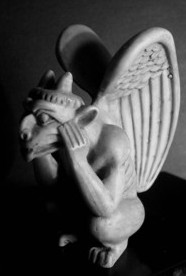
I'm quite taken with the Google Doodles this week, as though I was no fan of Sesame Street as a child, in my admiration for the late and truly great Jim Henson I am second to no man. Or gargoyle.

I'm particularly fond of today's, which is very clever and which has the Count on it.

For all that, though, I'm a bit surprised at Google having chosen to commemorate so determinedly the fortieth anniversary of Sesame Street (and indeed the twentieth of Wallace and Gromit, seemingly), in the same week that everyone else is commemorating the twentieth anniversary of the fall of the Berlin Wall.

I'm not complaining, but I am a bit puzzled. Why would you pick a children's programme over the end of the Cold War, indeed over what may have been the most important day in European if not world history since the end of the Second World War?

It's not as though it's because Sesame Street has lots of bright colours. The Berlin Wall had those too. And better music. Of course, you can kind of blur the two.

08 November 2009

Take up our quarrel with the foe...

I watched this morning's ceremony at the Cenotaph on the telly, and, as usual, found myself slightly perturbed about the whole thing. Don't get me wrong, I think it's important to honour those who've died in their country's service, and I get really bothered by how countries treat their veterans, especially when so many veterans are prone to mental health problems, something that tends to manifest itself in things like the huge proportion of London's homeless who are former servicemen.

(Although this has improved hugely; just a decade or so ago it was 22 per cent, and it's now about 6 per cent.)

But for all that, I can't help but feel a profound ambiguity about the whole thing whilst watching the coverage. There was the fifteen-year-old boy, an Army Cadet from somewhere in the North West -- Salford, I think, though I might be wrong -- saying how he felt it was his duty to go and serve and that he had always wanted to serve his country this way. I stared at the telly at the point and began to rant in exasperation: 'Always? He's fifteen! He's only a little boy, for Heaven's sake!'

There was the reference too a monument being erected in Cyprus to commemorate the 371 British service who were killed there in the 1950s when fighting to prevent Cypriot Independence; granted, they died serving their country, but it was hardly the most just of causes, was it? And I gather there are those in Cyprus who aren't too happy about it.

Again, I'm not saying these soldiers shouldn't be commemorated, and I fully appreciate that Remembrance Sunday is about commemorating the dead, not the wars, but it does have the effect of flattening out all of Britain's conflicts, making all wars seem equally worthwhile by painting all deaths as equally tragic. If everyone who dies for their country is a hero, then who are we to say that the causes for which they died were not just as heroic?

The ubiquitous poppy is at the heart of this, and it's been a propagandist symbol since McCrae penned 'In Flanders Fields'. The poppy had been a symbol of death in British poetry long before the Great War, but it came into its own on the Western Front. McCrae's poem is deceptively peaceful and forlorn, opening with the lines we've heard a thousand times:
In Flanders fields the poppies blow
Between the crosses, row on row,
That mark our place; and in the sky
The larks, still bravely singing, fly
Scarce heard amid the guns below.

We are the dead. Short days ago
We lived, felt dawn, saw sunset glow,
Loved, and were loved, and now we lie
In Flanders fields.
It's a pastoral elegy, isn't it? It contrasts sunset and dawn, hints at a gentle breeze amongs the flowers, alludes to Our Lord's sacrifice, evokes the beautiful song of the larks rising above the gunfire... and then it all changes:
Take up our quarrel with the foe:
To you from failing hands we throw
The torch; be yours to hold it high.
If ye break faith with us who die
We shall not sleep, though poppies grow
In Flanders fields.
It's a propaganda poem. It's a blatant recruiting piece, and an outright condemnation of anyone who might be inclined to stop the carnage by working for a negotiated peace, since doing so, in McCrae's mind, would be a betrayal of those who had already died.

I'm not saying that commemorating our war dead on Remembrance Sunday is a bad thing. I'm just saying it's not a straightforward one.

07 November 2009

Riding Through the Glen

I've always been a sucker for the whole Robin Hood malarkey. I'd say 'mythos', but that's obviously the wrong word, though a passable holiday beer. But yeah, when I was small one of my prize possessions was a hefty Robin Hood comic, bought at a fete in Celbridge if I remember rightly, and I followed it up by reading Robin Hood books by Enid Blyton, of all people, and by the wonderful Roger Lancelyn Green.

Robin of Sherwood was on the telly, of course, with the peerless Judi Trott playing Marion, being almost as foxy as the heroine of the Disney version of the tale.

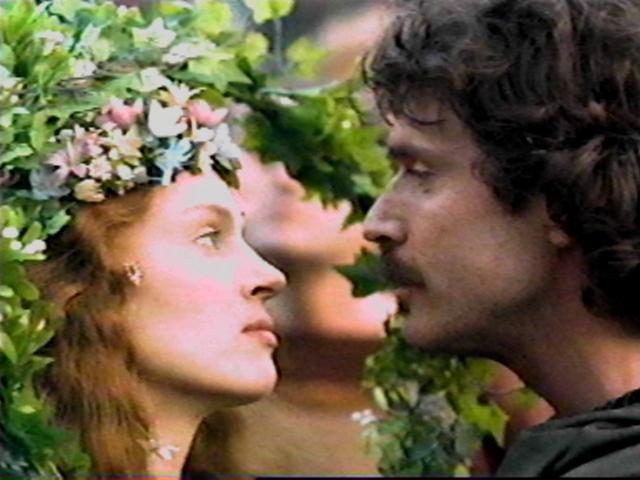
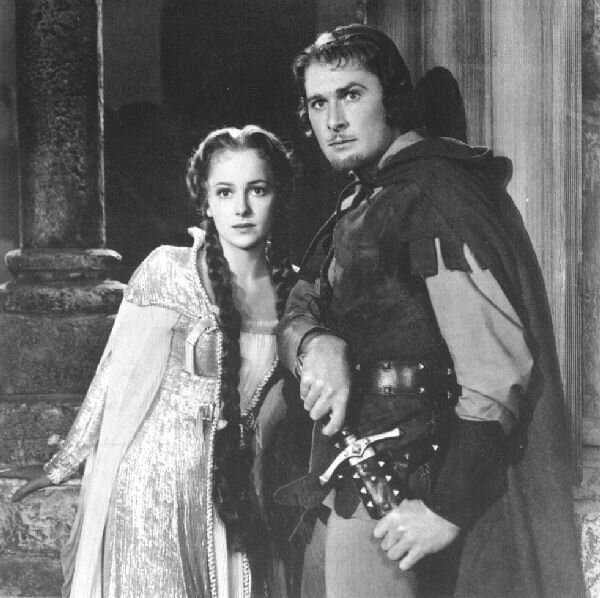
I'm afraid my weakness for the legends didn't die with my childhood; over the years, for very different reasons and in very different ways, I've been deeply fond of the gritty Patrick Bergin take on the story, the swashbuckling Errol Flynn version of the tale, and the beautiful, tender, and heartbreaking Sean Connery and Audrey Hepburn version.

I'm afraid, however, that I've not been won over by the current BBC attempt at the legend, and not just because of how one of the cast was once mean to someone very dear to me when she was four. No, I just think it's naff.

Not as naff, mind, as the Kevin Costner absurdity that was Robin Hood: Prince of Thieves. Oh dear me, no. Not as naff as that.

All of which is a clunky way of saying that earlier today, chatter here in El Casa led me to discover the Guardian's hilarious Reel History series, which comically shreds various pseudo-historical films. The piece on Prince of Thieves has some gems:
'Before you know it, Robin of Loxley has escaped a Turkish (or possibly Saracen) jail, along with improbable Moorish sidekick Azeem. They arrive back at Dover, where Robin cheerfully proclaims that it will only take them until nightfall to walk to his father's castle. Even if you had a car, from Dover to Loxley would take you five hours. Robin and Azeem only have feet. Worse still, Robin takes the scenic route, via Hadrian's Wall – a diversion of another 300 miles...

Having bonded over anachronistic swearing, Robin and his band build a sort of Ewok village in a bosky glade, complete with rope ladders, engineered lifts, mood lighting, canopy-level walkways, and a mosque for Azeem. If medieval peasants, with nothing but the natural resources of the forest around them, could build this sort of thing, why did they mostly live in filthy huts made of sticks and manure?

... The Sheriff's scribe frets about the cost of Robin's larceny: "We reckon he's nicked three to four million in the last five months, sire." Bearing in mind that the exchequer receipts for all of England in 1194 came to £25,000, this is impressive thievery. Even if the scribe is counting in pre-decimalisation pennies, Robin has managed to steal more than the entire crown revenue for five months, notionally equivalent to around £250bn today. Admittedly, with that sort of cash, Robin probably could have had as many canopy-level walkways as he wanted. Still, you'd think people would stop driving money carts through Sherwood Forest after the first billion or so.'
And so forth. To be fair, the cliffs at the start aren't those of Dover in Kent, but are the Seven Sisters in Sussex, but the point stands, I think: you'd have to be a hell of a walker to make it from Sussex to Hadrian's Wall and back to south Yorkshire in under a day. Read it and snigger.

06 November 2009

Suddenly, Hall Food Starts to Look Good...

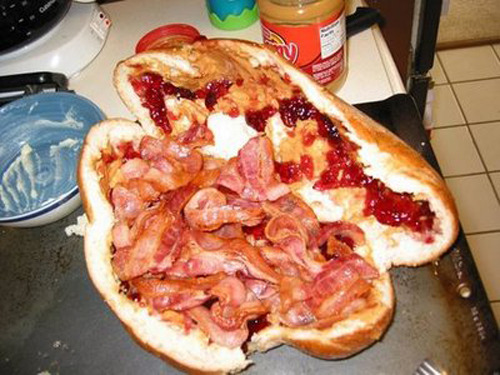
On a less serious and more disturbing note, some weeks ago I was introduced to the truly traumatic site that is thisiswhyyourefat.com. It's a terrifying site, one where your arteries clog just from looking at it. I'm still having issues dealing with the Fool's Gold Loaf, a monstrosity consisting of a hollowed-out loaf of bread filled with creamy peanut butter, a jar of grape jelly, and a pound of bacon. It looks like a wound.

I really thought I'd never see anything quite so troubling again.

And then, the other day, I was pointed towards this: a whole chicken in a can. Seemingly it just needs fifteen minutes in the oven.

And then, just when I thought it was safe to go back to the kitchen, I learned about The Testicle Cookbook, something I'm sure there's not one of us who hasn't longed for. It all seems very hearty, with testicle omelettes, barbecued testicles, testicle goulash, and deep-friend battered testicles for the Scots among us.

And there's testicle pizza too, of course.

05 November 2009

And People Take This Man Seriously?

Right, so I was talking about David Cameron's U-turn. You know, the way he lied to the British people when he promised them an opportunity to vote on the Lisbon Treaty? Ahem, yes, I know, sorry, it was only ever posturing. Still, though, what's his current strategy to keep the Europhobes onside?

It seems the big plan is to bring in a UK Sovereignty bill, 'to make it clear that ultimate authority stays in this country, in our Parliament.' Frankly, this seems a spectacularly pointless piece of posturing.

This seems utterly unnecessary. As the UK government pamphlet in 1975 said, Westminster retains the right to repeal any laws it has enacted, including all European treaties, and thirty-seven years of European integration haven't changed this one bit. The Lisbon reforms won't do so either: as the German constitutional court at Karlsruhe ruled on 30 June of this year that the European institutions have no powers in their own right, merely administering delegated competences in prescribed areas, with all sovereignty remaining in the hands of the individual member states which remain 'masters of the treaties'.

Secondly, Cameron's other big idea is to introduce a 'referendum lock' into British politics: the idea is that henceforth no powers shall be transferred to the Union without the British people specifically approving such a transfer by referendum. To quote the man:
'We will give the British people a referendum lock to which only they should hold the key, a commitment very similar to that which exists in Ireland... This is a major constitutional development, but I believe it’s now the only way to reassure the British people that powers cannot be given away without their explicit approval in a referendum.'
Leaving aside the extraordinary fascination with referendums, as though representative democracy is invalid, the obvious problem with this promise, as anyone with even a passing familiarity with the British constitution should know, is that it's a basic principle of the British constitution that no Parliament can bind its successors; if one Parliament enacts a law to say it lacks a certain power, a later Parliament can always repeal that law.

This may simply be a case of the Conservatives pretending to shut the stable door after the horse has ambled out. Not because Lisbon is self-amending, as so many of its opponents have falsely claimed, but simply because there's no appetite in Europe for another big reform treaty.

It seems increasingly clear that Cameron is all talk. He's gone back on his word, and now he's proposing pointless cosmetic laws as a sop to those he's lied to. Most of them will swallow it, too, the gullible eejits.

04 November 2009

Cast-Off Guarantee

Well, David Cameron's U-turn today was utterly predictable and completely inevitable, which leaves me wondering what he was playing at back on 26 September 2007 when he guaranteed the British people, via the Sun that now so openly supports him, that if he were to become Prime Minister he would hold a referendum on the Lisbon Treaty.

His words:
'But there's nothing "new" about breaking your promises to the British public. It's classic Labour.

And it is the cancer that is eating away at trust in politics. Small wonder that so many people don't believe a word politicians ever say if they break their promises so casually.

If you really want to signal you're a break from the past, Prime Minister, do the right thing -- give the people the referendum you promised.

Today, I will give this cast-iron guarantee: If I become PM a Conservative government will hold a referendum on any EU treaty that emerges from these negotiations.

No treaty should be ratified without consulting the British people in a referendum.'
And this was accompanied by his florid signature! This is the kind of gobbet Classics students cut their teeth on as a matter of course, so I'll refrain from shredding it now save to make three quick points.
  • Firstly, Brown had never given a guarantee that there would be a referendum on the Lisbon Treaty, signed on 13 December 2007 following negotiations which began in June 2007, based on the discarded text of the abandoned Constitutional Treaty.
  • Secondly, it's madness to say that no treaty should be ratified with the people having first been directly consulted, given that -- if my hasty counts are right -- 42 treaty command papers have been presented to Parliament already this year, 28 were presented last year, and 65 the year before. Does he envisage weekly referendums?
  • Finally, it's delightfully ironic that Cameron should have accused Labour of breaking a promise it hadn't made, before going on to make an explicit and unabiguous promise that he would himself go on to break.
Of course, nobody will care, because circumstances have changed since 2007, and it's very easy to claim that there's not really any sensible way Cameron could keep his word now, given that the Lisbon reforms are now part of EU law.

The thing is, it seems obvious that Cameron had made that promise in complete confidence that it meant nothing; it was surely designed to get the common-or-garden English Europhobe onside, for a couple of years at any rate, and was never intended to be kept. He obviously hoped that the Irish, or the Poles, or the Czechs, or somebody else would do his dirty work for him and derail the Union's attempt to streamline its workings while making them more transparent*; if they failed, and passed the treaty, well, it wouldn't be hard to simply say that now that the Treaty had come into force, it'd be impossible to put it to the people.

This isn't quite true, as it happens. It's not quite impossible. There is a precedent, of sorts. In 1975, despite having signed the Treaty of Rome, which explicitly set the signatory nations onto a path of 'ever closer union', the UK held a referendum on whether or not they should withdraw from that treaty. The question that was asked was, quite simply, 'Do you think the UK should stay in the European Community (Common Market)?

The pamphlet that the government issued at the time featured the following point:
'Fact No. 3. The British Parliament in Westminster retains the final right to repeal the Act which took us into the Market on January 1, 1973. Thus our continued membership will depend on the continuing assent of Parliament.'
There's no reason why this couldn't be done again. Cameron could offer the British a fresh referendum, asking essentially the same question as in 1975: 'Do you think the UK should stay in the European Union?'

If people voted no, well, then Parliament, which remains sovereign in these matters -- as the German and Czech constitutional courts have reiterated over the last year -- could repeal the Accession Act and the various acts that have implemented subsequent European treaties. And then the UK could leave the common market. Lisbon even gives them a mechanism for doing so.

__________________________________________________________
* Lisbon really does make the Union more transparent, by the way, despite nonsensical claims from the likes of the Sun about how future EU decisions will all be made behind closed doors. It requires Commission directives to be scrutinised by national parliaments before going to the Council, and requires the Council to vote publicly. The fact that the Council -- the Union's main decision-making body -- has hitherto voted in secrecy is very useful for governments which want somewhere else to apportion blame, as unpopular decisions can be blamed on 'Europe' and 'faceless Brussels bureaucrats'. Given this, it's hardly surprising that a prospective governing party, especially in a country with a rabidly xenophobic media, should be opposed to such transparency.

03 November 2009

When in Rome... again

Ruth Gledhill's post yesterday, though written with tongue firmly in cheek, is nonetheless most amusing. It's nice to see Oxford Circus so prominently emblazoned with a Celtic Cross.

Of course, it's just a pedestrian crossing, but there's a cross there too, for those who choose the see it. That's the way of these things, as in the story from Chesterton's The Ball and the Cross that Pope John Paul I drew on in Illustrissimi, relating how the monk Michael addressed Professor Lucifer, who had shrieked on seeing the cross above St Paul's. Michael told Lucifer he had once known a man like him:
'As I was observing,' continued Michael, 'this man also took the view that the symbol of Christianity was a symbol of savagery and all unreason. His history is rather amusing. It is also a perfect allegory of what happens to rationalists like yourself. He began, of course, by refusing to allow a crucifix in his house, or round his wife's neck, or even in a picture. He said, as you say, that it was an arbitrary and fantastic shape, that it was a monstrosity, loved because it was paradoxical. Then he began to grow fiercer and more eccentric; he would batter the crosses by the roadside; for he lived in a Roman Catholic country. Finally in a height of frenzy he climbed the steeple of the Parish Church and tore down the cross, waving it in the air, and uttering wild soliloquies up there under the stars. Then one still summer evening as he was wending his way homewards, along a lane, the devil of his madness came upon him with a violence and transfiguration which changes the world. He was standing smoking, for a moment, in the front of an interminable line of palings, when his eyes were opened. Not a light shifted, not a leaf stirred, but he saw as if by a sudden change in the eyesight that this paling was an army of innumerable crosses linked together over hill and dale. And he whirled up his heavy stick and went at it as if at an army. Mile after mile along his homeward path he broke it down and tore it up. For he hated the cross and every paling is a wall of crosses. When he returned to his house he was a literal madman. He sat upon a chair and then started up from it for the cross-bars of the carpentry repeated the intolerable image. He flung himself upon a bed only to remember that this, too, like all workmanlike things, was constructed on the accursed plan. He broke his furniture because it was made of crosses. He burnt his house because it was made of crosses. He was found in the river.'

Lucifer was looking at him with a bitten lip.

'Is that story really true?' he asked.

'Oh, no,' said Michael, airily. 'It is a parable. It is a parable of you and all your rationalists. You begin by breaking up the Cross; but you end by breaking up the habitable world.'

Human Rites?
I couldn't help but think of this earlier, when I heard of today's decision from the European Court of Human Rights. The decision is deeply bizarre, and it's hardly surprising that people in Italy are reportedly up in arms about it.

It seems that Mrs Soile Lautsi, a Finnish lady who is also an Italian citizen, has been embroiled for eight years in a quarrel with the Italian authorities over the fact that her children had to attend school in a school where every classroom had a crucifix on its walls. Wanting her children to be educated in line with her beliefs, which would have required the crucifixes' removal, she approached the school and subsequently challenged the school's refusal in the Italian courts. Getting nowhere there, she eventually took the case to Strasbourg, where the seven judges who dealt with the case today ruled unanimously in her favour.

Drawing on article 9 of the European Convention of Human Rights, and on article 2 of the Convention's first protocol, the Court found that 'The compulsory display of a symbol of a given confession in premises used by the public authorities... restricted the right of parents to educate their children in conformity with their convictions,' and likewise restricted the 'right of children to believe or not to believe'.

Mrs Lautsi was awarded €5000 as compensation for 'moral prejudice', but the Court refrained from directing the school to remove the crucifixes, and from advising the Italian State that the 1920s law, requiring the display of the crucifix, is incompatible with the Convention.

I have no idea whether she was awarded costs. It seems as though she wasn't.


The ECHR is NOT an instrument of the EU
There's a lot to chew on here, but it's worth starting by pointing out that the European Court of Human Rights, which implements and interprets the European Convention on Human Rights, is an instrument of the Council of Europe, and not the EU. It was established in 1950, so predates the EU by some time, and its remit governs 47 countries, whereas remit of the European Court of Justice, the EU's supreme court, extends only to the Union's 27 members. The UK's Human Rights Act, is based on the Convention, which makes it rather ironic that so many of the UK's 'Conservatives' want to repeal it, given the Convention's Conservative roots.

That the Convention has conservative roots seems far from insignificant in the current situation. I have difficulty believing that its signatories back in the day would have been keen to sign up to it -- or to decide that doing so should be a prerequisite for admission to the EU -- had they believed that their own laws, as they then stood, should be deemed in breach of the Convention.


The Basis for the Decision
It's worth taking a look at the Convention itself, to see the bits the Court has based its decision on. Article 9 has two parts and is as follows:
  1. Everyone has the right to freedom of thought, conscience and religion; this right includes freedom to change his religion or belief, and freedom, either alone or in community with others and in public or private, to manifest his religion or belief, in worship, teaching, practice and observance.
  2. Freedom to manifest one's religion or beliefs shall be subject only to such limitations as are prescribed by law and are necessary in a democratic society in the interests of public safety, for the protection of public order, health or morals, or the protection of the rights and freedoms of others.
Article 2 of the Convention's first protocol throws important light on Article 9:
No person shall be denied the right to education. In the exercise of any functions which it assumes in relation to education and to teaching, the State shall respect the right of parents to ensure such education and teaching in conformity with their own religions and philosophical convictions.
I think it's easy enough to see how the Court reached its decision. The Court clearly recognised that, given how the Italian state exercises certain functions regarding education and teaching, in that it has a national school system, the State should have respected the right of Mrs Lautsi to ensure that her children could be educated in line with her religious and philosophical convictions.


Well, yes.... but...
It seems to me that the first and most obvious problem with this is that Mrs Lautsi's children were hardly being taught in isolation. They were taught in classes, along with, say, twenty or more other children. Might it not have been the case that the parents of the other twenty or so children wanted their children educated in line with their convictions? Ought their convictions to have been dismissed in favour of Mrs Lautsi's?

It's probably worth bearing in mind that homeschooling is legal in Italy. Granted, it's very rare, but it is an option. That's not to say that Mrs Lautsi should have taken her children out of school, but she could have done so if she really wanted to. I know, that sounds drastic, but it happens in other countries when people aren't happy with the ethos in the local schooling system.

I also can't help but thinking St Ambrose of Milan's very old injunction that one should do as the Romans when one is in Rome. Mrs Lautsi is Finnish by birth and clearly at least partly by ancestry; she is hardly obliged to remain in Italy, and it seems a tad unreasonable that she should expect the Italian state to accommodate itself to her, rather than accommodating herself to it.


I'll have more on this issue, but not today.

02 November 2009

Randall Munroe is a Genius


In the mountain range of comic brilliance, XKCD regularly leaps from pinnacle to pinnacle, but I think today's a particularly dazzling summit. The Lord of the Rings diagram is particularly clever, with up and down loosely corresponding to northwest and southeast, and there are a couple of nice touches with the Star Wars one, with the dotted line to represent the Special Edition, and with Luke's time with Yoda rightly summed up as 'Luke's Entire Jedi Training'. I mentioned this to my housemates the other day, saying Yoda's presumably spent the last twenty years in his swamp figuring out how to concentrate a couple of decades of Jedi training into just a couple of days.*

Anyway, I think Edward Tufte would approve of this, and wonder how Randall would cope trying to map out Bleak House or The Count of Monte Cristo.
_____________________________________________________
* Or a month. Or a few weeks. Or half an hour. It's basically impossible to tell how long Luke spent with Yoda, and attempts to correlate it in a terrifyingly nerdy way with how long it'd have taken Han and Leia to reach Bespin from Hoth without the Millennium Falcon's hyperdrive are surely not the way to go. Star Wars is a fairy tale, after all.

01 November 2009

Adventures in Advertising

There's a terrifying ad on the telly at the minute, that says something like 'Wake up to Laser Eye Surgery from just £395.'

Wake up to laser eye surgery?