31 December 2007

Here below, to live is to change...

And so 2007 ends. It's been a quiet year in a lot of ways, certainly less tumultuous than 2006, thank God. I'm off to wrap it up at a friends' house in a few minutes. We're having a murder mystery dinner. I have narrowly escaped having to go in drag. There are some ways one really shouldn't start a new year, after all.


I was struck the other day by a passage in Father Martin Tierney's article in this week's Irish Catholic -- I'm rarely caught by Fr Tierney's column, but this one was a little different.
We come to the end of another year.
John Moriarty, the philosopher, was asked in a radio interview: 'are you happy?'
'That's not the question,' answered John.
'So what is the question?' asked the interviewer.
'The question is -- "have I grown?"'
If we have grown in holiness, wisdom, charity, and patience, this has been a good year.
Have I grown? It's a good question, and I really don't know the answer, though I think I have. I hope so, at any rate.

Certainly I've done so in how I've handled the ongoing mess in my life I tend to refer to as 'the War', and in terms of the decisions I've made regarding leaving academia and taking a new path. As for which path I'll follow, there are a couple of options that are foremost in my mind, and one of my main tasks in the next year will involve discerning which one's for me. I have hopes, but we don't always get what we want.

So what has the old year held? Well, I haven't got the work done I'd hoped to do, but then the war has rather been my priority -- justice needs to be done, I'm afraid, and to be seen to be done, and people need to be protected, so I've had to leave my own interests aside to focus on that. Yes, I know that my studies, my career, and my life have all been hurt in ways by this, but really, what option have I had? Could I have let things go, and still be who I am? And even if I could, should I?

Other than that, how does the year stack up?


Sister the Elder got married, and a new Brother-in-Law and a new niece joined the clan. Sister the Elder's wedding saw the Gargoyle clan in one exact spot for the first time in nearly ten years; once the photos were taken we dispersed, though not very far. Brother the Elder returned from America, and though I'd rather he hadn't had to come home, it's good to have him around.

Several of my friends enriched the world by bringing new people into it, though so far I've encountered only one of the offspring, who I'll be seeing again this evening; with luck I'll see the others soon enough. Two of my closest friends got together, following my nudging one of them into action. With nearly a year down, things are still going well, which pleases me more than I can say.

I had a lovely trip to Greece, where I tramped around battlefield after battlefield, renewed old friendships, spoke to one of my dearest friends while on the site of the 300's last stand, revisited a hill where my eyes filled with tears for the only time all year, and consumed far too much alcohol and not nearly enough octopus. And on the way back I had a decidedly strange night in Zurich.

I spent a few wonderful summer days in London, on the way there hearing a marvellous quote from Mother Teresa that has stayed in my head since, challenging me as much as it consoles. London was magical, with me seeing my niece for my first time, staying with one of the most attractive girls I know and lunching with another, catching up with a very old friend, falling in love with Westminster Cathedral, and saying goodbye for now to three people -- all of whom mean the world to me in very different ways, and none of whom I've seen since.

(I haven't had my hair cut since that week. This is a coincidence, I assure you, and since my barber offered me a charity haircut when I bumped into him on Christmas Eve, I shall probably be rectifying this soon enough. Five months of growth, would, I feel, be extravagant.)

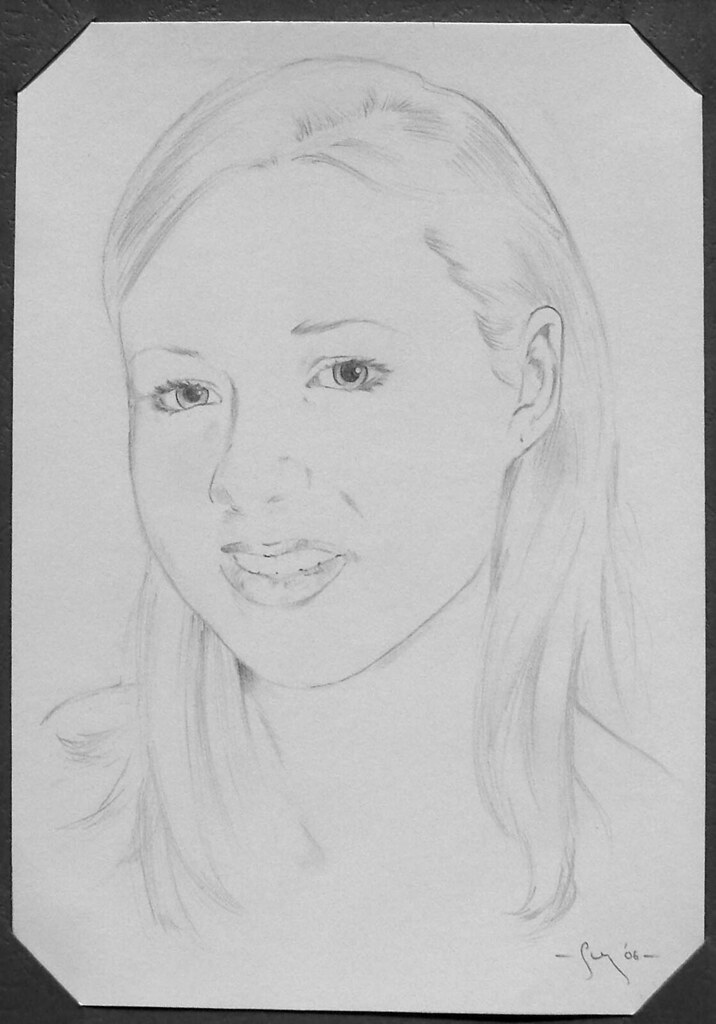
I fixed a portrait that I'd been unhappy with last year and gave it to its subject, and managed my first ever mass-produced Christmas card, and smiled to see how my cartoons had been acknowledged in my old school's fiftieth anniversary yearbook. I made my radio debut, which was fun, and is still online if you know where to look, and I marvelled at the discovery that people are still buying my book.

I let my old blog die with a whimper, and started this one with rather more sense of what I was doing than I ever had with my old one. If nothing else, I think I deserve some plaudits for the colour scheme. I've started a couple of other blogs too, but I'm keeping them under wraps unless things turn really nasty in the war. It does no harm to have a few nuclear options.

Speaking of which, I visited the Oireachtas, and addressed a very old acquaintance as Deputy, and just a week or so ago I addressed an old friend and travelling buddy as Counsellor. Times have changed; all these things were new to me. Also for the first time, I made the front page of a newspaper; considering my story was on the front page the reporter did a remarkably discreet job in relating my vindication.

And for all my thoughts of old friends, I made some fine new ones too, especially one cloak-and-dagger evening where truths were told. Along the way I've helped celebrate a few birthdays in style, and bestowed a couple of Claddagh rings to mark two angels' comings of age, telling them what they mean. If I've returned even the tiniest amount of the kindness, the patience, the generosity, the love, and the loyalty that's been shown to me over the last couple of years then I'll have done some good.

Not enough, I know. But some.


I've spent much of the last year making feeble progress with Bleak House, but have along the way -- aside from academic books and sundry bits of the Bible -- read The Names by Don DeLillo, Neil Gaiman's Fragile Things, Harry Potter and the Deathly Hallows, Jesus of Nazareth by Pope Benedict XVI, Rome Sweet Home, Letter and Spirit, and Reasons to Believe, all by Scott Hahn, Persian Fire by Tom Holland, John Nagl's Learning to Eat Soup with a Knife, By What Authority? and Making Senses of Scripture by Mark Shea, The 33 Strategies of War by Robert Greene, Garry Kasparov's How Life Imitates Chess, Heroic Leadership by Chris Lowney, Ethan M. Rasiel's The McKinsey Way, William Poundstone's How Would You Move Mount Fuji?, Bryan Talbot's Alice in Sunderland, The Complete Bone by Jeff Smith, Alan Moore and Kevin O'Neill's League of Extraordinary Gentlemen: Black Dossier, Larry Gonick's The Cartoon History of the Modern World, Volume 1, and John Wagner, Alan Grant, and Carlos Ezquerra's Strontium Dog Casefiles, Volume 1. I've also reread Donna Tartt's The Secret History, and The Man Who was Thursday, The Napoleon of Notting Hill, Orthodoxy, and The Everlasting Man, all by G.K. Chesterton.

I graced the cinema with my presence eighteen times, making this my most cinematic year in quite a while, taking in The Treasure of the Sierra Madre, London to Brighton, The Maltese Falcon, Into Great Silence, Black Book, Perfume, The Man Who Would Be King, Blood Diamond, 300, Amazing Grace, Spider-Man 3, Magicians, The Lives of Others, Pirates of the Caribbean: At World’s End, Harry Potter and the Order of the Phoenix, Stardust, Beowulf, and I Am Legend. It's an obvious call, but just as Pan's Labyrinth was my favourite film of 2006, so The Lives of Others was the film that impressed me most in the last year.

I'm afraid that a peculiar combination of necessity and opportunity saw me going to a concert alone for my first time, to see Ani DiFranco in what used to be The Red Box. It was the sixth time for me to see her play, and I was delighted to see that she hadn't lost her touch.

I also wound up seeing Henry V on my own too, enraptured for the best part of three hours in Manchester's Exchange Theatre. Don Pasquale in the RDS was rather more of a group outing, as were Julius Caesar in the Abbey and both trips to the breathtaking gate production of Sweeney Todd. Rosencrantz and Guildenstern are Dead was a delight in Manchester's Library, as was The Tempest in the Royal Exchange. I'm afraid that The Vortex was just as uninspiring as my Fairy Blogmother had warned me it would be, while Things of Dry Hours proved rather surprising, not least in how it developed in the second half.

Oh, and then there was Alton Towers.


Any regrets? Quite a few actually, but barring my failures to finish my thesis or to master straight-razor shaving, not getting to see The Police or Ireland play in Croke Park, seeing only one decidedly uninspiring football match all year, and not managing to meet up with Josh and Clare anywhere, I think they'll be staying strictly offline, except to say that insofar as I can do anything about them next year, I plan to do so.

30 December 2007

Christmas Sprouts

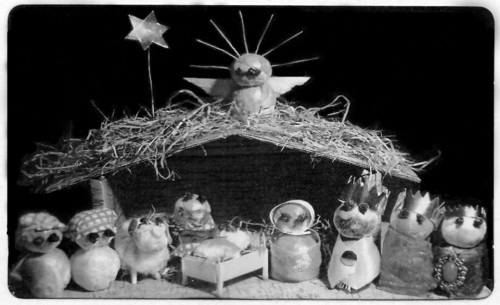
Having been babbling so much about cribs lately, this seems an ideal moment to show you what I regard as the finest Christmas card I have ever received.

Yes, it's the legendary Sprouty Nativity, as composed a few years ago by my Fairy Blogmother (rtd.) with her then beau, and which held pride of place atop my bookshelf until I was driven from Manchester just over a year ago.

It's a gem, isn't it? I can't help but think how appropriate it is that my favourite Christmas card ever should have been given me by my most festively named friend, who this year delighted me with a gift wrapped so magnificently that I was loathe to open it. Never mind brown paper parcels wrapped up with string, in 2007 the cool kids are going for shiny black parcels wrapped in silver ribbons. It's all about black and silver.

But, like Peter David, I digress, so back to the card.

The Blogmother is the first to admit that Joseph does look a little like Kermit the Frog, and that one of the Magi doesn't really look all that interested, and it does appear to be the case that the shepherds are naked from the neck down in a decidedly unscriptural fashion, but for all that it's rather a classic tableau, isn't it? You've pretty much got all the classic elements of the story there, after all. Granted, the Archbishop of Canterbury might point out that having the Magi there alongside the shepherds smacks of conflation, but that's really only true if you assume that an image must represent just one instant in time, in which case you really must read Scott McCloud's brilliant Understanding Comics.

I know, I know, you might think that sprouts aren't quite the most appropriate substance from which the cast of a crib ought to be fashioned, but they're surely the vegetable most synonymous with Christmas, and is there anything that makes sprouts intrinsically less suitable to this than, say, stone, or wood, or papier mache?

Other than their tendency to decompose, I suppose, and the fact that some people really don't like them...

In terms of its content, the only really remarkable feature of this nativity scene -- other than the sprout figurines -- is the notable absence of the Ox and the Ass, so prominent in St Francis' celebration at Greccio in 1223 and in pretty much every crib you're likely see. Neither beast is mentioned in either of the Biblical Nativity narratives, and it seems their near ubiquity in nativity scenes derives from an allegorical reading of Isaiah 1.2 in the light of the Septuagint rendering of Habakkuk 3.2.

Or in other words, the first Christians believed, as memorably expressed by St Augustine of Hippo, that in 'In the Old Testament, the New is concealed; in the New, the old is revealed.' The Old Testament scriptures used by almost all the early Christians from the very beginning -- or at any rate from the point when they began to be referred to as Christians -- was the Septuagint, the Greek translation of the Hebrew scriptures. The Septuagint's inaccurate rendering of Habakkuk 3.2 -- 'In the midst of the years make it known' -- as 'In the midst of two animals make it known,' seems to have been read as a reference to Isaiah 1.3, which states:
'The ox knows its owner,
And the ass its master's crib'
Working on the assumption that everything in the Old Testament somehow related to Jesus, it's hardly surprising then that early Christians took both these passages as references to the birth of Christ. Besides, it's not really improbable that they'd have been present in the stable, considering that the manger must have had some purpose. Still, their presence in nativity scenes certainly shouldn't be regarded as obligatory, explaining Dr Williams' willingness to live without them.

While I think of it, and while on the subject of cards, I was perusing some of the parents' ones the other day. They're hanging from the wall in the living room, slotted into a banner that -- until it was properly unfolded the other day -- had rather cryptically wished us 'Merry Chris'.

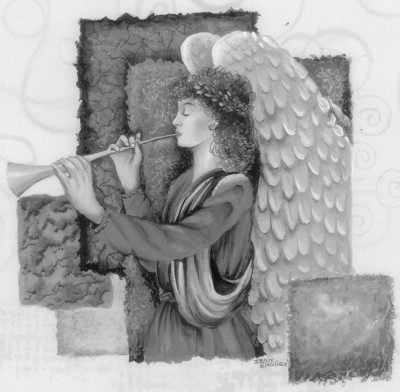
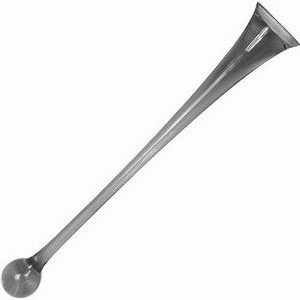
My favourite card in this particular banner is this one, showing an angel drinking a yard of ale. At least, I think that's what's happening. Something like that, anyway.

(No doubt someone will pipe up about he's holding a horn or blowing his own trumpet or some such. Balderdash, I say!)

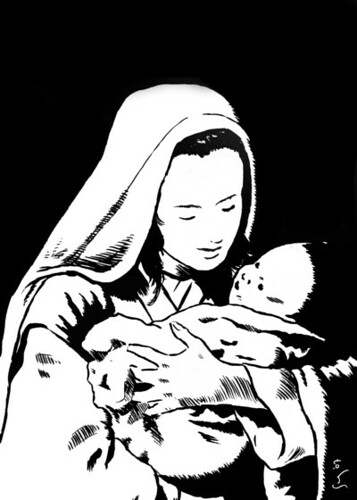
Another one of the cards shows a Madonna and Child, in a classic pose such as that nabbed by me for most of my own cards this year, and bears the equally conventional legend, 'O Come, Let Us Adore Him'.

'Is that a suggestion to the shepherds or a request for permission from the mother?' I mused over dinner the other day.
'It's a Paxmanism,' replied Brother the Elder, retorting in those all too easily imatated tones, 'Oh come! Let us adore Him!'

Somehow, it's not quite the same, is it?

29 December 2007

Christmas Delirium

Brother the Elder was over in England the other week, this time visiting for reasons other than the crack, and found himself at Sister the Eldest's house, musing upon my Christmas card, which had, in breach of my personal festive tradition, arrived spectacularly early.

Clearly, my siblings agreed, this card had been drawn last year. Nothing else could explain its punctuality.

This was, I feel, a rather harsh judgment, especially in light of the fact that the card as delivered to Sister the Elder's hadn't quite been hand-drawn, after all. I really think this should have given them a clue. It had clearly been printed, thereby facilitating me in getting this year's cards out on time.

I know, you might think of this as cheating, but Hal Foster used to do it, and if printed cards showing personal illustrations were good enough for that grand old man of American comics, then they should surely be good enough for the likes of me.

In truth, my plan this year had been to draw all my cards by hand, but having taken three hours to pencil and ink just this simple line drawing, I reluctantly concluded that hand-drawn cards wouldn't be practical if I hoped to send more than a handful this year. So onto the flatbed it went, there to be scanned and then opened in Photoshop, where I could comfortably grayscale, clean, darken, and tighten in various ways before getting stuck in with the paintbucket, airbrush, burn, and lens flare tools. After that it was just a matter of printing and setting to work with my scalpel on the backing boards. The first card -- bound for Brazil -- saw me experimenting with calligraphy as well, but the ink bled too much for my liking, so while that slightly wonky prototype was the first card in the post, I decided to skip the French Ronde on the subsequent cards.

All told, I'm pretty happy with this year's work, which probably betrays to some degree my recent obsession with Brian Bolland, at least in how slow I've worked, if not how well. Certainly, brushwork like this takes an immense amount of time -- I reckon I'd have drawn at least nine of my usual cartoon snowmen cards in the time it took me to draw this year's one -- but I think it's worth the effort, and I'm rather inclined to go for a similar approach next year, printing them again in a daring attempt at being timely two years in succession.

The only disadvantage of sending printed cards rather than originals is that people are -- I imagine -- more likely to throw them out rather than keep them. I have friends who revive old snowmen cards each Christmas, feeling they work rather well as decorations, and now that I think of it, Sister the Eldest has a framed set of cards from me and Brother the Elder on one of her walls. Still, that's just an ego thing, and best ignored.

The main thing is that people get their cards in the first place, that I'm letting them know that they matter to me, and that they're in my thoughts at Christmas time.

It's funny that I've only just remembered Sister the Eldest's framed set of cards. A few weeks back I mentioned in a letter how I had spent a night at Sister the Elder's house back in the summer and was rather startled to realise that hanging on the wall was a drawing I had done years ago. It was, I thought then -- and claimed in my letter -- the only picture of mine that anyone has ever framed. Evidently not, though. There are a couple of others. For all I know there may be more; on this point I must claim agnosticism, or at any rate admit ignorance.

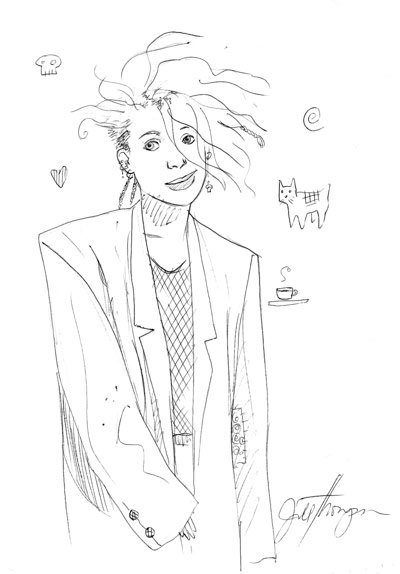
Anyway, the picture in Sister the Elder's house shows Delirium from Neil Gaiman's Sandman, here depicted not by me but by Jill Thompson. Jill made the character her own when she drew her in 'Brief Lives', a wonderful story that was only hampered by issues with the colour separators just opposite my local church; I've read a few times that they seem to have had an annoying tendency to ignore instructions. I'll be looking forward to seeing their screw-ups being rectified in the third Absolute Sandman volume.

Jill drew this for me at a convention in London years ago, back when I had hopes of becoming a comic artist myself, thinking that I might someday be good enough. I was amazed then at her astonishing speed, grace, and confidence with a humble ball-point, something which I'd forgotten until a few weeks ago when she wrote on her blog about her fondness for the biro. Her blog's well worth reading, actually, and I was gratified to see the other week that she too has embraced mechanisation in making her Christmas cards:
'I used to paint each one individually in an assembly line like process and would make about 25 to 30 of them. I think one year I made 50. And then I wised up and got myself to the copy center. The only downside is they used to be mounted on a nice colored background.'
You should take a look at some of her cards. Little watercoloured jewels that leave me feeling quite inadequate, they're really rather beautiful.

28 December 2007

In order to arouse devotion

Ah yes, so I was talking about the prevalence of cribs and relative dearth of carols in Dublin, and wondering whether this might reflect some of the differences between Catholic and Protestant Christianity.

My theory was that the Irish emphasis on the crib over the carol reflects how Catholic Christianity has a strong visual sense, largely due to it having developed well before the printing revolution of the fifteenth century, whereas the English penchant for the carol is a manifestation of the Protestant emphasis on words rather than pictures, a natural development of the mass production of Bibles that followed Herr Gutenberg's invention.

I don't think this theory should be overplayed, of course, partly because the Church of England has long seen itself as both Reformed and Catholic, but mainly because I've done hardly any work on this whatsoever. I rather wonder whether there's a popular history of the tradition of the crib. Surely there must be?


From Bethlehem...
Anyway, from what little reading I've done, it seems that at least from the Second Century the site in Bethlehem where the Basilica of the Nativity is situated was honoured among Christians. Origen, writing early in the Third Century, records that:
'With respect to the birth of Jesus in Bethlehem, if any one desires, after the prophecy of Micah and after the history recorded in the Gospels by the disciples of Jesus, to have additional evidence from other sources, let him know that, in conformity with the narrative in the Gospel regarding His birth, there is shown at Bethlehem the cave where He was born, and the manger in the cave where He was wrapped in swaddling-clothes. And this sight is greatly talked of in surrounding places, even among the enemies of the faith, it being said that in this cave was born that Jesus who is worshipped and reverenced by the Christians.' (Against Celsus, 1.51)
Even if we discount the Protoevengelium of James, as being difficult to reliably date, the tradition that the stable in which Luke places the birth of Our Lord was in fact a cave is first borne witness to by St Justin Martyr, writing in the middle of the second century. Justin observes that:
'But when the Child was born in Bethlehem, since Joseph could not find a lodging in that village, he took up his quarters in a certain cave near the village; and while they were there Mary brought forth the Christ and placed Him in a manger, and here the Magi who came from Arabia found Him.' (Dialogue with Trypho, 78)
This is not for a moment to say that the historicity of the traditional site of the Nativity can be established -- that's a very different question -- merely to say that the historicity of the tradition itself can be established as dating back, surely, to at least a few decades before the time that Justin wrote, so to no later than the early Second Century. It's worth remembering too that Justin was born around 100 AD in Flavia Neapolis, less than fifty miles north of Bethlehem; as such, he would have been in a position to have learned of such local traditions, and it should not surprise us if those traditions should have predated Justin's birth.

Indeed, it is worth bearing in mind that there is some evidence supporting such a theory. St Jerome, writing towards the end of the Fourth Century, at a time when he was living in Bethlehem, records that:
'From Hadrian's time until the reign of Constantine, for about 180 years, the Gentiles used to worship an image of Jupiter set up in the place of the Resurrection and on the rock of the Cross a marble statue of Venus. For the authors of the persecution supposed that by polluting the Holy Places with idols they would do away with our faith in the Resurrection and the Cross. Bethlehem, now ours, and the earth's most sacred spot of which the Psalmist sings 'the truth hath sprung from the earth', was overshadowed by a grove of Thammuz, which is Adonis, and in the cave where the infant Messiah once cried, the paramour of Venus was bewailed.' (Ep. ad Paul, 58.3)
Leaving aside the curiosity of how Jerome apparently regarded the site of the Nativity as more sacred than the sites of the Crucifixion and the Resurrection, which is surely worthy of contemplation for other reasons, what's striking about this is that if Jerome is right it seems that already by 135 -- following the Bar Kokhba Revolt, during which the area was devastated and its Jewish residents driven out -- the Bethlehem sanctuary was important enough for the Romans to believe it needed cultic neutralisation. It seems unlikely that the local Christians would have been allowed to worship in a pagan site, and it is telling that they did not simply shift their focus of worship to another site in the area; they clearly remained fast in their belief that this cave had been the site of the Nativity, and indeed seem to have at least occasionally shown it to visitors.

During the early Fourth Century what must have been a simple grotto shrine or cave sanctuary was converted into an chapel by the Empress Helena and further developed by her son Constantine, with Constantine's church being largely rebuilt by Justinian in the late sixth century.


To Rome...
During the pontificate of Sixtus III in the early Fifth Century there had been an oratory called the 'Cave of the Nativity' in the basilica of Sancta Maria Maggiore, erected it would seem as a response to the recognition of Mary as Theotokos -- 'God-bearer' -- at the Council of Ephesus in 431. The oratory would have been opulently decorated with gold and silver and all manner of precious ornaments.

At some point relics were taken from Bethlehem to Rome, with the most likely date of this being the middle of the Seventh Century, possibly by Sophronius, patriarch of Jerusalem when it came under attack from the rising Muslims. Support for this comes from the rededication of the basilica as Sancta Maria ad Praesepe by Pope Theodorea, a native of Jerusalem who served as Pope between 642 and 649. During the Eighth Century, Pope Hadrian I had an altar erected in the basilica which may have been for the purpose of displaying the relics. It is difficult to be certain of this, as the earliest clear historical reference to them dates to the Eleventh Century.


To Greccio...
Throughout the Middle Ages devotion to the Nativity grew throughout Christendom, with this devotion being expressed through depictions, elaborate liturgies, and mystery plays. Nativity plays developed in France in the Eleventh and Twelfth Centuries, with real mangers being erected by the altar with a statue of Mary being placed nearby. Popular devotion to the crib was transformed following a celebration in Greccio in Central Italy in 1223.

The earliest account of this celebration, written by Thomas of Celano just six years later, three years after the death of St Francis of Assisi, tells of how Francis spoke to his friend Giovanni Vellita -- a nobleman who had become inspired to follow Christ through the example of Francis -- and instructed him that he wished to do 'something that will recall to memory the little Child who was born in Bethlehem and set before our bodily eyes in some way the inconveniences of his infant needs, how he lay in a manager, how, with an ox and an ass standing by, he lay upon the hay where he had been placed.'

And so, fifteen days later:
'The manger was prepared, the hay had been brought, the ox and ass were led in. There simplicity was honored, poverty was exalted, humility was commended, and Greccio was made, as it were, a new Bethlehem. The night was lighted up like the day, and it delighted men and beasts. The people came and were filled with new joy over the new mystery. The woods rang with the voices of the crowd and the rocks made answer to their jubilation. The brothers sang, paying their debt of praise to the Lord, and the whole night resounded with their rejoicing. The saint of God stood before the manger, uttering sighs, overcome with love, and filled with a wonderful happiness. The solemnities of the Mass were celebrated over the manger and the priest experienced a new consolation.

The saint of God was clothed with the vestments of the deacon, for he was a deacon, and he sang the holy Gospel in a sonorous voice. And his voice was a strong voice, a sweet voice, a clear voice, a sonorous voice, inviting all to the highest rewards. Then he preached to the people standing about, and he spoke charming words concerning the nativity of the poor king and the little town of Bethlehem.'
The passage is interesting not least because it provides us with the only evidence that Francis was a deacon rather than a priest, which surprised me, but in the context of the development of popular devotion to the crib its real importance lies its emphasis on the poverty, the humanity, and sheer fragility of Our Lord.

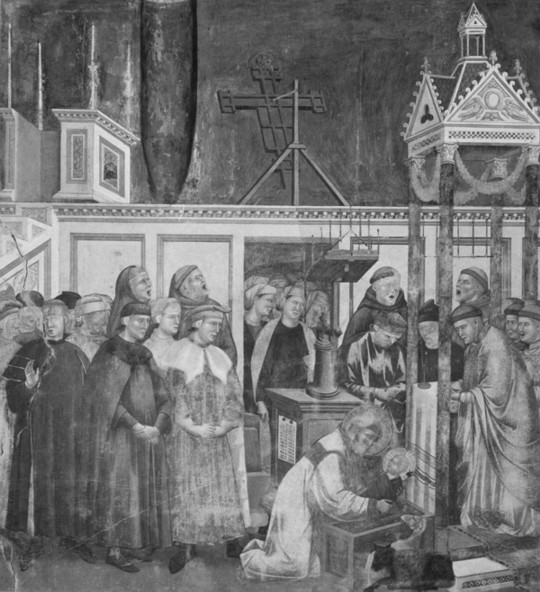
You can see it depicted here on a fresco in Assisi's Basilica of Saint Francis, traditionally attributed to Giotto and dated to the last decade of the Thirteenth Century, though it may well have been painted by another artist in the early years of the following century.

The ox and ass seem disproportionately tiny, but they're surely not meant to be models -- the historical accounts record that the animals were led into the cave. Presumably then a calf and a young donkey were used -- or were assumed to have been used -- as being more biddable than mature beasts. This depiction seems to be based not so much on Thomas's account as on the slightly later account of St Bonaventure, which says rather more than Thomas about the role of the child in this event, though his description perhaps raises more questions than it answers.

Bonaventure's shorter account of the episode, written a few decades later than that of Thomas, attempts to put the story into some sort of context, recording that Francis sought permission from the Pope for his service at Greccio. This makes sense: Francis had been in Rome in 1223, composing the final version of his Rule as approved by Pope Honorius III on 29 November, and the Pope would surely have granted his approval for the ceremony in light of his predecessor Innocent III's denunciation in 1207 of the irreverence that marked many mystery plays. Francis, he might have hoped, would do something to restore a real sense of solemnity and humility to popular devotion to the crib.

Certainly, the Greccio ceremony marked a new beginning in that it wasn't a play in any sense, lacking dialogue or acting of any sort, with the traditional figures -- Mary and Joseph, shepherds, magi, and random extras -- all apparently being absent. Indeed, Thomas's version even raises the possibility that there may not have been a child --or an effigy thereof -- in the manger!


And Around the World...
Whatever happened in Greccio seems to have had the desired effect, as cribs and crib ceremonies spread throughout Christendom, helped to no small degree by the missionary zeal of the Franciscans. Towards the end of the Thirteenth Century Pope Nicolo IV commissioned the Tuscan sculptor Arnolfo di Cambio to create a Nativity scene at the Cave of the Nativity in Rome's Basilica of Santa Maria Maggiore; these have been moved about the church a bit since, but are still on display, the oldest carved Nativity scene in the world. While mystery plays had a resurgence in popularity, carved cribs began to displace them in popular devotion, with the Medieval term praesepe being gradually abandoned in favour of such local terms as 'presepio', 'creche', 'nacimento', 'belem', 'krippe', 'and of course 'crib'.

By the Sixteenth Century, with the mystery plays fading away, the crib had become perhaps the centrepiece of popular piety at Christmas, largely driven by the Jesuits especially in central Europe. Home cribs -- which had been known of since the Fifteenth Century -- became increasingly popular from the start of the Seventeenth Century, appropriately promoted by the Capuchin Friars, and crib-making became an important folk art in Iberia, the Tyrol, and Southern Italy and Sicily.

You'll note that crib-making doesn't really seem to have caught on in the Protestant lands which takes us back to my initial suspicion that the early Protestants may have looked askance on such popular ways of retelling the Christmas story, without explicit reference to scripture.


Coming back to England!
It's curious, in light of this, that the traditional English mince pie -- flavoured with three spices in memory of the three gifts of the Magi and baked in the shape of a manger holding a child -- seems to have lost its oblong shape during the Seventeenth Century, thereby gaining the round shape by which we all know it today. We all know the story, after all, of how in 1657 Cromwell's government effectively banned Christmas and all its trappings, seeing it as a quasi-pagan festival not sanctioned -- let alone demanded -- by the Bible! Mince pies naturally were among the forbidden festive trappings, and by the time they emerged from the Puritan shadows they seem to have adopted their current shape, devoid of their old explicitly Christian form.

Cromwell represented an extremist faction, though, and the Church of England has long prided itself on being -- in its eyes -- both Reformed and Catholic, as I've said. As such, England's hardly devoid of cribs, and indeed, it seems that crib services are rather more important to the Church of England than they are to the Catholic Church in either England or Ireland.

I was chatting to a friend the other week, with her saying she was looking forward to being home for the Crib Service.
'The what?' I asked.
'The crib service.'
'What's that?'
'It's a crib service.'
'Oh,' I mused, thinking that I was sure I'd been as puzzled by an almost identical conversation last year.
And so, perplexed, never having experienced such a thing, I sought an explanation from some of my friends; the English Catholics were as clueless as me, but one self-described agnostic Anglican explained that they were traditional ceremonies held in churches on Christmas Eve, with the children dressing as shepherds, angels, animals, whatever, acting out the Nativity story as part of a service. He drily noted that they also gave plenty of parents an opportunity to get the children off the scene whilst busying themselves about whatever urgent tasks remained.

It sounds like rather a good idea on all counts, though it seems, having gandered online, that it's not an exclusively Anglican phenomenon, or at least not anymore. A Catholic Crib Service came pretty close to the top of the first google search I did. Amusingly, in my searches I also found a link to a clip on YouTube of a Crib Service in Putney last year, where the participants sing a rather jolly festive reworking of 'Old MacDonald had a Farm'.

All very well, you might think, but I reckon you'd have had to listen very carefully in Bethlehem back in the day if you'd wanted to hear an 'oink! oink!' here, or an 'oink! oink!' there, let alone an 'oink! oink!' everywhere.

Or, I suppose, perhaps not.

27 December 2007

This is my site! I can fix this!

There was a line in 'Voyage of the Damned', the Christmas episode of Doctor Who, where one of the characters remarked to the Doctor:
'Of all the people to survive, he's not the one you would have chosen, is he? But if you could chose, Doctor, if you could decide who lives and who dies -- that would make you a monster.'
There is, of course, a fine line between heroes and monsters, as I've discussed already here. This idea which was central to the Christmas episode of Doctor Who, strikes me in retrospect as having been curiously underplayed I Am Legend, which I saw -- and enjoyed -- last night.

Based on Richard Matheson's 1954 novel of the same name, I Am Legend has already been filmed twice, but I'm afraid that having neither read the book nor seen Vincent Price and Charlton Heston do their respective things in The Last Man on Earth and The Omega Man, I wasn't really sure what to expect from the new film. Sure, I had a vague notion of Will Smith being the last real human left alive in a world where some kind of plague had turned everyone else into vampires, but while that's pretty much the premise of the film it didn't really prepare me for what unfolded.

Obviously owing an immense amount to 28 Days Later, a film which itself owes more than a little to Matheson's novel, the film is almost wholly set in 2012 on a feral Manhattan island, cut off from the mainland, where for three years a military virologist named Robert Neville has lived alone with just his dog for company, somehow immune to a virus that has almost totally annihilated mankind.

90 per cent of those who contracted the virus when it developed in 2009 had died; almost all the survivors had mutated into rabid monsters with a craving for living flesh and a marked aversion to daylight.

As far as he knows, Neville is the only normal human left alive in the world, although this doesn't stop him from sending out a daily radio signal to whoever might be listening, and every day waiting where he promises to wait, in the vain hope of meeting just one other survivor. His days are dedicated -- when he's not picking corn in Central Park or hunting deer in Times Square -- to a seemingly endless quest to identify what it is that makes him immune, and by replicating that immunity to somehow cure the mutations and save humanity from what it's become.

Although there are quite a few glitches in the script, especially towards the end where some things really don't quite add up, it's a fascinating idea, beautifully executed in the main, with a handful of real jump-out-of-your-seat moments and some nice touches -- I rather liked the wind turbines of the final shot. It's particularly interesting in how it meditates on the notion of the importance of hope, with Neville being like Chesterton's dedicated sentinel at an unknown watch, but it seems that it strays radically from Matheson's book, especially in the sense of how Neville is a 'legend'.

It seems that Matheson's book, set in California rather than New York, features rather more conventional vampires and a third grouping, humans termed 'the still living' who are indistinguishable from the vampires themselves. Unable to distinguish predators from prey, Matheson's Neville kills both groups indiscriminately, becoming a mythical monster to them, the 'legend' of the title.

It's a shame that this aspect of the story was abandoned in the movie, as it would surely have added layers of depth to a film that already goes somewhat beyond typical holiday blockbuster fare. Well, that's not quite fair, as the theme isn't so much abandoned as transferred. Unlike in the book, the film's plague has been caused by an attempt to cure cancer through the creation of a manipulated strain of the virus that causes measles. Instead of Neville becoming a monster through usurping God's power of life and death, this dubious distinction is bestowed on poor Dr Krippin, Emma Thompson's well-meaning scientist who in an attempt to save the world created the mutant virus and unleashed Hell on Earth.

(I know, as a warning against scientists who might be tempted to play God, it's rather melodramatic; I'm just saying that the theme's not quite absent from the film.)

Aside from the eerily beautiful shots of New York being reclaimed by the wild -- albeit improbably quickly -- the film's main strength is Will Smith himself, who puts in a fine performance in an atypically grim role.

Through much of the film Neville comes across as a somewhat Quixotic character, as pathetic as he is noble, reliving the same day every day, following the same patterns, slowly going mad but with his madness keeping him sane, his obsessive-compulsive patterns creating a boundary of civilization and order between him and the monstrously depraved -- albeit smarter and better organised than Neville realises -- remnants of humanity. His quest to cure the virus seems pointless, as even were he to succeed in replicating his immunity, what hope would he really have of redeeming humanity?

Does he know this? Does he realise the futility of his mission? Is he staying put out of a sense of duty, or out of a sense of arrogance, or purely out of obsession? His constant mantra is 'I can fix this!', which -- driven though it is by both necessity and obligation -- might smack of hubris were it not for the fact that, well, he kind of does.

There's a lesson there somewhere. It's an interesting film. I just wish they'd taken an extra two minutes or so to fill in those annoying holes in the plot.

26 December 2007

A Gargoyle's Christmas

I'll come back to cribs another day; suffice for now to say that yesterday Dad and I wound up sitting next to the one in the Pro-Cathedral. We'd gone into town pretty much at my suggestion, giving Dad the opportunity of hearing the Pro-Cathedral's Palestrina Choir for his first time ever, him somehow having missed out on that treat in all his decades as a Dubliner.

I suspect that even had he heard them before he would have found it a memorable service, not least because at ninety minutes' long, it would have been more than double the length of most Irish masses! The Haydn Kyrie and the Gloria perhaps tilted the celebration in the direction of a performance rather than a mass, reminding me of how I've heard that Liszt used to seek out masses without music in order to avoid that very phenomenon, but all told it was a splendid affair, solemn, prayerful, and glorious, memorably marked by Cardinal Connell's remarkable homily, and culminating as the celebrants left the church with the Hallelujah chorus from Handel's Messiah.

As far as I know, the Messiah is the only major piece in the Classical repertoire to have been premiered in Dublin, back in 1742 if you're curious, but I'm afraid I can't help thinking whenever I hear it of a brilliant T-shirt I saw a fella wearing in my local a few years back, the front bearing the word 'Hallelujah' eight times, and the back the legend 'they don't write lyrics like that anymore'.

Home then, to open the wonderful gifts I'd received in the post over the previous week or so, reluctantly discarding the marvellous shiny black paper and silver ribbon that had concealed one fine present, and to gather around the rubber plant -- it's a long story -- giving and receiving presents, before starting into the first leg of the Annual Turkey Endurance Test in the Gargoyle household, all set to the dulcet tones of Showaddywaddy. Yes, that's a long story too.

Doctor Who followed, with me being spectacularly off in my speculations; frankly, despite all the media gushing, I thought it a ropey affair, cobbled together from clichés although with some decent light relief from Bernard Cribbins and the delightfully-named Bannakaffalatta, and with a heartwarming conclusion. As for Kylie, well, I couldn't help but admire her footwork, especially in a scene where she keeps her balance in hells when I'd be stripping down to bare feet.

Round to visit one of my oldest friends then, giving his parents my card and chatting to his sister, filling her in on my dramas of the last two years, and drily remarking that I shall look forward to resuming normal service, because I'm rather tired of talking about myself; as forms of narcissism go, detailing the manoeuvres of the last two years really isn't the most entertaining!

Home then, old comrade in tow, there to engage in an epic game of Trivial Pursuit, struggling on until three in the morning over an abundance of sandwiches and snacks, and wondering whether Bombay really boasts of having 100,000 homeless people. We played in teams, names having been drawn from my German hat, and I'm afraid that I did not win.

There has been speculation that my wine intake may have contributed to this in no small part, but in truth I don't think I would have answered any questions differently even had I been sober.

25 December 2007

In the beginning was the Word...

And the Word became flesh and dwelt among us.


HAPPY CHRISTMAS!

24 December 2007

Christmas Crib Crawl

I always think of Advent as a profoundly English time of year. I realise that may sound a tad odd, but it probably derives from my having been enchanted by The Dark is Rising and The Box of Delights when I was a child.

Last December saw me spending Advent -- or at least all of Advent bar a few wonderful Mancunian days -- in Dublin for my first time since 2000, and with new eyes I was struck by how small a part is played by carol-singing in the period leading up to Christmas at home. Looking at the latest Irish Catholic, Mary Kenny makes a related point:
As a child in the Dublin of the 1950s, I do not recall ever attending carol services. I rather think they were regarded as something English, and not in the true Irish tradition -- although other overseas influences had colonised our Christmas, such as the Americanised Santa Claus or the German Christmas tree.
It's an interesting point, but I think something even more fundamental may be in play, as the relative absence of carols and carol services here -- and it is only a relative absence, as it's not as though they're nowhere to be found -- may be compensated for by the extraordinary ubiquity of the crib in Dublin.

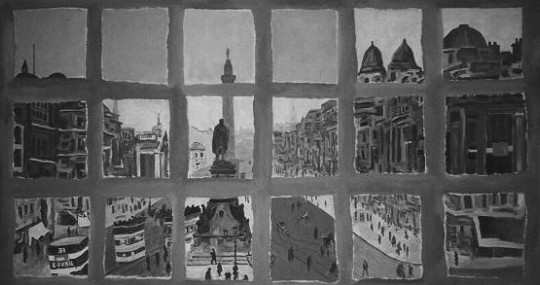
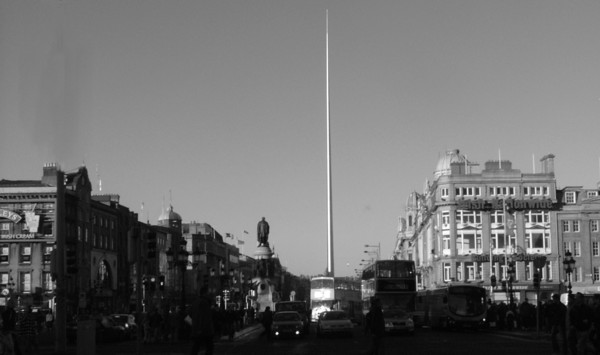
Take, for example, O'Connell Street, as painted here on a friend's wall by the Brother some years back. Yes, I know, it doesn't quite look like this any more, but I'm not happy with my own photos of it, so you'll have to admire the Brother's antiquarian artistry instead. O'Connell Street is Dublin's main thoroughfare, of which you'll hear Dubliners boasting that it's the broadest city street in Europe. I've a feeling that the Champs Elysees has a more credible claim to that distinction, but it's impressive enough for all that, especially now that it's getting a facelift after years of abuse and neglect.


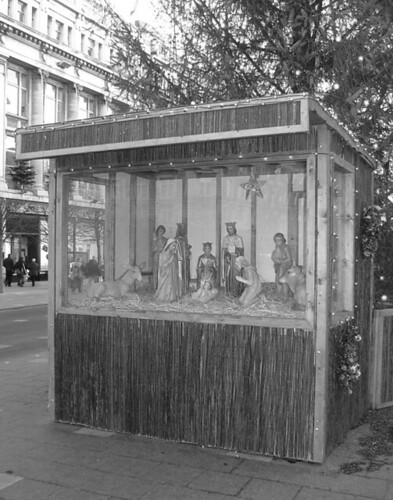
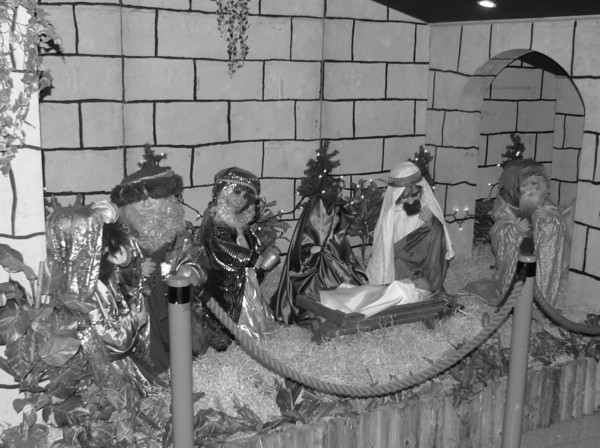
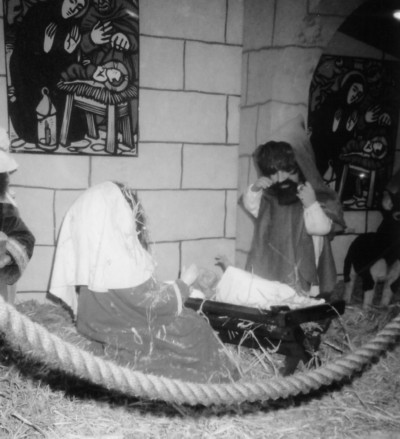
Anyway, if you visit the G.P.O., the big neoclassical building on the left of the Brother's mural, you'll see a crib, which though simultaneously gaudy and tacky is nonetheless not quite as sinister as it was a few years back when not merely did Joseph look eerily like Osama Bin Laden, but the back wall of the crib featured a painting of Jesus, Mary, and what can only be described as an Evil Joseph, looming over the manger in a decidedly threatening manner.

A little further up the street you'll see a fine outdoor crib, just beside the Christmas tree in the street's central island. It's unfortunately located just yards away from the Anne Summers shop, but what can you do? But that's what Christmas is about isn't it? The Incarnation of Our Lord, evergreen trees, and exotic underwear? No? Not quite? Oh.

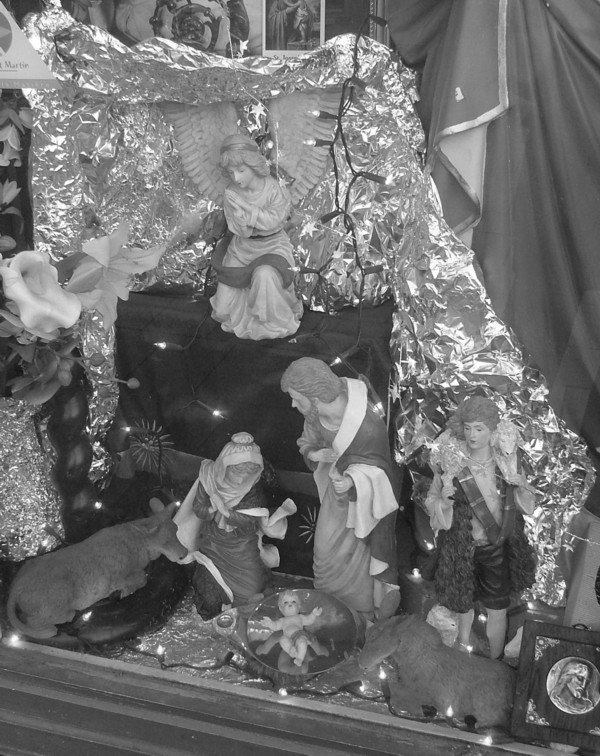
Crossing the road over towards the Savoy cinema, you may just notice the rather odd Mary Mediatrix shop. Naturally enough there is a crib in the window, with the conventional figures cheerily deployed against a tin foil backdrop.


That's just on the street itself; barely off it on Abbey Street, should you care to stray, you'll find the Veritas shop, which has recently been in the news because of the national broadcaster's concerns that references to cribs in an advert for Veritas might consitute illegal advertising, being 'directed towards religious ends'.

Also just off O'Connell Street, of course, on the junction of Marlborough Street and the somewhat ironically named Cathedral Street, there is the Pro-Cathedral, which this year has a rather less ambitious but also decidedly less bizarre crib than last year.

And then, finally, up at the St Martin Apostolate on Parnell Square, so just a couple of minutes' walk from the Parnell Monument at the northern end of O'Connell Street, you'll find the Moving Crib, which has been a fixture of Christmas in Dublin since 1956. Billed as possibly unique in Europe, it features mechanised scenes from the Garden of Eden up to the Nativity in -- I suppose -- an attempt to communicate the place of the Incarnation in Salvation History. Visiting it the other day, I was amazed at just how shabby and shoddy it all was, but in this regard I had the clear disadvantage of not being five years old. Loads of children were being led about by their parents, eyes glued to the various scenes, and hanging on every word their parents whispered to them.


That's six cribs either on or just barely off the street. You'll not see a concentration like that in England. I can't help wondering if this is one of those little differences that, while not absolute, derive from England being culturally a Protestant country and Ireland being culturally a Catholic one.

After all, Protestantism in all its forms is essentially a child of the age of print, Gutenberg begetting Luther, Zwingli, Calvin, Cranmer, and all those who've followed in their footsteps by making it possible for Christians to possess and read their own Bibles. The notion of sola scriptura arose from this new possibility, just as did the ransackings of so many churches. It's hardly surprising then that Protestant countries should even now emphasise verbal evangelisation, whether spoken or -- especially at Christmas -- sung.

Catholic Christianity on the other hand, having arisen in a time when books were priceless and few could read anyway, evangelised by any means possible. Despite having collated and canonised the Bible on which the Sixteenth Century Reformers were so exclusively -- they thought -- to rely, for over a thousand years Catholics had evangelised by visual means as much as by the written word. The results we know: statues, relief sculptures, Celtic crosses, icons, frescoes, stained glass windows, and cribs.

I may come back to this on St Stephen's Day. We'll see.

23 December 2007

The Coming of the Light

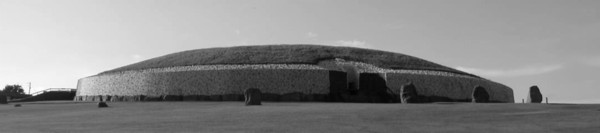
Whenever friends of mine tell me they're visiting Dublin and ask me where they should go, after reeling off my five or six 'must see' spots in my mother city, two of which are the 'Sacred Scripture' collection in the Chester Beatty Library and the Long Room in Trinity College, I ask them how much time they have, and, if they've more than a couple of days, I usually insist that they take a day trip to Meath, where they might be able to take in Tara or Slane or Monasterboice, but where they should make sure they visit Brú na Bóinne, most importantly the great passage tomb at Newgrange.

About 5,200 years old, so ranking with Gavrinis in Brittany and Hagar Qim in Malta among Europe's oldest and most impressive ancient buildings, Newgrange is an enormous megalithic tomb, far older than Stonehenge and the Pyramids. It remained a focus of ritual activity through the neolithic period, becoming a significant spot in later Irish mythology, but gradually disappearing from view over the millennia through mound slippage, only being rediscovered at the end of the Seventeenth Century.

Proper excavation began in 1962, and forty years ago on Friday, on 21 December 1967, UCC's Professor M.J. O'Kelly witnessed the most remarkable feature of the mound.

The excavations had discovered a small hole termed a 'roofbox' over the entrance, leading to a shaft running to a chamber at the tomb's centre. On the morning of the winter solstice the rising sun shone directly through that hole for about seventeen minutes, striking the floor at the back of the chamber.

It's happened on every winter solstice since, with only a handful of people being chosen by lot to see the illumination each year. Friday's winter solstice illumination was streamed live on the internet. It's been archived, if you fancy watching it. It's really quite breathtaking.

Newgrange always strikes me as one of the wonders of the ancient world, and I never cease to be amazed at how few people outside Ireland have heard of it.

22 December 2007

Gathering on the Day of the Sun

It seems that the 'news' of Tony Blair's conversion has rather wiped from the headlines the spurious stories of Rowan Williams having supposedly thrown the baby Jesus out with the extrabiblical bathwater. Whether Blair's conversion should be regarded as good or bad news for England's established church, or simply met with a shrug, I really don't know.

Anyway, one thing that's caught my eye in discussions of the Archbishop's observations the other day has been some annoyance at how, on being asked whether there would really have been snow on the ground when Our Lord was born, Dr Williams replied:
Very unlikely, I think. It can be pretty damn cold in Bethlehem at this time of year, but then we don’t know that it was this time of year, because again, the gospels don’t tell us what time of year it was. Christmas is the time of year it is because it fitted very well with the winter festival.
Leaving aside the issue of Judean Decembers being relatively mild, with the real cold weather not hitting -- in that typically Mediterranean way -- until February, before yesterday I'd have automatically assumed that everyone knew this, that it went without saying that our dating of Christmas was purely a sanctification of a preexisting pagan feast.

In doing so, I'd have been thinking both of the old Roman festival of the Saturnalia and of the formal institution in 274 AD by the emperor Aurelian of the Dies Natalis Solis Invicti, the celebration of the winter solstice under the guise of the Birthday of the Unconquered Sun, the solstice falling on 25 December under the Julian calendar. A Christianization of the latter festival would certainly have made sense, especially in connection with the notion of Jesus as the Light of the World and the longstanding Christian tradition of having the Day of the Sun as the principal day of worship.

It seems I may have been wrong, as it looks as though this belief is based on little more than assumption, with there being at least as much evidence against it as for it. For example, unless we're dealing with an interpolation, which is very possible, it seems that St Hippolytus of Rome, writing in the early Third Century -- decades before Aurelian's institution of the pagan feast -- recorded the date of Christ's birth as 25 December.

Assuming that this isn't a later interpolation, why might that date have been chosen?

Well, it might have been derived from highly questionable calculations based on a number of clues in Luke's gospel, but there seems far better reason to believe it's based on counting forward from the 25 March. It seems that Jewish tradition held that prophets had an 'integral age', whereby they died on the same date as that on which they were conceived or born, and since some early Christians placed Our Lord's death as having taken place on 25 March, it followed then that he must have been born or conceived on 25 March. They ran with conception -- as commemorated to this day with the feast of the Annunication -- and counted forward nine months to Christmas.

I'm not really sold on this, I must admit, but I haven't time to wade through all the detail of the arguments. Still, what seems absolutely clear is that we certainly shouldn't just assume that by celebrating Christmas on 25 December the early Christians were simply appropriating a pagan festival, not least because it seems that the ancient Romans attached no great significance to the winter solstice.

Unlike, it would seem, the ancient Irish, as I'll explain tomorrow.

21 December 2007

Separated by a Common Language

Just sticking with Poor Rowan Williams for a bit longer, I see that you can watch his discussion with Ricky Gervais on YouTube. Contrary to the Telegraph's description of the show, his discussion with Gervais did not follow his interview with Simon Mayo; rather, it preceded it! The Archbishop arrived while Simon Mayo was interviewing Gervais, and the two guests overlapped and had a discussion about The Simpsons, denominational schools, and the importance of forgiveness, among other matters.

It's worth watching, not least to see the Archbishop's skill in finding common ground with a self-professed 'evangelical atheist', and indeed Gervais's outright declaration that people doing horrendous things in the name of God really has nothing to do with religion. Once Ricky Gervais heads off Simon Mayo gets stuck in interviewing Dr Williams properly, and -- before moving on to discuss several things including the historicity of Nativity scenes on Christmas cards -- starts by asking him about the discussion he'd just had:
SM: We’ve the Archbishop of Canterbury here with us. I wonder, Archbishop, how much time you spend engaging in debate like that, which it seems to me a lot of people would think you’re for, which is a key part of your job in promoting your church, and how much time is spent in the wretched business of running the Church of England?

RW: Well, you won’t be surprised to know that plenty of time is spent running the Church of England or trying to, but I think that kind of engagement with people outside the family of faith is really important. In the last year or so I’ve talked to John Humphreys of course, I’ve done something with Richard Dawkins which will be on television before very long, so I regard it as a bit of a priority to try and be there and have the arguments.

SM: Do you wish you could do more of it?

RW: Yeah, quite often, quite. It's, you know, it’s hard work -- it tests you, it pushes you to the limits of what you know and what you’re confident of --

SM: Because, without minimising the importance of the debate about what happens in the Anglican Communion and trying to fight schism and all that, those people outside of the Church look on with a degree of bafflement.

RW: Absolutely, absolutely.

SM: They’ll have understood the debate they’ve just heard between you and Ricky and think ‘Oh, that’s quite good, I see what you’re saying.’

RW: No, they don’t want to know about the politics of the Church, the inside politics of the Church. They want to know if God’s real, they want to know if they can be forgiven, they want to know what sort of lifestyles matter more. And they want to know, I suppose, if their prayers are heard.

SM: When we spoke a couple of years ago you talked about setting a tone. I think the question I asked you was about your job description, how you’d write a job description. You said the first thing was setting a tone while you’re in charge, modelling ways for people to get on with each other, people making sense of each other. How are doing with that? If that’s the job description, how are you conforming to your own template?

RW: If you measure that up against the Anglican Communion at the moment, I’ve got a bit of a way to go. 'Room for improvement,' I think the school report would say on that one. Well, I still believe it’s worth doing, and that unless you do try to model some style of patience, some listening to each other, then really you’re just going along with some of the worst -- the most destructive -- currents in the kind of world we live in, where it’s all throwing slogans at each other.
That last point strikes me as particularly important, especially at a time when the barriers seems to be flying up between those within and without what Dr Williams calls 'the family of faith'. Jaw-jaw, as Winston Churchill is reputed to have said in what I presume was one of his moments of clarity, is better than war-war, and I think this holds here. It's surely better for atheists, agnostics, apathetics, and believers of all stripes to talk to each other than to simply to shout down anyone who disagrees with them.


I think Dr Williams is absolutely right on this, and it's particularly discouraging that not merely have Wednesday's discussions have been so misrepresented in the media, but that people have been so keen to believe the false reports, responding themselves in a way that's been far from charitable. Atheists have jeered at what they see as evidence that the Archbishop of Canterbury doesn't even believe in what he preaches, Catholics have gloated at what they see as typical 'cake or death' Church of England wishy-washiness or else been aghast as the Archbishop's apparent willingness to downplay the significance of the Virgin Birth, while it seems that exasperated members of the Archbishop's own communion are sneering at what they see as the Archbishop's tendency to say the wrong thing at the wrong time.

By this they presumably mean talking about Christmas at Christmas.

To be fair, I say exasperated Anglicans, whereas I really mean exasperated Episcopalians, who of course -- being in America -- live right on the faultline of the schism that now looks so unavoidable within the Anglican communion. Part of their exasperation comes, as far as I can tell, from a sheer inability to understand English as spoken in England. I know, that sounds a bit patronising, but run through the comment thread here and look at the huge debate surrounding why the Archbishop replied 'I should think so,' on being asked whether he believed the depiction on Christmas cards of the baby Jesus in the manger was historically and factually true.

Yes, 'I should think so' -- a phrase that in England simply means 'of course' or 'that goes without saying' -- gets torn apart for what's perceived as its staggering ambiguity. It's not remotely ambiguous if you understand English English. it's also important to keep in mind that the Archbishop was talking on a radio show which -- while accessible to people all over the world -- is directed towards a domestic audience, all of whom pay for the radio show through licence money, and the vast majority of whom think Christianity is nonsense, if they even think of it at all. Harking back to a question he'd put to Ricky Gervais earlier on, Dr Williams comments on this, in fact, later in the interview, saying:
I think the trouble in the country is that people imagine that when we speak about religious faith there’s only one kind of faith that counts, and it’s slightly off-the-wall, very intense, very literalist, in some ways rather anxious and violent, the sort of thing they associate with the Anerican Right -- the American Religious Right.
One of the things the Archbishop is doing is trying to present mainstream Christianity as something which is reasonable and plausible, and I think he makes a decent fist of that.


It's a shame then that he should get it in the neck from Catholics and his own Anglicans for what's wrongly seen as his willingness to drop the Virgin Birth as a fundamental Christian belief. It's worth unpacking what he says, as I think he has three points when he says:
I don’t want to set it as a kind of hurdle that people have to get over before they can, you know, be signed up, but I think quite a few people would say that as time goes on they get a deeper sense of what the Virgin Birth is about. I would say that of myself, that thirty years ago I might have said I wasn’t too fussed about it, now I see it much more as dovetailing with the rest of what I believe about the story.
To begin with, he doesn't want the Virgin Birth to become an obstacle that discourages people from approaching and exploring Christianity. I think this is fair enough, as despite its significance in the historical creeds, it is something at which most people would -- naturally -- balk. It does sound incredibly unlikely, after all, though whether it is more unlikely than water being turned into wine, thousands of people being fed from a few loaves with there being more leftovers than there was bread to start with, people rising from the dead, or God becoming man, well, that's another matter. The real question here concerns whether or not one accepts the possibility of miracles, and that in turn depends on whether one is willing to believe in the existence of God.

His second point was that thirty years ago, which was when he was first ordained as an Anglican deacon, he wasn't 'too fussed' about the doctrine of the Virgin Birth. I know, that might seem a bit odd, in that in an interview with The Catholic Herald just over a year ago he commented that the kind of Anglicanism in which he grew up wasn't panicked by the idea that a proper devotion to Mary was part of Christian practice, but I think all he means is that he accepted this doctrine but didn't dwell on it. This miraculous sign didn't have any special meaning for him over other miraculous ones, at least when he was first ordained.

His final point is that as Christians explore their faith they tend to gain a 'deeper sense' of the significance of the Virgin Birth. In his own case, he seems to have realised this while Bishop of Monmouth in the 1990s, when he used to take groups from the diocese to Walsingham every year. It seems that on his first such pilgrimage he was struck by how liberating and life-giving people found the concept of honouring Mary as mother and sister; among other things, he admits that although it's a cliché, he believes that if we are take Jesus' humanity seriously, we much recognise that that humanity was shaped by Mary.

As for the Virgin Birth, he made his views on this very clear in the Spectator poll Simon Mayo cited in the interview:
Yes; I believe that the conception of Jesus was a moment when the creative action of God produced a reality as new in its way as the first moment of creation itself. And I believe that what opened the way for this was the work of God through human history over centuries, coming to its fullest moment in Mary’s consent to God’s call. The recognition of the uniqueness and newness of Jesus is a recognition of the absolute freedom of God to break the chains of cause and effect that lock us into our sins and failures; the virginal conception is an outward sign of this divine freedom to make new beginnings.
Talking of new beginnings, today was the Winter Solstice. I may get on to that tomorrow.

20 December 2007

The Archbishop of Canterbury has a large festive beard, in which robins can nest...

I've never listened to Simon Mayo's radio show, but intrigued by a piece yesterday on Ruth Gledhill's religion blog on the Times website I tuned in last night to hear his discussions with Ricky Gervais and the Archbishop of Canterbury, not least for the curious bit where his two guests overlapped with each other. The entirety of the Gervais piece can be downloaded as a podcast, but if you want to listen to the bit where it's just Simon Mayo and Rowan Williams talking you should get your skates on, as it will only stay online for a few more days.

Both parts of the discussion are well worth listening to, and it's a terrible shame that Gledhill and other journalists have been rather mischievously misrepresented what Dr Williams has said about the Christmas story. And, predictably enough, people haven't actually listened to the interview or read anything sensible* on the topic, instead reacting purely to the reports. In the almost certainly vain hope of stemming this probably rather small tide of nonsense, and annoyingly oblivious to the Telegraph having done the same thing, I typed up the relevant part of the interview.
SM: We can talk more on that - I’m sure you’d love to - later on, but we’ll talk about Christmas first of all! It comes around every year, this story about how we’re not being Christian enough, or people don’t know where Bethlehem is, or people have never heard of Mary and so on, so that this is almost like a tradition of Christmas, isn’t it, really? But I wonder if people have got a traditional religious Christmas card in front of them, I just want to go through it, Archbishop, to find out how much of it you think is true and crucial to believing in Christmas, so let’s start with - we’ve got the Baby Jesus in a a manger. Historically and factually true?

RW: I should think so. The Gospel tells us he was born outside the main house, probably because it was overcrowded, because of pilgrimage time or census time, whatever. Yeah, he’s born in poor circumstances, slightly out of the ordinary.

SM: The Virgin Mary next door to him?

RW: We know his mother’s name was Mary, that’s one of the things all the gospels agree about, and the two gospels that tell the story have the story of the Virgin Birth, and that’s something I’m committed to as part of what I’ve inherited.

SM: You were a prominent part of a Spectator survey - the current issue - which carried the headline ‘Do You believe in the Virgin Birth?’ There are some people in this survey who would say they were Christian, who don’t have a problem if you don’t believe in the Virgin Birth. How important is it to believe in that bit?

RW: I don’t want to set it as a kind of hurdle that people have to get over before they can, you know, be signed up, but I think quite a few people would say that as time goes on they get a deeper sense of what the Virgin Birth is about. I would say that of myself, that thirty years ago I might have said I wasn’t too fussed about it, now I see it much more as dovetailing with the rest of what I believe about the story.

SM: Christopher Hitchens in that, amongst many others, makes the point that isn’t the translation for ‘young woman’ rather than ‘virgin’ - does it have to be seen as ‘virgin’? Might it be a mistranslation?

RW: Oh that’s - it is - well- What’s happening there is that one of the gospels quotes a prophecy that a virgin will conceive a child. Now the original Hebrew doesn’t have the word ‘virgin’, it’s just a young woman. But that’s the prophecy from the Old Testament that’s quoted in support of story which is in any case about a birth without a human father. So it’s not that it rests on a mistranslation - Saint Matthew has gone to his Greek version of the Bible, said ‘Oh! The Virgin! That sounds like the story I know!’ and put it in.

SM: Right, so we’ve got the Virgin Mary and Jesus. Joseph?

RW: Yeah. Again, the gospels are pretty consistent. That’s his father’s name.

SM: So we’re padding out now. Shepherds, there with their sheep and with the oxes and asses?

RW: Pass on the oxes and asses, they don’t figure very strongly in the gospels. So I can live without the ox and asses.

SM: And the wise men, with gold, frankincense, and myrrh, with one of the wise men being black and the other two being white, for some reason?

RW: Well, Matthew’s gospel doesn’t tell us there were three of them, doesn’t tell us they were kings, doesn’t tell us where they came from. It says they’re astrologers, wise men, priests from somewhere outside the Roman Empire. That’s all we’re really told, so, yeah, the Three Kings with the one from Africa - that’s legend. It works quite well as legend, so I suppose that’s possible.

SM: But would they have been there?

RW: Not with the shepherds, they wouldn’t!

SM: Right, so if I’ve got on my card the kings -

RW: If you’ve got on your card the shepherds on one side and the three kings on the other, there’s a bit of conflation going on.

SM: And pulling back further: snow on the ground?

RW: Very unlikely, I think. It can be pretty damn cold in Bethlehem at this time of year, but then we don’t know that it was this time of year, because again, the gospels don’t tell us what time of year it was. Christmas is the time of year it is because it fitted very well with the winter festival.

SM: Just as a side issue, on the kings and the wise men, do you have a problem with astrologers being seen as wise men? There would be many people in your church who would think ‘Actually, astrology’s bunk and should be exposed as bunk, and the idea of saying they’re wise is somewhat farcical.’

RW: Well, I’m inclined to agree that astrology’s bunk, but you’re dealing there with a world in which people watched the stars to get a heads up on significant matters, and astrologers were, you know, quite a growth industry. They were people who were respected, who had a kind of professional, technical skill, and were respected as such. The thing is here, of course, what’s the skill all about? Well it’s all bringing them to Jesus. It’s not about fortune telling or telling the future, it’s about a skill at watching the Universe which leads them inexorably to this event. So I don’t think it’s a justification of astrology.

SM: Okay, so if we’re pulling back even further then, is there a star above the place where the child is?

RW: Don’t know. I mean, Matthew talks about the star rising, the star standing still, but we know stars don’t behave quite like that. That the wise men should have seen something which triggered a recognition that something significant was going on, some constellation or star in the sky - there are various scientific theories about what it might have been around that time - and they followed that track, that makes sense to me.

You'd really be determined to damn the poor man to find anything offensive in this. If you read it and then look at the reports you'll see that the Ruth Gledhill rather ambiguously cites him as claiming the visit of the Three Wise Men as nothing but a legend whereas his point was merely that the number and ethnicity of the wise men are matters of legend, while the Australian and the Telegraph omit a crucial sentence in quoting Dr Williams on the Magi in order to create the false impression that he had claimed the entire tale of the visit of the Magi was a fabrication.

Certainly what cannot be claimed based on this is that he described the Nativity in any sense as a legend. Rather -- and this is the case for the whole interview, not merely this five-minute segment -- he answers all questions put to him with honesty and integrity, inoffensively making the case for an intellectually credible Christianity. Granted, he could perhaps have mentioned Herodotus and Strabo referring to the magi as a Persian priestly class and the possibility that the timing of our Christmas celebrations might not be based upon a previous Roman festival, and perhaps also Isaiah's reference to the ox and ass, but doing so might have complicated things too much.

It's spectacularly unfair to present the interview as an own goal on the Archbishop's part. If the head of the worldwide Anglican Communion can't talk about Christmas at this time of year, when should he talk about it?


It's worth bearing in mind, too, that the Archbishop is speaking to a British audience, and his remarks certainly shouldn't be viewed in light of culture wars in other countries. In Britain the main problem for the churches is that people simply don't care about religion, as I've said before, and that they're almost completely ignorant of the fundamentals of the Faith.

To put that point into context, there's something almost unreal about the fact that Simon Mayo is asking the Archbishop of Canterbury to discuss the historical plausibility of the typical nativity scene as represented on Christmas cards. Why? Well, nativity scenes aren't all that common on English Christmas cards. I've received six cards from friends in England so far, not one of which has a religious theme, and I think that's pretty representative: a couple of years back I noted that in my local newsagents in Fallowfield there were over a hundred distinct Christmas cards there, and yet there wasn't a religious image in sight.

And before anyone gets shirty, no, the shop wasn't run by Muslims. Unless you specifically go to a church or a religious shop -- a CTS one or Wesley Owen if you're in Manchester, probably depending on your denomination, or St Paul's if you're in London -- then you'll be hard pressed to find Christmas cards with a religious theme.

I'm not happy with other Catholics sneering at the Archbishop over this; it's beneath us, and besides, would it have been better if he'd lied?
__________________________________________________________
* Albeit with a misleading headline. Do journalists not have any say in the headlines bestowed on their columns?

19 December 2007

Visiting the Jedi Library

I couldn't help but get rather disheartened last week by the news that Terry Pratchett has been diagnosed as suffering from a form of early onset Alzheimer's. It's gloomy news, though the fact that he's confidently working on two new books is encouraging, as is his observation that
This should be interpreted as 'I am not dead'. I will, of course, be dead at some future point, as will everybody else. For me, this maybe further off than you think - it's too soon to tell. I know it's a very human thing to say "Is there anything I can do", but in this case I would only entertain offers from very high-end experts in brain chemistry.
Among Pratchett's ideas, one of my favourite has long been that of 'L-Space', the notion that all libraries and even bookshops are somehow linked as being a separate dimension in their own right; as a frustrated academic, I've often wished this were the case, not least when waiting for an inter-library loan to come through.

I've been having trouble with libraries a lot lately, especially in Manchester, but finally today I attained my own Holy Grail in being granted access to Dublin's best library. And no, I don't mean the Chester Beatty Library, because magnificent though it is, it's more a museum than a working library.


The library of Trinity College, or the University of Dublin if you want to be fancy, is a copyright library, entitled to claim a copy of anything published in Ireland or the United Kingdom. In practice it doesn't even come close to claiming all it could, of course, not least because there's no way it could store everything, but it gets enough for free.

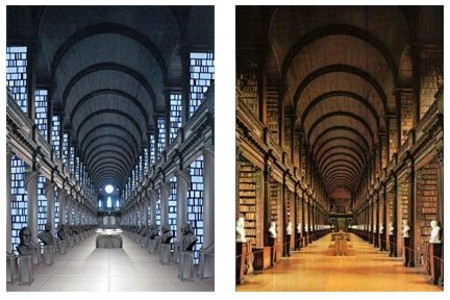
The most impressive part of the library in my books is the Long Room, which I reckon as one of the five or six most important spots in any trip to Dublin. You're probably familiar with it, in a way.

Take a look at the pictures. Do they look familiar? No? Well, can you spot the differences? Yes, well done, the one on the right has light-coloured busts and dusty books while the one on the left has dark-coloured busts and, um, glowing books.

Or putting it another way, one is the Jedi Library where Obi wan Kenobi hunts in vain for a missing planet in the feebly named Attack of the Clones, while the other is Trinity's Long Room.

It might help if you looked at them in colour. Colour sometimes matters, after all.

Amusingly, when this was first brought to light, Lucasfilm appears to have maintained that it was entirely coincidental, with a spokesman for George Lucas having said that 'it is totally untrue that there is any connection between the scene in Attack of the Clones and Trinity College'. I think Trinity dropped the case in the end, though I can't for the life of me see why. I mean, you don't need to be an architect to spot the similarities here: I recognised the Jedi library as the Long Room the moment I saw it in the cinema!

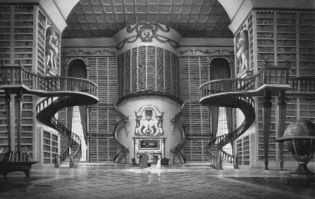
I'd easily rate the Long Room among the three or four most important rooms to be visited by any guest in Dublin, and if it catches your imagination I'm sure you'll be glad to know that plenty of other cities -- Manchester among them, as it happens -- have their own beautiful libraries gently awaiting awestruck bibliophiles to come and marvel like Belle.


I was alerted a few weeks back to the Facebook group for girls who would marry Disney's Beast just to get a library like his out of the deal. I guess if you're to be married for anything other than love it might as well be for books. After all, the idea of having someone gasp with a mixture of envy, admiration, and desire on seeing how many books you've got has a certain charm.

Mind, I'm probably biased. My bibliophilia is well attested, and I've long passed the 2,000 book threshold which Augustine Birrell laid down a century or so back as the benchmark for a basic private library:
Libraries are not made ; they grow. Your first two thousand volumes present no difficulty, and cost astonishingly little money. Given £400 and five years, and an ordinary man can in the ordinary course, without undue haste or putting any pressure upon his taste, surround himself with this number of books, all in his own language, and thenceforth have at least one place in the world in which it is possible to be happy. But pride is still out of the question. To be proud of having two thousand books would be absurd. You might as well be proud of having two top-coats. After your first two thousand difficulty begins, but until you have ten thousand volumes the less you say the better. Then you may begin to speak.
I've passed that threshold, mind, but not be far. I'm a long way from Birrell's 10,000 books. Hmmm. I should probably stop talking.