24 April 2005

Grim news or an ignorant media?

It's extraordinary how much gibberish has been written in the aftermath of the John Paul's death and the election of his successor. Take this article, for example, plucked from today's Observer. It takes all of, oh, six sentences before launching into this delight: 'Catholicism is attractively unambiguous about sins. Some are too grave ever to be forgiven.'

Really? Which ones? The best I can do is 'blasphemy against the Holy Spirit', but even that's not quite as unforgivable as it seems. After all, God's mercy is potentially infinite, isn't it? The Catechism's pretty clear on that, and the Church has long taught that when Jesus spoke of blasphemy against the spirit he must have meant a final impenitence, a defiance of God's will even in death. In other words, sins are only unforgivable - in the sense that God would choose not to forgive them, only if we reject their forgiveness.

I know, it's complicated. My point, though, was that yer man didn't know what he was talking about, which rather destroyed the credibility of his thesis.


And it's with that sole consolatory thought that I read in today's same Observer that:
'Pope Benedict XVI faced claims last night he had 'obstructed justice' after it emerged he issued an order ensuring the church's investigations into child sex abuse claims be carried out in secret. The order was made in a confidential letter, obtained by The Observer, which was sent to every Catholic bishop in May 2001. It asserted the church's right to hold its inquiries behind closed doors and keep the evidence confidential for up to 10 years after the victims reached adulthood.'
The article makes for grim reading, while the letter is just painful, since unless you're a canon lawyer I don't see how you could make head nor tail out of it.

It's funny that the Observer should be announcing this as a proud exclusive, since the letter's apparently been floating about online for a good year-and-a-half now. But then, this is hardly the first time they've made such claims. Similar accusations were made back in the summer of 2003 about a 1963 letter, discovered by the same lawyer who discovered this one - notice a pattern there? Back then the Observer acted as though it had an exclusive on its hands, though the story had been reported in the American media a couple of months earlier, and even so, on closer inspection the scandalous letter turned out to have been a mere storm in a tea cup. Is this new one the same, though, that's the question?

The key bits seem to be, as far as I can see, the following:
' The more grave delicts [a delict's a deliberate wrong] both in the celebration of the sacraments and against morals reserved to the Congregation for the Doctrine of the Faith are:

... -A delict against morals, namely: the delict committed by a cleric against the Sixth Commandment of the Decalogue with a minor below the age of 18 years.

Only these delicts, which are indicated above with their definition, are reserved to the apostolic tribunal of the Congregation for the Doctrine of the Faith.

As often as an ordinary
[that's a church official] or hierarch [a bishop or archbishop] has at least probable knowledge of a reserved delict, after he has carried out the preliminary investigation he is to indicate it to the Congregation for the Doctrine of the Faith, which unless it calls the case to itself because of special circumstances of things, after transmitting appropriate norms, orders the ordinary or hierarch to proceed ahead through his own tribunal. The right of appealing against a sentence of the first instance, whether on the part of the party or the party's legal representative, or on the part of the promoter of justice, solely remains valid only to the supreme tribunal of this congregation.

It must be noted that the criminal action on delicts reserved to the Congregation for the Doctrine of the Faith is extinguished by a prescription of 10 years.(11) The prescription runs according to the universal and common law;(12) however, in the delict perpetrated with a minor by a cleric, the prescription begins to run from the day when the minor has completed the 18th year of age.'
What does this mean? Your guess is probably as good as mine. Daniel Shea, the lawyer who discovered it, argues that it's a way of hushing things up, of blocking lower ranking clergy from reporting crimes to the police, and of ensuring that nobody even discusses such crimes until ten years after they've happened, or until ten years after victims of child abuse have become adults.

I'm not sure. I'm no canon lawyer, but I'd have thought what this meant is that any allegations of abuse should be reported to the Congregation for the Doctrine of Faith, which could then choose to deal with it itself, or allow it to be dealt with at the local level. Further, I think, the Congregation would have ten years in which to take action. This should guarantee that the Vatican could step in if the local authorities were making a mess of things, and also that it would retain that right for quite a while. In no sense does the letter even suggest that evidence should be concealed from the police, or indeed that any form of obstruction be brought into play. It deals with such matters as abuse allegations purely a matter of internal discipline, I think, and has nothing to say on how the local authorities should deal with the police or courts.

Okay, you might say, but it doesn't tell them to cooperate, does it? Well, no, but bear in mind that the letter's not just about abuse allegations. Read all the things that are covered by it. They include such matters as 'Direct violation of the sacramental seal' and 'retaining the consecrated species for a sacrilegious purpose'. If the letter was solely about abuse allegations, and it said nothing about cooperating with the secular authorities, then yes, there might be serious grounds for concern. But as it is, I think this is fine.

Actually, if my reading of it is right - and I shall be asking around - then it strikes me that this is a good thing, rather better than allowing blunderers like Bernard Law to shunt paedophile priests around from parish to parish. These regulations would basically allow the Vatican to say 'You're screwing up. We're going to have to take over.'

I think there are grounds for hope on this. Just a year or so back the then Cardinal Ratzinger reopened the case of Father Maciel, a friend of John Paul II and the founder of the Legionaries of Christ, who'd been accused a few years previously. It seems that since 2001, when Ratzinger's office took direct control of dealing with this problem, it's become far more aware of the scale and depth of the abuse crisis.

According to Cardinal Francis George of Chicago, the new Pope is determined to back episcopal attempts to defeat the problem in America, and actively supports the American bishops' recent attempts to deal with paedophile priests.

Again, remember Benedict's meditation on the Ninth Station of the Cross when he stood in for John Paul on Good Friday just a month or so back:
''Should we not also think of how much Christ suffers in his own Church? How often is the holy sacrament of his Presence abused, how often must he enter empty and evil hearts! How often do we celebrate only ourselves, without even realizing that he is there! How often is his Word twisted and misused! What little faith is present behind so many theories, so many empty words! How much filth there is in the Church, and even among those who, in the priesthood, ought to belong entirely to him!'
I have a feeling the Observer has got it wrong. It's my paper of choice on Sunday, but still, sometimes even Homer nods.

22 April 2005

Balls to that

We've our annual hall ball tonight, for which I have cautiously high expectations. It's the first combined ball - involving both new and old parts of our hall - in three years, so I really hope it goes well. I'll have to scarper in a few minutes, in fact; the bus goes at half six.

By the way, I had brilliant news today. I reckon it's not for general broadcast just yet, but if you e-mail me, I'll fill you in. Perhaps.


Secrecy, Schmecrecy
It appears either that our new Pope has decided to adopt a thoroughly media-friendly tone, or that at least one cardinal is incapable of keeping his word intact and his tongue still. You know the way that Cardinals, before going into Conclave, take an oath of secrecy? If I may quote:
'In a particular way, we promise and swear to observe with the greatest fidelity and with all persons, clerical or lay, secrecy regarding everything that in any way relates to the election of the Roman Pontiff and regarding what occurs in the place of the election, directly or indirectly related to the results of the voting.

We promise and swear not to break this secret in any way, either during or after the election of the new Pontiff, unless explicit authorisation is granted by the same Pontiff.'
Well, either Ratzinger gave the boys permission to yabber, or else someone's not too hot at keeping secrets. Or else, I guess, the Italian media are a rather imaginative and deceitful bunch. Either way, all manner of details have been leaking it, and it looks as though it's possible to more-or-less piece together what happened in the Conclave. The Irish Times and Washington Post between them give a fairly clear picture. And if you can believe an open-source encyclopedia on such a secretive issue, you can look at Wikipedia too.

The guts of what happened - at least according to the questionable details we're hearing - seems to have been that Cardinal Martini and the then Cardinal Ratzinger were the two clear leaders in the first ballot, getting around 40 votes each. 77 would have been needed, out of 115.

Martini, for all his brilliance, is quite ill and was never a serious candidate, having instead largely been supported as a stalking horse. Cardinals Lehmann and Kasper, both Germans and leaders of the opposition to Ratzinger fished around for an alternative candidate, but no natural choice appeared. Ratzinger's vote edged upwards as Martini's splintered. Martini then spoke to Ratzinger, who assured him of his commitment to ecumenism - apparently Martini had had fears about Ratzinger's attitude to this. His fears calmed, Martini voted for Ratzinger, as did the bulk of his supporters.

Some Italian papers are claiming that Ratzinger ultimately garnered the support of more than 100 of the 115 cardinal-electors. If Wikipedia's to be believed, he had received the necessary two-thirds majority on the third ballot, the second on Tuesday morning, and he asked for another ballot on Tuesday afternoon, to confirm - or reject - his appointment, and it was in this ballot that he received the backing of over 100 of his peers.

Or so we're told. Of course, every historian's instinct that I've picked up over the last decade is screaming about this. Our sources on what happened, frankly, are abysmal. This could all be hogwash. Let's face it, the Italian papers could be making it all up.

Ah well.

I suppose, if you really wanted, you could e-mail the Pope and ask him what really went on.

19 April 2005

Habemus Papam... Benedictum XVI!

Well, it was Ratzinger after all. Benedict XVI. I really didn't see that one coming.
 
I wonder how long it'll take before people start calling him Der Panzerpabst. I'm sure the phrase 'God's Rottweiler' will be heard a lot over the next while - though maybe there's a chance for 'The German Shepherd'. And I imagine those who used to call him 'The Pope's Enforcer' will simply call him 'The Enforcer Pope'. 'Cardinal No' could easily become 'Pope No'. 'Papa Ratzi' is almost too obvious.
 
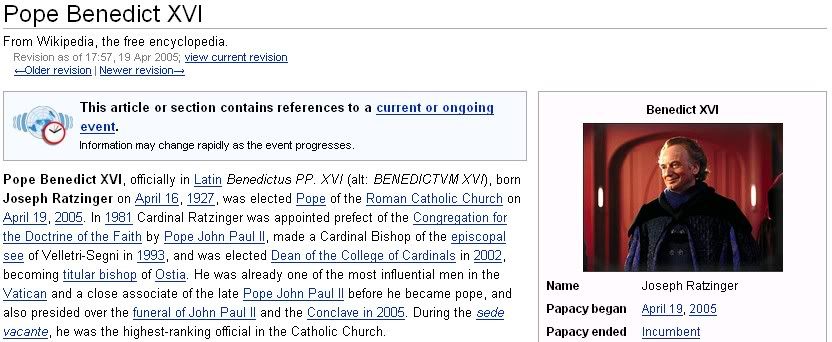
More creatively, it seems some are already calling him Palpatine I. In fact, over at Wikipedia, where there ought to be a picture of the Holy Father, instead there's a picture of the smiling Supreme Chancellor of the Republic. This is what you get when you've an encyclopedia that anyone can edit. One day a few weeks back, I looked up 'Ireland', only to find the word 'penis'. And 'see vagina'.
 
I suspect Wikipedia will sort that out, so just in case I've taken a screenshot.
 
I was out when Ratzinger's election was announced, and only found out over dinner, for which I'd barely made it back in time. 'In case you haven't heard, we have a Pope,' said the Warden.
'Oh?', I said, amazed since I'd expected another couple of days with the cardinals in conclave*. 'Who?'
'Ratzinger,' she said, flatly. 'Benedict the Sixteenth.'
 
To say I was astounded would be to understate, somewhat. I was convinced he didn't stand a chance, fifty guaranteed cardinals or not. He was too controversial, too polarising a figure, and it seemed obvious that the fifty or so cardinals who'd have backed him in the first ballot would have shifted to a more central candidate pretty swiftly. There must have been an impressive shift towards him over the second, third, and fourth ballots.
 
 
Don't Panic
So, what can we expect? After all, the nicknames given to the Holy Father when he was in charge of the Congregation for the Doctrine of the Faith aren't the most flattering. Benedict has been a controversial figure, even more divisive that his predecessor in the Papacy - people regularly deem him 'conservative', 'hardline', 'authoritarian', 'dogmatic', and 'polarising'. Well, there's some truth in all those claims, but things are nowhere near as bad as might be made out.
 
It's well worth reading anything John Allen has to say on the matter. Benedict's biographer, it'd be hard to think of a better judge of what to expect of the new Pope.
 
 
'If the world hates you, know that it has hated me before it hated you...'
Fortuitously, I finished reading John Allen's biography of Benedict, Cardinal Ratzinger: The Vatican's Enforcer of the Faith, this morning. Vatican correspondent for America's National Catholic Reporter, Allen is highly regarded by George Weigel but viewed with suspicion by many of his country's more conservative Catholics, as far as I can discern. He takes, in the main, a highly critical view of Benedict, as chapter after chapter of the book dismantles Ratzinger's statements and actions over time. However, his final chapters, though still critical, present his subject in a rather more positive light.
 
One passage, entitled 'Listening to Ratzinger', strikes me as very important, especially considering how nuanced and precise - and concise! - his statements tend to be, and the fact that he has written and spoken so much:
'Because Ratzinger is a polarising figure, reaction to him is often uncritical, driven more by emotion and instinct than sober reflection. Progressives do not read his books, they disregard his public statements, and they assume every position he takes is based on power politics; conservatives revere most of what he says as holy writ, often spouting it mindlessly without penetrating to the principle or value he sees at stake. Neither response takes Ratzinger seriously.'
Allen thinks if people wish to challenge Ratzinger seriously, they first need to get a handle on what Allen considers his legitimate insights. Four main ones stand out, and I'm summarising here, so bear with me and don't dive in to attack if I oversimplify or misrepresent Ratzinger.
  • Ratzinger believes that we need to recover our belief in an objective truth, in a standard beyond ourselves - admittedly people have abused such beliefs in the past, but that doesn't necessarily make the point invalid.
  • Further, he believes that when we consider the faith of the wider church, we must consider it not merely in a geographic sense, but in a diachronic one - in other words we can't just go by what Catholics today supposedly believe, based on polls and such, but must also consider the beliefs of those who have gone before us, with whom we have a sacramental link.
  • On top of that, the fact that we belong to a global family has implications, notably, Ratzinger believes, that we can't always make the Church what we'd like it to be. Catholics in San Francisco, Sao Paulo, Beijing, Berlin, London, and Lagos are all likely to have rather different views of the what the Church should teach. Remember that, and then bear in mind what happened in 1054. Is schism really so desirable?
  • Finally, Ratzinger is concerned that we in the West run a risk of being too much in thrall to our culture, a culture where we're bombarded with hundreds of commercial messages a day, where we live in comfort and hardly give a thought to the thousands of children who die each day from simple hunger. Though talk of ours as a less moral age than, say, thirty years ago is mere cant, we must recognise that our world is far from perfect, and we're often far too cosy within it.
 
Some hints of what's to come...
JCecil has posted a couple of interesting links on his blog - it seems that while liberal Catholics tend to see Ratzinger as some kind of Darth Vader, the reformers' great hope who turned to the dark side, ultra-conservatives hate him too! And that, surely, is cause for people to calm down, at least a bit. Hell, even Hans Küng, who has said in the past that Ratzinger 'sold his soul for power in the Church,' thinks we should give him a chance - you know, 100 days of grace in which to prove himself.
 
In terms of what we can broadly expect from Benedict, it's worthwhile considering the Church's most famous Benedicts. Benedict of Nursia, the father of Western monasticism, is perhaps the most famour bearer of that name - he left Rome, which he considered corrupt, to found a monastery at Subiaco, and from there a monastic movement spread, crucial to the evangelisation of the Roman Empire's successor kingdoms. The monastic movement in all its forms was crucial to the preservation and the development of Western tradition. Giacomo della Chiesa was the last Pope to bear the name of Benedict; Sepreme Pontiff during the Great War, which he called 'the suicide of Europe', in 1917 he issued a seven-point Peace Proposal. This was largely ignored by most of the combatants, though several of the ideas within the proposal were echoed in Woodrow Wilson's subsequent peace plan. (Wilson rejected Benedict's own plan as he said there could be no peace until the Kaiser, who he called 'the ruthless master of the German people', abdicated. Cue unstable Weimar state, and the rise of Nazism. Hmmm.)
 
You can read into that what you wish.
 
More directly, it'd be helpful to consider his recent homilies and statements. Take a look at his meditations for the Way of the Cross on Good Friday, a conference speech at the Benedictine monastery of St. Scholastica at Subiaco, his homily at the funeral of John Paul II, his homily at the Mass for the Election of the Roman Pontiff and his brief first address as successor to Peter.
 
 
Can 'a simple, humble worker' cleanse these stables?
The meditation on the ninth station is encouraging, especially for those who want a purer and more humble church, notably when he said:
'Should we not also think of how much Christ suffers in his own Church? How often is the holy sacrament of his Presence abused, how often must he enter empty and evil hearts! How often do we celebrate only ourselves, without even realizing that he is there! How often is his Word twisted and misused! What little faith is present behind so many theories, so many empty words! How much filth there is in the Church, and even among those who, in the priesthood, ought to belong entirely to him!'
I imagine there have been few occasions in history when a cardinal has spoken so harshly of the Church, only to be appointed to head that church only a few weeks later. The question there is what he'll do about it, and one thing his biographer is sure of is that despite Ratzinger's lack of pastoral experience, he'll be likely to appoint better bishops, in the main, than his predecessor. Decades of service on the Vatican's Congregation for Bishops has given him a vast amount of first-hand experience of those best qualified to be raised to the episcopacy, and, Allen reckons, even though his appointees will almost certainly be solidly conservative - even reactionary at times - they'll all be intelligent and capable administrators. Considering the clerical abuse scandals that have come to light over the last decade, and how badly so many dioceses have handled them, this can only be a good thing. For what it's worth, he's thought to have persuaded John Paul, some years back, against appointing the disastrous Kurt Krenn as Archbishop of Vienna. And that, I'm sure you'll agree, was a good thing.
 
For what it's worth, there's long been a rumour that Ratzinger, as John Paul's doctrinal watchdog, persuaded John Paul against formally declaring the Church's teachings on birth control infallible. It's impossible to tell if there's any truth to this, but it certainly seems the case that he has some doubts about Humanae Vitae. In a 1992 interview, when asked about birth control, Ratzinger admitted that the Church hadn't come up with anything helpful on the issue of global population, and said that distinctions between natural and artificial methods of birth control were confusing, and tended to obscure the 'real problems'. He concedes that there will have to be a development in Church thinking on this topic. So, some hope for progressives there, perhaps. Mind you, expect another generation to pass before anything is done! The Church is huge and slow, and takes a very long time to turn. Rushing it might achieve nothing bar its disintegration.
 
 
And finally...
I'm rather glad that I've just finished Allen's biography of the Pope, as I've a gloomy feeling that I'll be correcting a depressing amount of misconceptions for at least the next few weeks, but quite possibly for the duration of this Papacy. The most obvious one is the claim that he's a Nazi, something swiftly dismissed by John Allen is this article, where he says:
'When Ratzinger was in the equivalent of high school, membership in the Hitler Youth was made compulsory and he was briefly enrolled, though he asked to be removed and never attended any activities. He was later conscripted into the Germany army and served briefly in an anti-aircraft battalion before deserting. His family was anti-Nazi, and Ratzinger never demonstrated the least affinity for National Socialism.'
That's easily dealt with, as is the claim that he's anti-Semitic. More difficult to refute are accusations of homophobia. Me, I suspect he finds the idea of homsexuality distasteful, yes, and that he thinks homosexual acts are, simply, wrong. Sounds bad? Maybe, but hardly surprising considering scriptural references along with the combination of human attitudes and Church teaching over the centuries. But then, he's adamant that homosexual people are entitled to the protection of the law just as much as anyone else, and that, 'It is deplorable that homosexual persons have been and are the object of violent malice in speech or in action. Such treatment deserves condemnation from the Church's pastors wherever it occurs. It reveals a kind of disregard for others which endangers the most fundamental principles of a healthy society. The intrinsic dignity of each person must always be respected in word, in action and in law.'

He's not saying homosexual people should get special protection because of their sexuality rather that they should not be treated with prejudice because of that sexuality, and must be protected and loved - yes, loved - for their humanity. In other words, that they should be treated exactly the same as everybody else.
 
I made the mistake of throwing my hat into the latter ring in a debate on that point on Making Light, Teresa Nielsen Hayden's warm, clever, funny, and humane blog, but unfortunately it's been rather shouted down. But then, that's what John Allen reckons is the normal reaction to Ratzinger, and what he says - he evokes such strong reactions that people rarely listen carefully to what he has to say, and either lap up his every word or just shout in his face.
 
What's that about bigotry being an inability - or a refusal - to imagine that what you believe might possible be wrong?
 
I dunno, I have hopes on this one. I think Ratzinger - or Benedict now, I suppose, though it'll be hard to get into the habit of calling him that - could be a fine pope. The question is whether people will listen to him or not. After all, despite all the adulation, they didn't listen to John Paul.
____________________________________________________________________________________
* There was just one ballot last night, and two in this morning's round of voting. I have no idea whether there were two this afternoon, or just one. Either way, this was a very speedy result. The average length of time for a Twentieth Century conclave was 3.2 days - this one took scarcely more than 24 hours. It's a pretty efficient system, as though it can generate the odd marathon, it's way better than the older electoral system - following the death of Clement IV in 1268 the cardinals took two days and nine months to pick a successor, and even then managed it only under duress. Gregory X, the eventual choice, who wasn't even a priest - he was an archdeacon, and was on pilgrimage to the Holy Land at the time, accompanying England's future Edward I - overhauled the system into, more or less, the form we have today.
 
Part of me thinks it'd be more fun if they ran the conclave like 'Big Brother', with cardinals being proposed for eviction, and the rest of the Church getting to vote on them. Needless to say, the last one left would become the next Pope. Imagine the ratings. Whether there's be a diary room, or just a confessional box I don't know.
 
We could call it 'Pope Idol'.
 
Don't pretend you wouldn't watch it.

17 April 2005

Waiting for Bells and White Smoke

Well, the Conclave starts tomorrow, so please God we should have our 265th Pope before too long. Watching the media babble about favourites has been interesting; it's rare to see quite so much hot air being expended at once. One thing does need clarifying, though, which is that the old Italian saying that 'he who enters the conclave a pope, leaves it a cardinal' isn't quite true. Eugenio Pacelli and Giovanni Montini were clear favourites for the Petrine Ministry in 1939 and 1963, and both men were indeed appointed, becoming, respectively, Pius XII and Paul VI.

On the other hand, they were very clear favourites. This time matters are far more murky, and it's difficult to discern a natural successor to John Paul II. There are plenty of fine candidates, but it's almost impossible for an outsider to judge if any of them is significantly better suited than the rest to lead the Church towards its third millennium.

Bear in mind how little the secular media knows on this topic. Mark Shea had some wise words on this not long ago:
When it comes to papal elections, the media are idiots who think they are covering (and influencing) the New Hampshire primaries. They. Don't. Have. A. Clue.

Exhibit A: This breathless story on Cdl. Arinze. It's dumb for so many reasons. First, it is thoroughly Americentric. We American are obsessed with questions of race because of our own tortured history, so we assume the rest of the world would be shocked by an African Pope or a Pope in a black skin.

Earth to CNN: Most of the Church is not WASPs. A Pope with a dark skin would be a Pope who looks like most of the Church. But then, most of the Church is grown up enough to not much care what color package the successor of Peter comes in. Only American think stuff like that matters.

Second: Arinze, who is telegenic and shows up in the media a lot, is one of those guys that reporters have heard of. So they naturally assume that he's "near the top of the list" since Cardinals must have "Is he telegenic?" as a big question in their minds, like media types do. They don't. Believe it or not, cardinals are actually thinking a great deal about *theology* (among many other things) as they discern this question. Arinze's theology is fine, don't get me wrong. But my point is that the media are in completely different worlds from the College of Cardinals as they jabber, predict and prognosticate.

Third: Being media types with the historical memory of fruit flies, what these guys are failing to think about is the last papal election: in which the winner blind-sided all the media experts by being some guy nobody ever heard of. My money is on it being some guy nobody ever heard of again. (I'm crossing my fingers that I'm wrong, since I'd love to see Cdl. Schoenborn become Pope. But I don't think I will be wrong. I think we will probably see some bolt from the blue. And if he's African, I will cheer very loudly, since Africa is cranking out some wonderful guys, including Arinze.)'
There are some good points there. Arinze would doubtless make a fine pope, but over the last decade the attention that had focussed on him as natural successor to John Paul may well have largely due to the media's excitement at the prospect of there being a black pope. Arinze seems to have fallen from favour - to some degree over the last year - and though this may be due to his rather conservative interpretations of doctrine, it may equally be due to people feeling that just as one shouldn't be barred from a position because of skin colour, neither should one be offered it for that reason.


From PanzerKardinal to PanzerPope?
Curiously, just as Arinze's star seems to be in decline, at least in the eyes of the media, so Ratzinger's has flared up in the last couple of weeks, largely propelled, I presume, by his fine homily at the funeral of John Paul. Again, this may simply be media hogwash, but rumours in Rome suggest that a Ratzinger papacy would have the support of at least forty to fifty cardinals, which might do more than simply float his name to honour him, before getting down to the nitty gritty of selecting a new pope. And yes, there is nitty gritty, because even if the Holy Spirit is at work, the process of selecting a new pope is still a human process. Some years ago, Cardinal Ratzinger was asked about this on German television, and replied as follows:
'I would not say so, in the sense that the Holy Spirit picks out the pope. ... I would say that the Spirit does not exactly take control of the affair, but rather like a good educator, as it were, leaves us much space, much freedom, without entirely abandoning us. Thus the Spirit’s role should be understood in a much more elastic sense, not that he dictates the candidate for whom one must vote. Probably the only assurance he offers is that the thing cannot be totally ruined. There are too many contrary instances of popes the Holy Spirit would obviously not have picked.'
So what if Ratzinger himself is picked? What should we expect? At the very least we can expect horror from the media, not least because of the fact that when Ratzinger was fourteen he was, like virtually all German boys in 1941, enlisted into the Hitler Youth. The fact that he never joined the Nazi party, and stopped attending Hitler Youth meetings soon after being enlisted, despite attendance being compulsory, probably won't cut a whole load of ice. Nor, no doubt, will his desertion from the infantry unit into which he was conscripted in late 1944. The New York Post really doesn't seem to be taking a particularly balanced approach on this one.

The Times tells us, beneath a headline that's hardly news, since Ratzinger has never concealed his childhood membership of the Hitler Youth, and has often spoken of the evil and indeed folly of the Third Reich, that one unnamed 'liberal theologian' is somewhat troubled by the prospect of a Ratzinger papacy. 'It fills me with horror,' he says. Maybe so, but if elected - and I still thing he's a long shot - Ratzinger may yet surprise us.


And who else?
To be blunt, trying to figure out who's most likely to be chosen to serve in the Petrine ministry is a fiendish task. Paddy Power decided to take bets on the Conclave, initially ranking Father Dougal at 1000-1 against - a wasted wager, that, since being fictional he has the disadvantage of being automatically disqualified - but to look at the current form-list is to confuse yourself further.

Yes, Ratzinger's prominent among the favourites, as is Arinze. Cardinal Martini, the great former archbishop of Milan is there too, though I suspect the Conclave would balk at the prospect of a second successive pope, no matter how gifted, with Parkinson's disease. That might be a shame, though. If Ratzinger is perhaps the most eminent cardinal of the Church's centre-right, Martini was for a long time surely the most papabile of the Church's centre-left. Either of the two men would make a fine pope, and a safe pair of hands, since with both men being 78, neither would be likely to serve for too long.

If Ratzinger's name is unfairly tarnished by his having been enrolled in the Hitler Youth, then I presume that of Jean-Marie Lustiger, former archbishop of Paris, is sadly polished by having lost his mother in Auschwitz. A Jewish convert, like Saint Edith Stein, Lustiger would doubtless have much to offer to the Church's dialogue with its older brother. At 78 he'd be another natural choice as an 'interim pope', but I wonder how comfortable the Cardinals would be with selecting as pope the head of such an ailing church as that in France.

There's Dionigi Tettamanzi too, of course, perhaps the most plausible of the favourites. (Should I say 'favourites'? The proper word, after all, is papabile. Hmmm.) Of the 'soft conservative' tendency, he'd be slightly closer to the centre than Ratzinger, and not nearly as controversial a candidate; though he's a respected moral theologian, thought to have ghost-written some of John Paul's encyclicals - Evangelium Vitae and Veritatis Splendor.

Apparently his critics - and there don't seem to be many serious ones - feel that he tries to be all things to all men, but from what I've seen so far I'm quite impressed. He seems fairly astute too, with an ear for a good phrase, if this is anything to go by: "The first and fundamental problem concerns us Christians and our faith: To what point are we Christians? In Europe today, the priority does not lie in 'baptizing the converted' but in 'converting the baptized.'"

Spot on, that. On the other hand, is he really so ambitious as this article makes out? Hmmmm.

Of course, there are plenty of other good options there. Canada's Marc Ouellet could be one to watch in the next conclave - though he'll be ranked as far too young now. Austria's Christoph Schoenborn looks even more promising, but again, he's too young for now. The American Francis George sounds well-suited to the task, but right now being American could definitely count against him. The Argentinian Jorge Mario Bergoglio looks very promising, and only really has the fact of being a Jesuit against him. There's never been a Jesuit pope before. Mind you, until 1978 there'd never been a Polish one.

And I can't see anything wrong with Ennio Antonelli of Florence. Maybe it's time to give another 'smiling Pope' a chance. After all, despite the warm and sparkling brilliance of Illustrissimi, poor John Paul I hardly had time to teach the universal church anything.

As for what the next pope should be like, that's a question for the cardinals to decide. Do we want another charismatic figure or a quiet organiser? Would even a charismatic figure enable the church to battle against the apathy of the modern West? And though some people would like him to be a skilled politician - which would probably be a good thing. Others might like him to be a classical liberal, claiming that economic liberalism is 'the basis of our culture', though what 'our' means in that context is rather open to discussion. Others would argue that any prospective pope should have proven 'a powerful and positive compassion for the poor'.

That he should be a deeply holy man is something, I think, that can be taken for granted.

The thing is, there are loads of them who'd be good at one point or another; the trick is finding the right one for now. It's going to be some task and I don't envy the cardinals having to make it. This really matters, after all.

If you want to get any more information on the people and the process involved in the conclave, I'd suggest you have a look at the Papabile blog, Richard Neuhaus's Rome Diary, and glance at 'What the Cardinals Believe'. Anything by John Allen in America's National Catholic Reporter is well worth reading too.

16 April 2005

Fog in Channel - Continent Cut Off

I found yesterday's test a little tricky, mainly because I tried to do it as a British subject, rather than an Irish citizen (albeit one of half-English blood) who happens to live here. It seems to me that in voting next month I ought to cast my ballot as though I were planning on living here in, say, six months time, rather than going home.

So, why did I assume I'd wind up backing the Liberal Democrats? In a word: Europe.

Yeah, I know things are looking messy on the European front at the moment, what with Germany still struggling to pay for reconstruction, the constitution in danger of being chucked out by the French of all people, nobody having children anymore, and the fact that while hardly anyone really wants Turkey to join -- for starters because she's not European -- nobody is willing to take responsibility for saying 'no'.

But despite all that, I think Britain -- England in particular -- should get stuck in. For over a thousand years the British were at the forefront of European culture and politics... and with the European project to give political expression to cultural reality having stalled, this could be the ideal time to jump into the driving seat.

It all started that day in July 306 when Roman troops in York hailed the young Constantine as emperor. Within a few years he had achieved that position in fact as well as name, and had put Christianity on the path to becoming the official religion of the Roman Empire. Four hundred years later Saint Boniface, a monk from Devon, would go on to evangelise to the Frisians and to the Germans, founding vast numbers of churches and bishoprics, earning for himself the accolade of 'Apostle of Germany'. Alcuin of York, just a few decades later, would be the leading figure of the Carolingian Renaissance, the first great flowering of western European civilization after the fall of Rome.

Just as Britain had shared in her neighbours' woes as Rome fell and the Germanic tribes plundered their way across the disintegrating Empire, so she shared in the crisis of the ninth century, when Viking, Saracen, and Magyar ravaged the successors of the Roman west. Eventually she succumbed to Norman invasion in 1066, only to be drawn even further into the European story. The Angevin dynasty that ruled England until the close of the fourteenth century had more lands in France than in Britain, and so their kings were naturally at the forefront of European affairs. Richard the Lionheart was one of the leaders of the ill-fated Third Crusade, while Edward III began the Hundred Years' War through his desire to unite the crowns of England and France.

While the Plantagenets were embroiled in the blood and dirt of European politics, medieval culture was flowering in Britain. Gothic cathedrals in England were the match of any on the continent, and Franciscans such as Roger Bacon, John Scotus, and William of Ockham were among Christendom's greatest thinkers, while John Wycliffe anticipated the Protestant Reformation of the Sixteenth Century. Geoffrey Chaucer freely borrowed from Boccaccio and other continental writers to compose his Canterbury Tales, perhaps the most unforgettable portrait of medieval life, and Thomas Malory, in his Le Morte d'Arthur, retrieved and reworked a British legend that had become the literary obsession of whole medieval world.

It was only as the medieval world faded away, with Constantinople falling, the invention of Gutenberg's printing press, and a New World being discovered, that Britain began to slowly break from the continent. While figures such as Thomas More and William Shakespeare were true Europeans, giants of the Northern Renaissance, analogous to Erasmus and Cervantes, Britain's rulers turned away from her continental cousins.


I'm thundering into Mongolia!
The Henrician Schism began the break, of course, as Henry established himself, in the manner of an Eastern emperor, as head of Church and State. The monasteries were dissolved and a vernacular liturgy imposed, severing many of the cultural ties that linked Britain with her neighbours. Until the civil wars of the mid-seventeenth century and the Puritan dictatorship, Britain's Reformation was relatively painless - at least compared to the carnage on the continent. This comparative stability allowed Henry's successors to disengage from the chaotic quagmire of continental politics, and seek empire overseas, first in the New World, then in India, and eventually in Africa. But what of her newly estranged European brethren? Lord Palmerston put it best, in 1848:  
'We have no eternal allies and we have no perpetual enemies. Our interests are perpetual and eternal and those interests it is our duty to follow.'
Perhaps the most obvious of those perpetual interests was the principle that no major continental power should be allowed gain control of the Low Countries. As long as the continental powers were occupied with each other, and a threatening fleet wasn't harboured at Antwerp or Rotterdam, Britain could do as she wished around the world.

(I know, it's a bit squalid when compared to the glories of the previous millennium, but you've got to give it full marks for cunning. If you play Risk you'll recognise this tactic. It's the classic move where you grab Australia and maybe South America early on, leaving all the other players to slog it out over the main Eurasia block, only interfering to prevent anyone getting a whole continent. Clever, eh?)

The Twentieth Century changed all that, of course, as like the continental powers, Britain lost her empire. Ireland was the first to go, but it was India's attainment of independence that sent the imperial dominoes crashing to the ground.


'We must recreate the European family...'
Winston Churchill may have called for a 'United States of Europe' in 1946, but he never envisaged Britain as being part of this European Union. Rather, he saw Britain maintaining her traditionally distant position, aloof from continental affairs and occupied with her empire. But then, he hadn't foreseen that Britain might wind up sans empire.

Having lost her empire, Britain has spent much of the last forty years or so trying to perch between two stools, claiming a 'special relationship' with the United States of America, whilst becoming a half-hearted member of the European Economic Community, and later the European Union. This has led to such perversions as the conviction that Britain is separated from the continent - oddly referred to as 'Europe' - by a channel just 21 miles across, while linked with the United States by an ocean over 2,000 miles wide! Strangely you also get people who claim that Britain never joined a European Union, that the British people were lied to in the 1970s, not being told that the 'common market' they joined had a secret political agenda.

Hmmm. Well, Mrs Thatcher was surely aware of what was going on when, joining the European Community to gain access to the 'common market', Britain signed the Treaty of Rome. I've always thought her posturing as Prime Minister to have been a bit on the disingenuous side.

By signing up to that treaty, Britain affirmed that she was 'determined to lay the foundations of an ever closer union among the peoples of Europe'. Yep. Ever closer union. And that phrase, that objective to which all the members of the EEC bound themselves by treaty, wasn't exactly hidden away in the thickets of the treaty. No, it was in the preamble. You know, the bit that says what the treaty was meant to achieve?

In fact, it wasn't just in the preamble. It's the first substantive clause in the whole thing.


'Let Europe Arise'
So, what does this have to do with the price of fish, you might ask? Well, despite having gone into the EEC with her eyes open, Mrs Thatcher spent most of the 1980s complaining about her European partners infringing on Britain's sovereignty. She seemed oblivious to the notion that sovereignty could be shared, and by being shared, could be amplified.

Unfortunately, by the time her rather more open-minded successor, John Major, took office, the Europhobic poison had run to the heart of British political discourse, with large chunks of the national media being adamantly opposed to any progress in Britain's relations with her European partners. Strikingly, the most rabidly anti-European papers were owned by Rupert Murdoch and Conrad Black, neither being English and both having media empires primarily based in North America.

It hardly seems healthy to have such powerful organs of public discourse under foreign ownership. You might wonder whether they really have Britain's best interests at heart.

Back in Spring 2004, Irwin Stelzer, Rupert Murdoch's right-hand man, visited Tony Blair in Downing Street...
'Soon after, the Prime Minister made the biggest U-turn of his career by announcing a referendum on the European Union constitution, a matter on which he had originally said he would not budge. Political commentators were in no doubt: Stelzer had threatened Blair with an ultimatum that, unless he let the people decide, the Eurosceptic Murdoch would order the Sun and the Times to withdraw their support and back the Tories at next year's general election.'
And it's not just liberal journalists, desperate for any conspiracy to fill their columns, that have made this assumption. No, Chris Patten has wondered the same way, and considering that he enabled John Major to snatch victory from the jaws of defeat in the early 1990s, he probably knows what he's talking about:
''Is it true, and I think we are entitled to be told, that Irwin Stelzer waited on the Prime Minister and the Chancellor of the Exchequer, or their nearest and dearest, to tell them that, unless the British Government committed itself to a referendum, the Murdoch papers would support the Conservatives in the run-up to the next election? We hear a great deal about British sovereignty: are we to set, alongside the Queen in Parliament, Mr Irwin Stelzer and Mr Rupert Murdoch? How would the Americans react if their agenda were being set by foreign press proprietors? How would any of our European friends?'
Sure, Europe has problems. But maybe it's not the case that Britain shouldn't get involved because her partners are having difficulties. Maybe it's rather that they;re having difficulties because she's not helping. Certainly, her standing on the sidelines, crossing her arms and wittering about 'red lines' isn't doing anybody any good. And if she's doing this just because Iago Murdoch is whispering in her ear...

It seems to me that of all the British political parties, the Liberal Democrats are the only ones willing to jump into the European boat, the only ones with the balls to give it a shot. The other parties seem paralysed by a mixture of ignorance, distrust, fear, and contempt.

It seems to me that a vote for the Lib Dems is a vote for hope, for courage, and for a future that builds on a glorious past. Somehow, I suspect I may be in a minority on that one, mind.

13 April 2005

Thoughts on John Paul, Part II

Bear with me on this one, those of you who are doubtless bored, as I've been trying over the last week to try to pull together the countless thoughts and feelings I've had about the Pope over my life, trying to take on board all the new facts and analyses that I've read and heard lately. It's not been easy.

Okay, so in terms of how John Paul will be remembered, a lot depends on the effects of his ministry. Frankly, and this is the big one in many ways, we have to consider in what state he left the Church, and his impact on the wider world. After all, he's had more than a quarter of a century in charge of the biggest and oldest organisation on the planet.

(How many Catholics are there anyway - and I mean baptised ones, rather than practising? I've heard everything up to 1.3 billion, with the BBC reckoning there'll be 1.1 billion some time this year. Roughly half the Christian family, anyway.)

It's becoming a cliche to talk about John Paul's role in the collapse of the Soviet Bloc and the end of the Cold War, but I read Bernstein and Politi's book on the Holy Father years ago, and it was pretty clear that the lads had done their research properly - at least on this topic. So kudos have to be given to the man for playing an utterly pivotal role in the collapse of the Soviet Union and the liberation of Eastern Europe, as well as his constant reiteration of the moral bankruptcy of communism as a system. To be fair, he's almost as damning of free market capitalism, and though it's still going strong that doesn't disprove his criticisms.

Still, with the tearing down of the Iron Curtain being credited to him by many - even if his role is somewhat exaggerated, it's not surprising that he gets lionised by people as much for his political achievements as his religious ones.

Not everybody has been quite so impressed, of course. President Clinton was rather more guarded, saying, 'He centralized authority in the papacy again and enforced a very conservative theological doctrine. There will be debates about that. The number of Catholics increased by 250 million on his watch. But the numbers of priests didn't. He's like all of us. He may have had a mixed legacy.'

Maybe, Bill, maybe. That last point isn't quite true, anyway, at least if what Bill meant was that numbers of priests are dropping - such is what we tend to hear every day, after all. There are admittedly far fewer priests in the developed world now than there were in the glory days of the Second Vatican Council, but numbers of priests in the developing south are growing. Overall, it seems that there are 405,000 priests in the world today, compared to 404,000 in 1961. Further, there were 50,000 more seminarians in the world in 2001 than there were when John Paul became Pope in 1978.


'Peter, standing with the eleven...'
What of the charge that John Paul centralised power in the Vatican? There's definitely something to this, though not quite so straightforward. John Paul saw himself primarily as a teacher, as an evangelist, and not as a manager or an administrator. Fair enough, you might say, the Petrine ministry is an apostolic one after all. Unfortunately, a side-effect of this was that the governance of the Church was left largely in the hands of his Vatican subordinates, who seemed to do all they could to undermine the independence of the bishops' conferences.

It is possible, as some have argued, that undermined and suppressed in this way, the bishops' conferences lost initiative and will, which crippled their ability to respond to the various abuse scandals that have broken in the English-speaking world, first in Ireland and then elsewhere, notably America. Certainly, if anything will be remembered as a stain on John Paul's papacy, it'll be the failure of so many national churches to have dealt with this cancer among them.

On the other hand, whenever we talk about the power of the Papacy, and the Vatican's tendency to grab all power for itself, we need to remember how many decisions the Pope doesn't make, as this passage from a recent Guardian article makes clear:
'John Allen, Vatican-watcher for the US-based Catholic News Reporter and for CNN, says he spends about a third of his time dismissing five widely held myths about the Vatican: singlemindedness (that everybody in the Vatican thinks exactly alike on every issue); the quest for absolute control (that every decision in the Catholic church is being made by somebody in the Roman curia); obsessive secrecy; enormous wealth; and rampant careerism.

"The Catholic church is one of the most decentralised organisations in the world," says Allen. "It is also one of the least internally coordinated organisations you'll ever find. In theory, every question could be resolved on the Pope's desk, but of course in reality it doesn't work that way. A system is set up so that 99.9% of the decisions that have to be made never reach the Pope."

The size of the curia and its relatively small annual budget (about $270m) demonstrate the looseness of its control. "I know to the outside world it looks like the heavy hand of authority and everything is rigidly centralised," says Allen. "But the danger that people in the Vatican constantly see is that the thing is going to spin apart. What strikes them is how little actual control they have most of the time. Bishops value their autonomy and many of them would say, 'I'm the Vicar of Christ in my diocese and my relationship is to the Pope, not to the Vatican'."'
270 million dollars? What's that, about fifteen or twenty pence for every Catholic in the world? That seems like fairly good value, really.

Of course, we can't play this down. The Curia's control over the universal Church may not be as vice-like as people tend to assume, but it is indisputably greater than it has ever been; only in this century have Popes been able to directly appoint all bishops, and it's been a feature of John Paul's Papacy that virtually every word he said was picked up and transmitted all over the world, by the secular media even more than by the Church's own channels. In the past, Papal directives worked slowly, being sent to Bishops who would then speak to their flock, tailoring things to their specific concerns if appropriate.


Is the Pope a Catholic?
What then of Clinton's charge that John Paul 'enforced a very conservative theological doctrine'? Well, obviously it's easy to just sneer as Mark Steyn and Kevin Myers would do, and say, 'well what do you expect?' But they've got a hold of a couple of important truths in their otherwise smug and smarmy way.

Firstly, the Pope is always a conservative, in that a crucial part of his job is to conserve the tradition of the Church. For all the myths about 'Papal infallibility', the Pope doesn't sit there inventing rules and beliefs - rather he enunciates and clarifies the Faith of the Church. It seems perverse to criticise John Paul for having been, well, orthodox.

Secondly, it's a rare Pope who is characterised for shortsightedness. The Church is two thousand years old, and its leaders have a tendency to think in centuries; Church doctrine can hardly be expected to move purely to stay in touch with the trends of any given era. Fallacies, after all, don't become facts just because they become fashions, and as G.K.C. said, 'a dead thing can go with the stream, but only a living thing can go against it'.

On the other hand, while John Paul may well have been a faithful guardian of the truths with which he was entrusted, it could well be argued that he didn't go about protecting them in the most desirable way. For all that people in the media rave about John Paul as a 'great showman' who knew how to work the media, his treatment of dissident theologians demonstrated fairly clearly that he cared more for protecting Catholic truth than showboating for the press. There's a pretty hefty list of theologians who, over the years, were told that their views were incompatible with the Catholic Faith, and were basically told, if not quite to shut up, at least to be told to shut up as long as they were wearing their 'Catholic badge'.

In many ways the key to understanding this issue is to read up on Joseph Cardinal Ratzinger, the head of the Congregation for the Doctrine of the Faith. I'm actually reading John Allen's biography of him now.

John Reese, a Jesuit priest, and author of a book called Inside the Vatican argues that 'The mistake the Vatican makes is to not realize that the theological community is a self-correcting community of scholars, like any other discipline. Often the worst thing the Vatican can do is to condemn a theologian, because no one will criticize that theologian for fear of looking like a toady of the Vatican.' Reese's point is valid, and if he's right, then the it may well turn out that John Paul's attempt to silence the Church's dissidents may well transpire to be not just unfair, but counter-productive.

Maybe, though, Ratzinger and the Pope have it right. The same global media that enables the Pope's most casual observation to be heard that day anywhere in the world gives dissident theologians an immense power. Consider how quickly the theories of Luther and Calvin spread, facilitated purely by the infant art of printing; imagine what the modern media, telecommunications, and the internet could do for the likes of Hans Kueng.

Theologians all too often play with doctrinal fire. In many ways, that's their job. At times even the most orthodox of them get it wrong. That's to be expected, but what happens if their wrong ideas become common currency, zipped around the world by a media all too desperate for any sort of news, the more sensational the better? And what if their ideas are perceived to have the backing of the Church? That's a recipe for chaos and confusion. It's understandable, if sad, that the Church should demand that those theologians on the fringes of heresy* should either stop their work or hand in their badge.


Blood on his Hands?
Perhaps the most serious charge being laid at John Paul's feet is that he was responsible for the deaths of millions of people in Africa. Christopher Hitchens has made this point numerous times, along with other criticisms - the child abuse scandals in America and John Paul's opposition to the invasion of Iraq. Certainly there's a case to be made that John Paul was nowhere near as damning of human rights abuses in the Muslim world as he had been of those in the Soviet Empire, but I think that can be explained by his fear of a supposedly rational atheism that over the course of the Twentieth Century sent perhaps 100 million people to an early grave.

But as for John Paul being a catalyst for the spread of AIDS in Africa? Well, Hitchens isn't alone in his criticisms. Polly Toynbee, writing in the Guardian, rages 'With its ban on condoms the church has caused the death of millions of Catholics and others in areas dominated by Catholic missionaries, in Africa and right across the world. In countries where 50% are infected, millions of very young Aids orphans are today's immediate victims of the curia.' Terry Eagleton, in the same paper a few days earlier, made the same point amidst a litany of anti-Catholic prejudices and half-informed opinions, declaring that the greatest crime of John Paul's Papacy was 'the grotesque irony by which the Vatican condemned - as a "culture of death" - condoms, which might have saved countless Catholics in the developing world from an agonising Aids death. The Pope goes to his eternal reward with those deaths on his hands.'

Perhaps the most devastating attack on the Pope's legacy in this regard comes from Johann Hari, in the Independent, who, after recycling a litany of half-truths about Pius XII, gets stuck in:
'The next scandal is the most unsightly. The Pope's response to the greatest threat to human life in our times - Aids in Africa - was to make it far worse. He did not simply preach abstinence, as some apologists have argued. No; he ordered his Church to promote the lie that condoms are useless.

The head of the Vatican's office on the family, Alfonso Lopez Trujillo, announced that condoms contain "tiny holes" that let the HIV virus through. Even the scientists whom Trujillo cited said he was talking "absurd nonsense". Nonetheless, in El Salvador, the Church fought for (and achieved) the publication of a warning on every packet of condoms declaring that they do not prevent HIV transmission. The Archbishop of Nairobi went further and announced that condoms caused Aids, and he did not receive any papal reprimand.

These lies about condoms were proclaimed from pulpits in rural African churches where illiterate villagers often had no other source of information. The Pope's message condemned them to a death as slow and agonising as his own; only they will not be dubbed saints, but sinners. Don't take my atheist word for it: even the Bishop of Rustenburg in South Africa described the Pope's stance as "a death-dealing code"...

If we want to talk about respecting the dead, today we should grieve not for one peddler of superstition, but for the tens of thousands who - thanks to him - did not live to see this day. I do not believe John Paul II will face a Judgement Day in "Heaven". But one day, the fatuous tributes of the past week will rot, and his name will be cursed here on earth.'
Sorry, Johann, again things aren't quite so simple. In the first place, yes, you're right to claim that Trujillo made that ludicrous claim, but there's not a jot of evidence to suggest that he was told to say so. By anyone. See the quote from John Allen above, you know, about how in the Vatican '99.9% of the decisions that have to be made never reach the Pope'.

Even if you wanted to stretch the charge so that it applied to the whole Church, rather than just to John Paul, you'd rapidly have to admit that any evaluation of the Church's actions in Africa might well have its opposition to condom use in one corner, but would have things like building and organising schools, building medical centres, training staff, supplying medication, and providing immunisations in the other. Things might look a bit less stark then.

It troubles me, in any case, to read the claim that 'lies about condoms were proclaimed from pulpits in rural African churches where illiterate villagers often had no other source of information'. There's a hint of racism there, isn't there, a condescending claim that 'these people are stupid, and would believe whatever they're told'. Let's keep in mind that the same priests who presumably transmitted ridiculous claims about porous condoms also, we can assume, exhorted their flocks on such matters as abstinence and fidelity. But were they listened to?

David Aaronovitch's column in the weekend's Observer completely undermined this notion of Church pronunciations on condom use contributing to the spread of AIDS when he said that Catholic 'teaching on birth control hasn't prevented a dramatic drop in family sizes in some African countries. It seems unlikely, therefore, that the church is being magically obeyed on condoms, while being ignored on everything else. In other words, where doctrine conflicts with culture, doctrine loses. It wasn't the Pope that done it.' He's right too. Western Catholics routinely ignore the Vatican's teaching on contraception - we've done so for decades, and our birthrates are plummetting as a result, with Italy being in perhaps a worse state than any other Western country. And yet we're being asked to assume that Africans uniquely obey the Church's injunction not to use condoms, while presumably ignoring it on issues of monogamy and abstinence? This is nonsense.

In fact, even leaving common sense aside, if we actually take the time to look at some statistics, we'll quickly see that attempts to blame the Church for contributing to the spread of AIDS in Africa are, frankly, balderdash. Look at some of the worst-hit countries: South Africa has a HIV/AIDS rate of about 20 per cent, Botswana has 37.3 per cent, and Swaziland had 38.8 per cent, the last two being the worst-hit in the world. Catholics make up almost 20 per cent of the Swazi population, but well under 10 per cent of the Botswanan and South African population. Are we really to assume that the overwhelmingly non-Catholic majorities in these countries hang on every ridiculous word to drop from the mouth of Cardinal Trujillo? In fact, figures from Uganda suggest that the prevalence of HIV among Anglicans and Catholics there is about 20 per cent for both groups, despite their differing views on AIDS. Curiously, it seems that infection rates are lower - at 15 per cent - among Muslims, who are also opposed to condoms.

Tricky, eh? In fact, an article in the Tablet a few months back argued that in the case of people infected with HIV or AIDS condom use may well be justifiable, but that that wouldn't win the war against AIDS in Africa:
'In African countries condom-based anti-Aids campaigns are generally ineffective, partly because for an African man his manliness is expressed by making as many children as possible. For him, condoms convert sex into a meaningless activity. Which is why – and this is strong evidence in favour of the Pope’s argument – among the few effective programmes in Africa has been the Ugandan one. Although it does not exclude condoms, it encourages a positive change in sexual behaviour (fidelity and abstinence), unlike condom campaigns, which contribute to obscuring or even destroying the meaning of human love. '
It does seem difficult, faced with statistical evidence, and indeed our own common sense and experience of à la carte Catholicism, to maintain the ludicrous charge that the Pope has the blood of millions of Africans on his hands.

Over to you, George!
Oh well, that's me done, I think**. I had quite a lot to get out of my system. Ultimately, when weighing up John Paul's legacy, you could do worse than read what George Weigel or Cormac Murphy-O'Connor have to say on the matter.

Funny stuff tomorrow.
___________________________________________________________________________________
* I know it's an old-fashioned word, and I feel uncomfortable using it. But offhand I can't think of a better one.
** I was tempted to go up against the charge of misogyny, but reckon that's for another day. I'm tired now.

12 April 2005

Who invented the fireplace? Alfred the Grate!

Sorry, that just came to mind there when trying to think of a title - it was in a Beano annual when I was small. It's a peculiar idea, though, greatness, isn't it? It's certainly not an unambiguous term, as John Quiggin as pointed out. How many people have been honoured with this term in our history? I can think of Cyrus of Persia, Alexander III of Macedon, Hanno of Carthage, Pompey, Constantine, Theodosius, Pope Saint Leo I, Pope Saint Gregory I, Charlemagne, Alfred of Wessex, Albertus Magnus, Peter I of Russia, Catherine II of Russia, Fredrick II of Prussia, and, um, Gonzo. A bit of a mixed bag there, so.

It hasn't taken long for a clamour to have gone up for the title of 'the great' to be thrust upon the last Pope; A.A. Gill was suitably scathing about this over the weekend:
'Television likes a celebrity death. It’s a denouement, a plot device, a commercial break. Television can put on its serious face, and newsreaders know they are the voice of history, not just of current affairs. Foreign correspondents can go purple — and they certainly rolled out the papal purple for the passing of the Pope. There was a steep curve in hagiography as the rolling news stations outbid each other to write the application for beatification. He started off as a good man, then a good pope, then a great pope, pope of the century, one of the greatest popes ever and ended up on Fox News as the greatest human being in the history of human beings and an über-pontiff for all mankind. You could almost hear the Hollywood producers saying: “Hey, do you think there’s a movie in this Pope guy? See what Bruce Willis’s availability is. Maybe Mel will direct.”'
Of course, truth be told, the term 'John Paul the Great' has been floating around for a few years now, so the phrase isn't quite as new as Mr Gill would make out, though it certainly hadn't been in common use until the last fortnight, with the likes of Cardinal Sodano tossing it round within moments of the Holy Father having breathed his last.

Of course, whether the term sticks is another matter. Certainly, while Leo I and Gregory I are widely remembered as 'Great' - even if hardly anyone can remember why - the phrase 'Nicolas the Great' is hardly to be found on anyone's lips nowadays, even though the ninth century pope was indeed once normally referred to as such.

It's very hard to tell whether people a few centuries down the road will remember Karol Jozef Wojtyla as John Paul the Great. Much will surely depend on popular support: if the current wave of enthusiasm for John Paul is not a purely ephemeral phenomenon, then there's a good chance people will commemorate him; since John XXIII is still remembered, nearly half a century after his death, as 'Good Pope John', I reckon John Paul stands a fairly good chance of being remembered as 'John Paul the Great'.


'There is no one as dead as a dead Pope.'
Much also will depend on John Paul's successor, and whether he honours John Paul as such. That won't be a simple matter of whether he speaks of John Paul as 'John Paul the Great'; more than that, the question will be the extent to which he follows the path and builds on the teaching of John Paul. If he, or later Popes, are inspired by John Paul, then he may well be remembered as 'the Great'. But that's a big 'if'. Popes, after all, have a habit of ignoring their predecessors.

And on top of that, there's that old cliche: 'history will decide'. Of course, that assumes that history is a force in itself, and not simply that which historians do, what historians write, but the basic idea is sound. Future generations will look back on John Paul's Petrine Ministry, and will judge it rather more objectively than we can. Look at the immediate reactions to his death. We need to step back, and to wait.

We're too close, and he's too big.


'I will give you the keys of the kingdom of heaven...'
I was startled a few days ago to read an article by a Lutheran theologian, claiming that he had thought of John Paul as 'his Pope', and another article, this time by a prominent American Evangelical, arguing for John Paul's greatness as a Christian teacher and leader. I had visions of Martin Luther and John Calvin revolving in their graves. Timothy George, the Evangelist in question, recognised the importance of John Paul's ecumenical agenda:
'He was eagerly interested in reaching out to everybody. I think his greatest interest, ecumenically, was not with Protestants or evangelicals, it was with the Eastern Orthodox churches. He talked about the church being able to breathe with its two lungs, of which he meant East and West. He saw the Protestant movement and evangelicalism as an offshoot of one of the lungs, and therefore not urgent on the agenda. But having said that, I think he came to see, particularly in the last probably 10 to 15 years of his pontificate, the enormous importance of evangelicalism as a world Christian force.'
And indeed, it does appear that while his ecumenical priorities were with the Eastern Churches, he did a enormous amount of bridge-building with the Evangelical Churches, most of which I was unaware of. It probably didn't hurt that all his teaching and theology was so thoroughly grounded in Scripture; as Scott Hahn has put it, John Paul was 'a pope who could speak to Protestants.'

It seems that he was a Pope who could speak to anyone, in fact, and would do so. The World Day of Prayer held in Assisi in 1986 was proof of that, as he invited members of other world religions to join him in praying for peace - there can be few people who thought, when a Polish 'conservative' became Pope, that within a few years he'd be kneeling in prayer alongside Buddhists, Hindus, Muslims, and native American and African shamans. His respect - indeed, love - for the Jewish people was spelled out from the first, a legacy perhaps of the many Jewish friends of his childhood. It wasn't just religious people that John Paul was interested in, either. A gifted philospher, he regularly used to hold seminars in his summer residence at Castel Gandalfo with atheist and agnostic philosphers.

Despite his constant struggle at the ecumenical coalface, John Paul always stayed firm and held to the traditions of the Church, working to achieve a common ground, without compromising the Faith. For this, despite all his achievements, his liberal enemies called him 'conservative'; while others have called him a 'liberal'. In truth, he was both: a defender of the Faith; an enemy of the commodification of everyday life and of the objectification of women; an implacable opponent not merely of war and the death penalty, but of abortion and euthanasia too.

So where does this leave him? Can terms like 'conservative' or 'liberal' ever do him justice? In truth, do they ever do any of us justice? How many of us really fit snugly into such neat boxes?

But wasn't he out of step with the times? Of course, but then it's hard to think of a time when the Church marched in step with the secular world. What's that about marrying a fashion today and being left a widow tomorrow? That's a mistake the Church has never made before, and it didn't make it under John Paul, who while far more hopeful than his friend Joseph Ratzinger clearly thinks that the West's notions of progress are profoundly dangerous. And he might be right: we have a tendency nowadays to babble on about our rights, but it's rare that you hear people talking about their duties.


'Pontifications on a Sunday afternoon'
Alfred the Okay, who resolutely declines the honorific 'the Great', had this to say on the matter of the Holy Father's demise:
'My number 3 son, still reeling at the untimely croakedness of JP2, asked me what exactly the Pope did…
"What exactly does the Pope do for his money then Dad?"
"Oh, you know, he sort of wears a dress, does a lot of blessings and can’t have any sex at all"
"How much does a Pope get paid then?"
"You know, I don’t think they actually get paid anything – but they do have free unfettered use of the Popemobile"…
"So, the Pope, doesn’t actually get paid, drives a car that looks like a greenhouse, wears a dress and never has sex – ever?"..
"Apparently so"
"You know, being a Pope sounds like a pretty crap job all round, really"'
There's something to that, strangely. To an outsider it must look as though the Pope had a cushy life, what with all his meals being cooked for him, and the adulation of millions, but that could hardly be further from the truth.

Take a look at any general obituary or appraisal of the Pope - neither a hagiographic one, nor one with an axe to grind. I know, it's hard to do, but this one from the Telegraph isn't bad, and the BBC one is pretty good. This one from The New Republic is very perceptive. John Allen's piece in America's National Catholic Reporter is excellent. Then there's George Weigel, the Pope's official biographer - on the one hand he is pretty much the pope's biggest fan, but on the other he comes pretty close to knowing him on the inside, something no other writer on the pope can claim. You'd be doing well to find a better guide to the Pope's life, thought, and achievements, than Weigel. Any of these articles would do.

John Paul's mother died when he was nine; his only brother died when he was just twelve; his father died when he was twenty, shortly after the Nazi invasion that saw his country devastated, his university closed down, and his church suppressed - about a third of Poland's priests were killed in the concentration camps. Many of his childhood friends - Jewish ones in particular - were killed in the war, while John Paul was forced to work as a labourer in a a quarry. He joined Poland's cultural resistance, risking the death penalty, doing what he could to preserve his country's culture, something the Nazis were determined to annihilate.

It was against this background that the young John Paul realised that he had a vocation and joined an underground seminary, convinced that there must have been a reason why he had been allowed live when everyone he had ever loved had died. By throwing himself on God's mercy, putting his whole life into God's hands, he was making a sacrifice of himself, denying himself the luxuries and the love we all hope for in order to serve God as best he could.

Such was the life he led as a priest and bishop in Poland under the shadow of the Kremlin. Becoming Pope in 1978, his active life was cut short by an assassination attempt in 1981 - he survived, but never recovered his full strength, and in his later years he shattered his thigh bone, needed hip surgery, had a large tumour removed from his colon, and suffered from Parkinson's disease. Despite all this, he continued in his ministry right up to the end, determined to show the World that human life always matters, putting into practice something he had preached all his life. He never sought pity for this, since it was his choice, but surely he earned our respect. Christ, he said, did not descend from the cross. Nor, he implied, should we.

 
A Mirror of Christ?
There's a magnificent chapter in Chesterton's book on Saint Francis of Assisi, entitled 'The Mirror of Christ,' where he argues that as Francis modelled himself on Our Lord, so we can gain an understanding of Our Lord from Francis:
'It may give a much milder shock if I say here, what most of us have forgotten, that if St. Francis was like Christ, Christ was to that extent like St. Francis. And my present point is that it is really very enlightening to realise that Christ was like St. Francis. What I mean is this; that if men find certain riddles and hard sayings in the story of Galilee, and if they find the answers to those riddles in the story of Assisi, it really does show that a secret has been handed down in one religious tradition and no other. It shows that the casket that was locked in Palestine can be unlocked in Umbria; for the Church is the keeper of the keys.

Now in truth while it has always seemed natural to explain St. Francis in the light of Christ, it has not occurred to many people to explain Christ in the light of St. Francis. Perhaps the word "light" is not here the proper metaphor; but the same truth is admitted in the accepted metaphor of the mirror. St. Francis is the mirror of Christ rather as the moon is the mirror of the sun. The moon is much smaller than the sun, but it is also much nearer to us; and being less vivid it is more visible. Exactly in the same sense St. Francis is nearer to us, and being a mere man like ourselves is in that sense more imaginable. Being necessarily less of a mystery, he does not, for us, so much open his mouth in mysteries. Yet as a matter of fact, many minor things that seem mysteries in the mouth of Christ would seem merely characteristic paradoxes in the mouth of St. Francis. It seems natural to reread the more remote incidents with the help of the more recent ones.'
The 'problem of pain' is one of the central ones in philosophy, and despite numerous valiant attempts at theodicy over the centuries, Christians have never been able to explain why we suffer. Christ never explained to us why we suffer. What he did, was to show us how to suffer.

John Paul's life, centred at all times on Christ, was an unforgettable reminder of that.